- Animals
- ›Chordates
- ›Vertebrates
- ›Mammals
- ›Therians
- ›Marsupials
- ›Kangaroos, Possums, Wombats, and Allies
- ›Macropods
- ›Kangaroos, Wallabies and Allies
- ›Kangaroos, Wallabies, Pademelons, and Dorcopsises
- ›Kangaroos and Wallabies
- ›Notamacropus
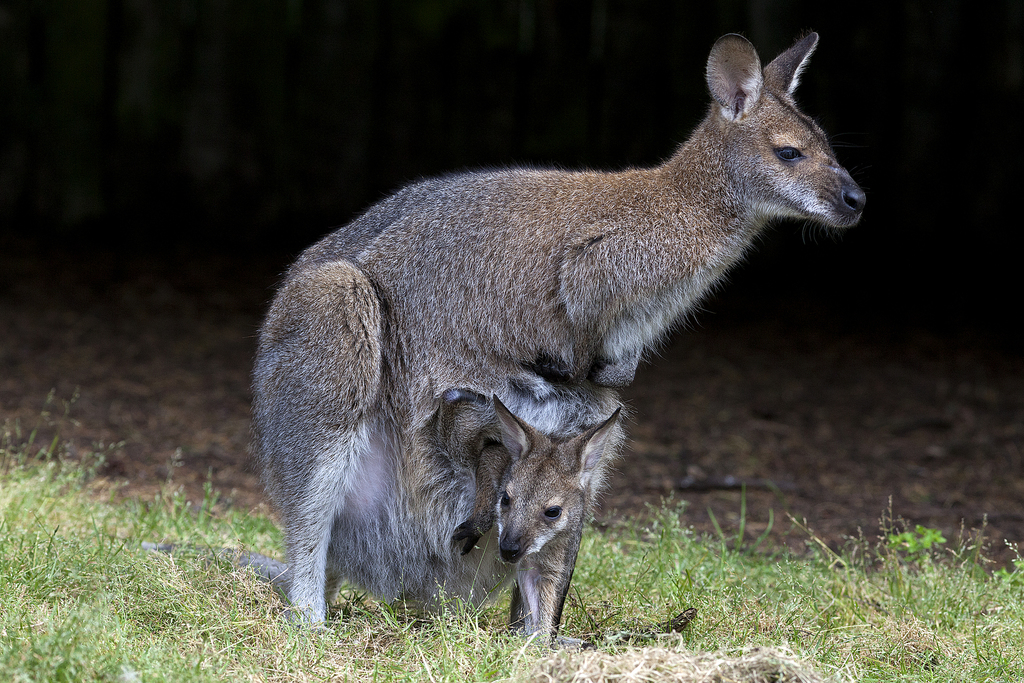
Red-necked Wallaby
Notamacropus rufogriseus
The red-necked wallaby or Bennett's wallaby (Notamacropus rufogriseus) is a medium-sized macropod marsupial (wallaby), common in the more temperate and fertile parts of eastern Australia, including Tasmania. Red-necked wallabies have been introduced to several other countries, including New Zealand, the United Kingdom (in England and Scotland), Ireland, the Isle of Man, France and Germany.
From the article Red-necked wallaby on Wikipedia (CC BY-SA), quoted section by section
Description
Red-necked wallabies are distinguished by their black nose and paws, white stripe on the upper lip, and grizzled medium grey coat with a reddish wash across the shoulders. They can weigh 13.8 to 18.6 kilograms (30 to 41 lb) and attain a head-body length of 90 centimetres (35 in), although males are generally bigger than females. Red-necked wallabies are very similar in appearance to the black-striped wallaby (Notamacropus dorsalis), the only difference being that red-necked wallabies are larger, lack a black stripe down the back, and have softer fur. Red-necked wallabies may live up to nine years.
Range & habitat
Red-necked wallabies are found in coastal scrub and sclerophyll forest throughout coastal and highland eastern Australia, from Bundaberg, Queensland, to the South Australian border; in Tasmania and on many of the Bass Strait islands. It is unclear which of the Tasmanian islands have native populations as opposed to introduced ones. In Tasmania and coastal Queensland, their numbers have expanded over the past 30 years because of a reduction in hunting pressure and the partial clearing of forest to result in a mosaic of pastures where wallabies can feed at night, alongside bushland where they can shelter by day. For not altogether clear reasons, they are less common in Victoria.
Wikipedia: “Distribution and habitat”
What it does
Red-necked wallabies are mainly solitary but will gather together when there is an abundance of resources, such as food, water or shelter. When they do gather in groups, they have a social hierarchy similar to other wallaby species. A recent study has demonstrated that wallabies, as other social or gregarious mammals, are able to manage conflict via reconciliation, involving the post-conflict reunion, after a fight, of former opponents, which engage in affinitive contacts. Red-necked wallabies are mainly nocturnal. They spend most of the daytime resting. A female's estrus lasts 33 days. During courting, the female first licks the male's neck. The male will then rub his cheek against the female's. Then the male and female will fight briefly, standing upright like two males. After that they finally mate. A couple will stay together for one day before separating. A female bears one offspring at a time; the young stay in the pouch for about 280 days, whereafter females and their offspring stay together for only a month. However, females may stay in the home range of their mothers for life, while males leave at the age of two. Also, red-necked wallabies engage in alloparental care, in which one individual may adopt the child of another. This is a common behavior seen in many other animal species like wolves, elephants, humans, and fathead minnows.
Diet. …
Wikipedia: “Behaviour”
Listen
Looking for field recordings…
Where it lives
Recorded sightings
—
geo-referenced records in GBIF, from museums, herbaria and field observers.
Drag the globe to turn it. Dots are where records exist, not a range map; darker means more records.
In the stacks
Searching the stacks…
Every page naming Notamacropus rufogriseus in the Biodiversity Heritage Library →
This page is assembled live from iNaturalist, GBIF, Wikipedia, the Source Library and the Internet Archive. It is not yet part of the hand-edited codex. iNaturalist taxon 1453431.