- Animals
- ›Chordates
- ›Vertebrates
- ›Mammals
- ›Therians
- ›Marsupials
- ›Kangaroos, Possums, Wombats, and Allies
- ›Macropods
- ›Kangaroos, Wallabies and Allies
- ›Kangaroos, Wallabies, Pademelons, and Dorcopsises
- ›Kangaroos and Wallabies
- ›Notamacropus
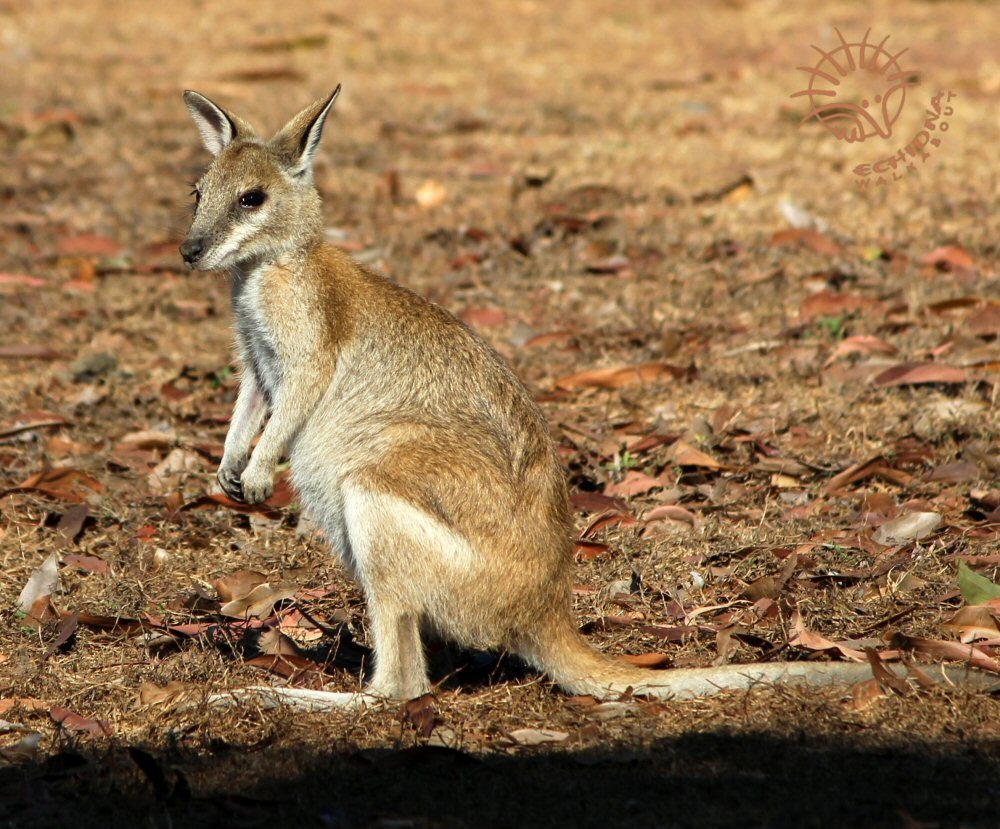
Agile Wallaby
Notamacropus agilis
The agile wallaby (Notamacropus agilis), also known as the sandy wallaby, is a species of wallaby found in northern Australia and southern New Guinea. It is the most common wallaby in north Australia. The agile wallaby is a sandy colour, becoming paler below. It is sometimes solitary and at other times sociable and grazes on grasses and other plants. The agile wallaby is not considered threatened.
From the article Agile wallaby on Wikipedia (CC BY-SA), quoted section by section
Description
Male agile wallabies are considerably larger than females, having a head and body length of up to 85 cm (33 in) and weighing 16 to 27 kg (35 to 60 lb) while the females grow to 72 cm (28 in) in length and weigh 9 to 15 kg (20 to 33 lb). The tails of both sexes are long and flexible, giving a total length of double the head and body length. They have relatively large ears, which are edged with black, and the tip of the tail is also black. Their backs are sandy brown while their underparts are whitish. They have a dark stripe between the ears, a pale cheek stripe on each side of the face and another pale streak across the thighs.
Range & habitat
The agile wallaby is found in northern Australia, Papua New Guinea and the Indonesian province of South Papua. It is the most common wallaby over much of the north of Australia. In northern Australia and down the eastern coast of Queensland it is quite common, and there are isolated populations in southeastern Queensland around Coomera, Jacobs Well and Hope Island. It is also present, though not common, on Stradbroke Island and on Woogoompah Island in the Southern Moreton Bay Islands, and it may still be present on Peel Island. In Australia its typical habitats are dry open woodland, heaths, dunes and grassland. It is often present in the vicinity of rivers and billabongs. When grass is in short supply, it sometimes browses on shrubs or moves onto agricultural land, including sugar cane plantations.
Wikipedia: “Distribution and habitat”
What it does
In general, the agile wallaby is a solitary animal, but it sometimes forms into groups when feeding on open pastures, a behaviour that may help with predator awareness. The agile wallaby feeds mainly at night on grasses, legumes, and other herbaceous plants, but may also forage by day, especially in the wet season. In the dry season, the animal's range grows larger as the quality of the grazing deteriorates, and the diet expands to include flowers, fruit, twigs, fallen leaves, roots, and bark. In the dry season in Boodjamulla National Park in Queensland, when food is in short supply, it has been observed pulling up seedling Livistona palms with its teeth, eating the roots and stems, and discarding the leaves. When they are available, it eats the fruits of these palms, but in the dry season it also crushes and eats the hard seeds. It also consumes other seeds that have passed through the guts of fruit-eating birds. It sometimes digs holes in dry creeks and billabongs to search for water, and this is thought to help it avoid being killed by the saltwater crocodile (Crocodylus porosus) that can be found beside rivers. Breeding takes place at any time of the year, with the female becoming receptive soon after giving birth. Male behaviour includes "play-fighting", leaping into the air, and sinuously lashing the tail. …
Wikipedia: “Behaviour”
In human culture
In the Bininj Kunwok language the male agile wallaby is known as warradjangkal, and the female as merlbbe. According to Kunwinjku elder Peterson Nganjmirra, the "small one" (joey) is known as njip.
Wikipedia: “In Aboriginal language and culture”
Listen
Looking for field recordings…
Where it lives
Recorded sightings
—
geo-referenced records in GBIF, from museums, herbaria and field observers.
Drag the globe to turn it. Dots are where records exist, not a range map; darker means more records.
In the stacks
Searching the stacks…
Every page naming Notamacropus agilis in the Biodiversity Heritage Library →
This page is assembled live from iNaturalist, GBIF, Wikipedia, the Source Library and the Internet Archive. It is not yet part of the hand-edited codex. iNaturalist taxon 1453432.