- Animals
- ›Chordates
- ›Vertebrates
- ›Mammals
- ›Therians
- ›Marsupials
- ›Kangaroos, Possums, Wombats, and Allies
- ›Macropods
- ›Kangaroos, Wallabies and Allies
- ›Kangaroos, Wallabies, Pademelons, and Dorcopsises
- ›Kangaroos and Wallabies
- ›Notamacropus
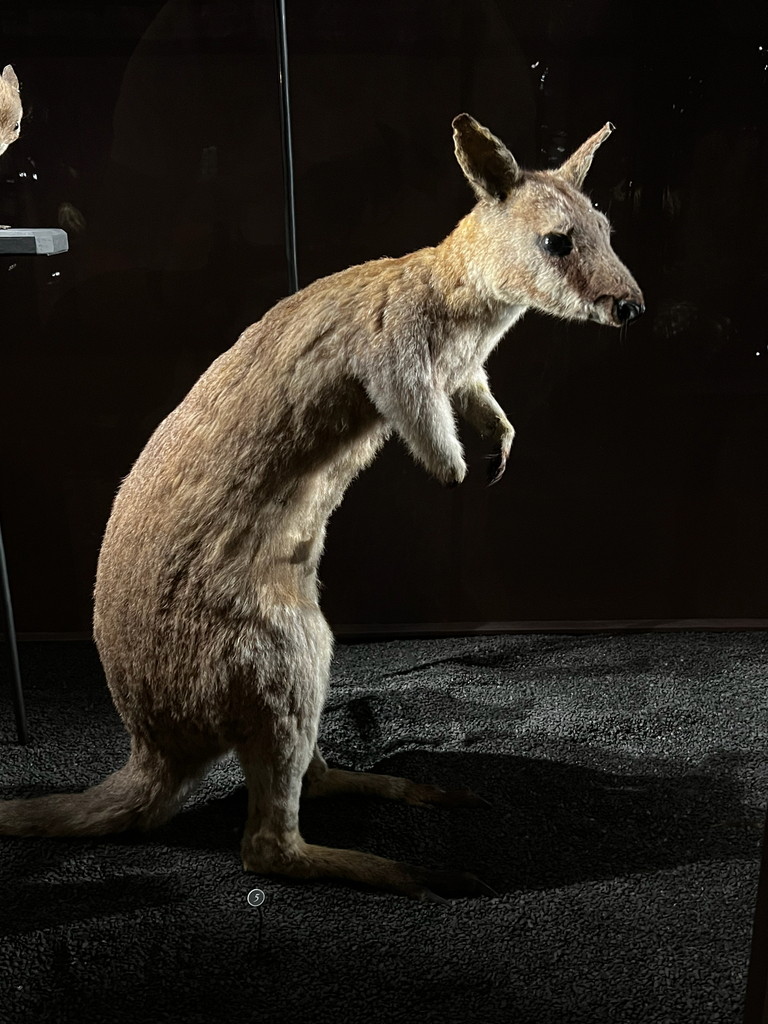
Toolache Wallaby
Notamacropus greyi
The toolache wallaby or Grey's wallaby (Notamacropus greyi) is an extinct species of wallaby from southeastern South Australia and southwestern Victoria.
From the article Toolache wallaby on Wikipedia (CC BY-SA), quoted section by section
Description
The toolache wallaby was a slim, graceful, and elegant creature that had a pale ashy-brown pelt with a buff-yellow underbelly. The tail was pale grey and became almost white near the tip. The distinct black mark on its face reached from its nose to the eye. The forearms, feet, and tips of the ears were also black. The different colours of the animal also consisted of different textured furs which are believed to have changed seasonally or varied depending on the individual. The body measurements differed between males and females. In general, male toolache wallabies had a head and body length up to 810 mm while females measured up as 840 mm. Despite the females being taller, males had longer tail lengths at about 730 mm while the female's tail length was 710 mm. Footage of the last captive female toolache wallaby was taken by B. C. Cotton in 1937.
Range & habitat
The toolache wallaby occupied the southeastern corner of Australia to the western part of Victoria. The preferred habitat ranged from swampy short grassland areas, to taller grassed areas of the open country. Toolache wallabies were known to be sociable creatures who lived in groups; they were often seen resting and grazing in groups.
Wikipedia: “Habitat”
What it does
The toolache wallaby was a nocturnal animal, foraging for vegetation during the twilight hours of the day. Their movements were unusual and extremely rapid, able to outpace almost any terrestrial predator; they were known to evade the fastest dogs of the colonial hunters.
Wikipedia: “Behaviour”
Listen
Looking for field recordings…
Where it lives
Recorded sightings
—
geo-referenced records in GBIF, from museums, herbaria and field observers.
Drag the globe to turn it. Dots are where records exist, not a range map; darker means more records.
In the stacks
Searching the stacks…
Every page naming Notamacropus greyi in the Biodiversity Heritage Library →
This page is assembled live from iNaturalist, GBIF, Wikipedia, the Source Library and the Internet Archive. It is not yet part of the hand-edited codex. iNaturalist taxon 1453515.