On eBird ↗
Sahel Paradise-Whydah
Live sightings near you, the range map, bar charts of when it is seen, and Macaulay Library photos and recordings.
Sahel Paradise-Whydah
Vidua orientalis
The Sahel paradise whydah, or northern paradise whydah (Vidua orientalis) is a small songbird in the passerine family Viduidae.
From the article Sahel paradise whydah on Wikipedia (CC BY-SA), quoted section by section
Description
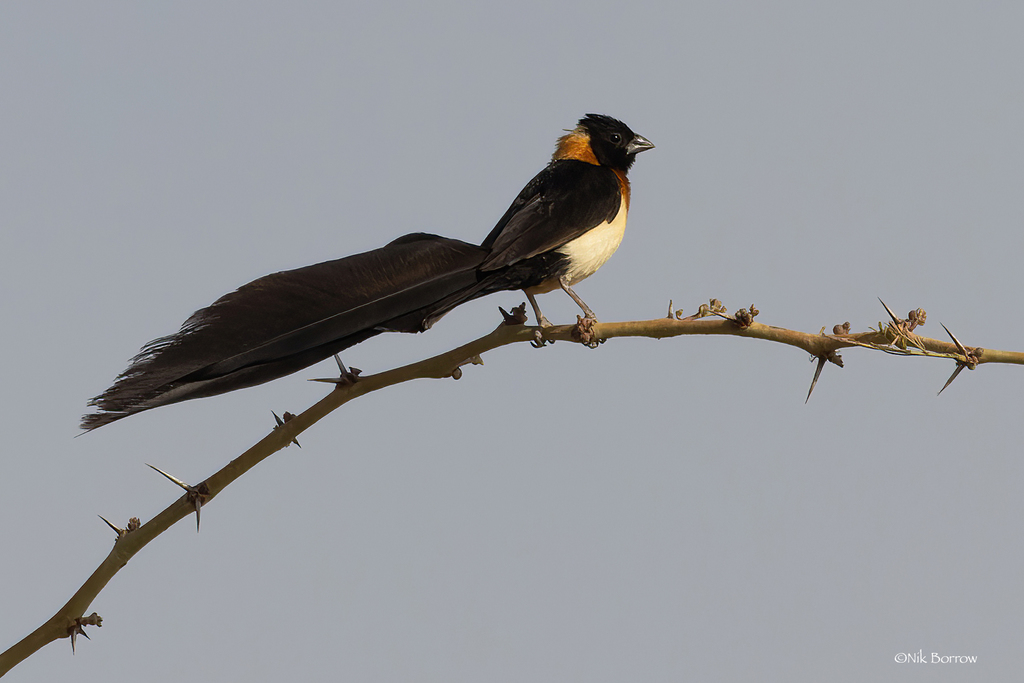
The females are 13–14 cm (5.1–5.5 in) long, tawny above with narrow mantle streaking; in females a dark line extends behind the eye. When in non-breeding plumage, the males are similar to the females; juveniles are also similar to adult females. The males in breeding plumage have black back and wings, with a rufous breast and pale belly; the head is black, with a pale nape; this is straw-yellow in the nominate eastern subspecies V. o. orientalis, and chestnut-toned like the breast in the western subspecies V. o. aucupum. The feet and the bill are dark grey. The dual-length ornamental tail feathers are black. These tail feathers have a width of 24–32 millimetres (0.94–1.26 in) and give breeding season males a full length of 30–31 cm (12–12 in).
Range & habitat
Vidua orientalis is a resident breeding bird in the Sahel region of north tropical Africa. It lives in open acacia savannah with scattered trees.
Wikipedia: “Distribution and habitat”
What it does
The Sahel paradise whydah does not build its own nests, but parasitises the green-winged pytilia Pytilia melba. Like other whydahs, it does not destroy the host's eggs, but they deposit their own eggs in the nests of their hosts, adding them to those already present. As in other whydah species, the songs of the males mimic the song of their hosts. These birds do not form monogamous pairs, but males will breed with many females. In a breeding season females may lay about 22 eggs, that hatch after 12–13 days of incubation. The diet consists of seeds and grain.
== References ==
Wikipedia: “Biology and behaviour”
Listen
Looking for field recordings…
Where it lives
Recorded sightings
—
geo-referenced records in GBIF, from museums, herbaria and field observers.
Drag the globe to turn it. Dots are where records exist, not a range map; darker means more records.
In the stacks
Searching the stacks…
Every page naming Vidua orientalis in the Biodiversity Heritage Library →
This page is assembled live from iNaturalist, GBIF, Wikipedia, the Source Library and the Internet Archive. It is not yet part of the hand-edited codex. iNaturalist taxon 145354.