On eBird ↗
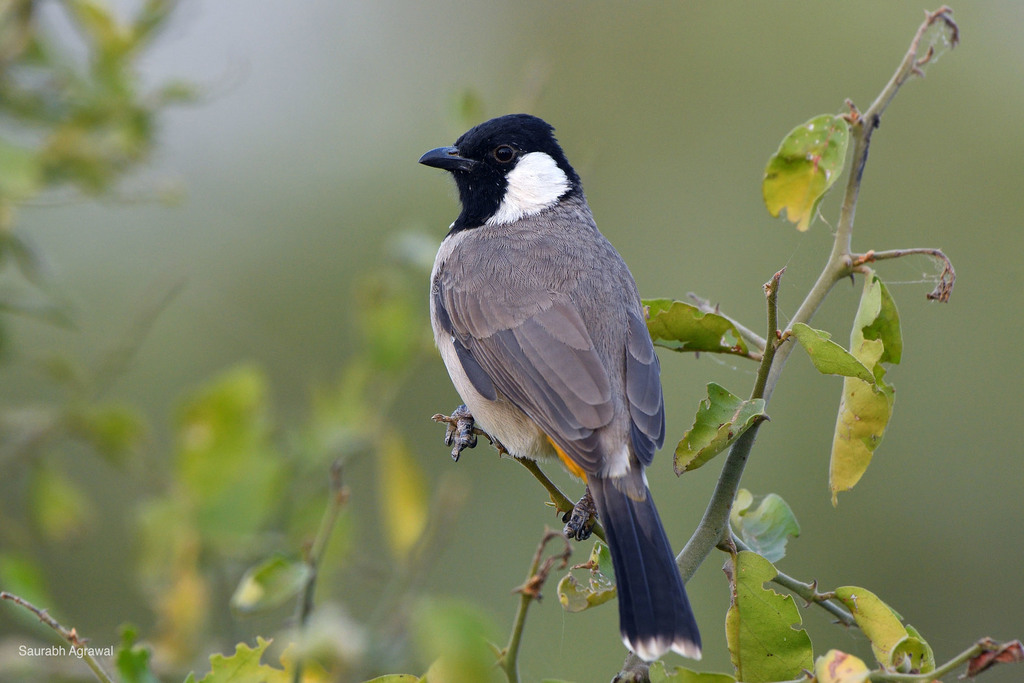
White-eared Bulbul
Live sightings near you, the range map, bar charts of when it is seen, and Macaulay Library photos and recordings.
White-eared Bulbul
Pycnonotus leucotis
The white-eared bulbul (Pycnonotus leucotis), or white-cheeked bulbul, is a member of the bulbul family. It is found in south-western Asia from India to the Arabian peninsula.
From the article White-eared bulbul on Wikipedia (CC BY-SA), quoted section by section
Description
The white-eared bulbul is rotund in appearance, and has a brownish-grey body. The tail of this bird is relatively long, tapering outwards. Starting off black, the tail feathers end in white tips. The head of the white-eared bulbul is black, with the area around its cheeks bearing a large white spot. The eye rings of the bulbul are bare, and the beak short. The vent of the bird is bright yellow. The white-eared bulbul does not have a uniform song but rather a set of notes, which can be used to chirp different melodies. The song is brief, but is described as being "pleasant and fluid."
Wikipedia: “Description and vocalisations”
Range & habitat
It is native to the western reaches of India, much of Pakistan, southern Afghanistan, coastal Iran, as well as much of the two-river basin in Iraq, Kuwait and the island of Bahrain. It has been introduced to the remaining Persian Gulf countries including Oman, the United Arab Emirates, and Qatar.
Wikipedia: “Distribution”
What it does
Usually the females build the nest, which is constructed in the shape of a messy cup from thin twigs, dry grass, and various plant fibers, and is located in a hidden spot on trees. The clutch contains 2–4 eggs, usually 3, very rarely 5. The eggs are creamy white with purple spots. The incubation, which is made by the female, lasts 13–14 days in Pakistan, or 10.5–12.5 days in Iraq. Both parents participate in feeding the chicks, which fledge after 9–11 days (in Iraq). Of 19 nests in Iraq, only three (about 16%) have raised a new generation; this is likely due to predation by crows, as many nests are only poorly concealed. This is a monogamous species, and males tend to aggressively defend nesting territories from other males
Wikipedia: “Ecology”
Listen
Looking for field recordings…
Where it lives
Recorded sightings
—
geo-referenced records in GBIF, from museums, herbaria and field observers.
Drag the globe to turn it. Dots are where records exist, not a range map; darker means more records.
In the stacks
Searching the stacks…
Every page naming Pycnonotus leucotis in the Biodiversity Heritage Library →
This page is assembled live from iNaturalist, GBIF, Wikipedia, the Source Library and the Internet Archive. It is not yet part of the hand-edited codex. iNaturalist taxon 14590.