 NL·0656
Herbarium of the Nature Library
- Name
- Pycnonotus cafer
- Family
- Pycnonotidae
- Native to
- Pakistan, India, Sri Lanka, Nepal, Bhutan, Bangladesh and Myanmar to SW China; introduced to Hawaii, Fiji, Samoa, Tonga and parts of the Arabian Peninsula
- Habitat
- Urban, Scrub, Farmland, Open woodland
On eBird ↗
Red-vented Bulbul
Live sightings near you, the range map, bar charts of when it is seen, and Macaulay Library photos and recordings.
Red-vented bulbul
Pycnonotus cafer
Also calledBulbul (Urdu/Hindi/Punjabi) · Bulbuli (Bengali) · Hēi hóu hóng tún bēi 黑喉红臀鹎 (Chinese)
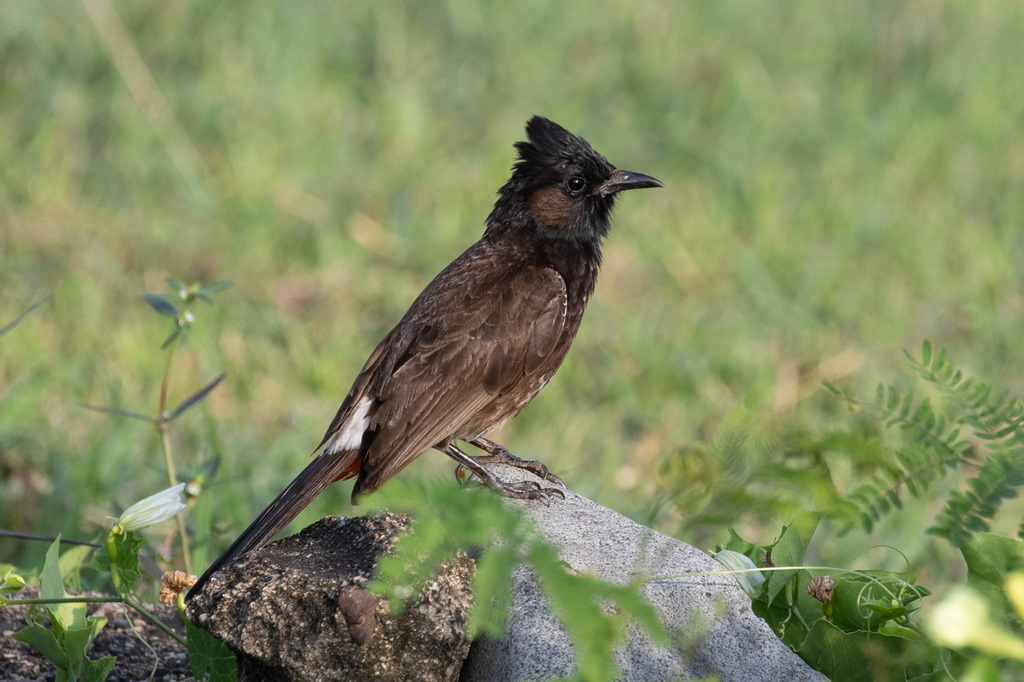
A perky, crested garden bird with a black head and a scarlet patch under the tail, one of the most familiar voices in South Asian courtyards. Cheerful to people but invasive on Pacific islands, it is an expert disperser of berry seeds.
The red-vented bulbul is a member of the bulbul family of passerines. It is a resident breeder across South Asia extending east to Burma. It has been introduced in many other parts of the world and has established itself in Argentina, Tonga and Fiji, as well as parts of Samoa, USA and Cook Islands. It is included in the list of the world's 100 worst invasive alien species. In New Zealand they were the target of a successful extermination campaign in 1955, however they are still sporadically reported. Wikipedia
What it can do
- iDisperses seeds of shrubs such as lantana, which has helped its spread on islands
- iiLives comfortably in gardens and will nest on verandas and in hanging plants
- iiiPairs mob snakes, cats and owls with loud alarm calls
In the field
Field marks
- aShort black crest and black head, throat and breast
- bScaly dark-brown back and breast
- cBright crimson undertail (vent) and white rump
- dDark tail with white tip
- Voice
- Cheery, rather fluty 'be-care-ful' or 'ginger beer' phrases and a sharp 'peep-peep' alarm
- Not to be confused with
- Red-whiskered bulbul has a tall pointed crest, white cheeks and a red whisker patch; Himalayan bulbul (northern Pakistan) has a white cheek and yellow vent; White-eared bulbul (Sindh/Punjab) has white cheeks and a yellow vent.
- Where to see it
- Gardens and parks throughout Pakistan and India, e.g. Islamabad's Margalla foothills, Lahore and Karachi gardens
- When
- Resident year-round
Listen
Looking for field recordings…
Life & habits
- Diet
- Fruit, berries, nectar, petals and insects
- Habitat
- Gardens, scrub, farmland edges and dry open woodland
- Size
- About 20 cm long
Pairs keep up a constant cheerful chatter, and the male displays by fluffing his white rump and spreading his tail to show the red vent.
Where it lives
Recorded sightings
—
geo-referenced records in GBIF, from museums, herbaria and field observers.
Native range
Pakistan, India, Sri Lanka, Nepal, Bhutan, Bangladesh and Myanmar to SW China; introduced to Hawaii, Fiji, Samoa, Tonga and parts of the Arabian Peninsula
Drag the globe to turn it. Dots are where records exist, not a range map; darker means more records.
In the old herbals & bestiaries
No plate in the Source Library names this exact species, so these show its closest relatives as the old naturalists drew them: same genus, or the same kind of animal. Click a plate to read the page it came from, with translation.

In the stacks
Searching the stacks…
Every page naming Pycnonotus cafer in the Biodiversity Heritage Library →
Marginalia
The 'bulbul' of Persian and Urdu poetry is really the nightingale, but in South Asia the name passed to these garden birds. In Assam, captive bulbuls were traditionally set to fight at Hajo's Hayagriva Madhava temple during Magh Bihu.
Curiosity
It is on the IUCN list of the 100 worst invasive alien species because of its effects on Pacific island crops and native birds.
Kinship

Photographs: iNaturalist contributors under the licences shown. Records: GBIF.org. Historical plates: Source Library (CC BY-SA 4.0; originals public domain). Summary text: Nature Library editors and Wikipedia (CC BY-SA). Medicinal and edibility notes are historical and educational, not advice. iNaturalist taxon 14593.