- Animals
- ›Chordates
- ›Vertebrates
- ›Reptiles
- ›Snakes and Lizards
- ›Lizards
- ›Iguanas and Allies
- ›Iguanas, Anoles, and Allies
- ›Iguanas and Chuckwallas
- ›Cyclura
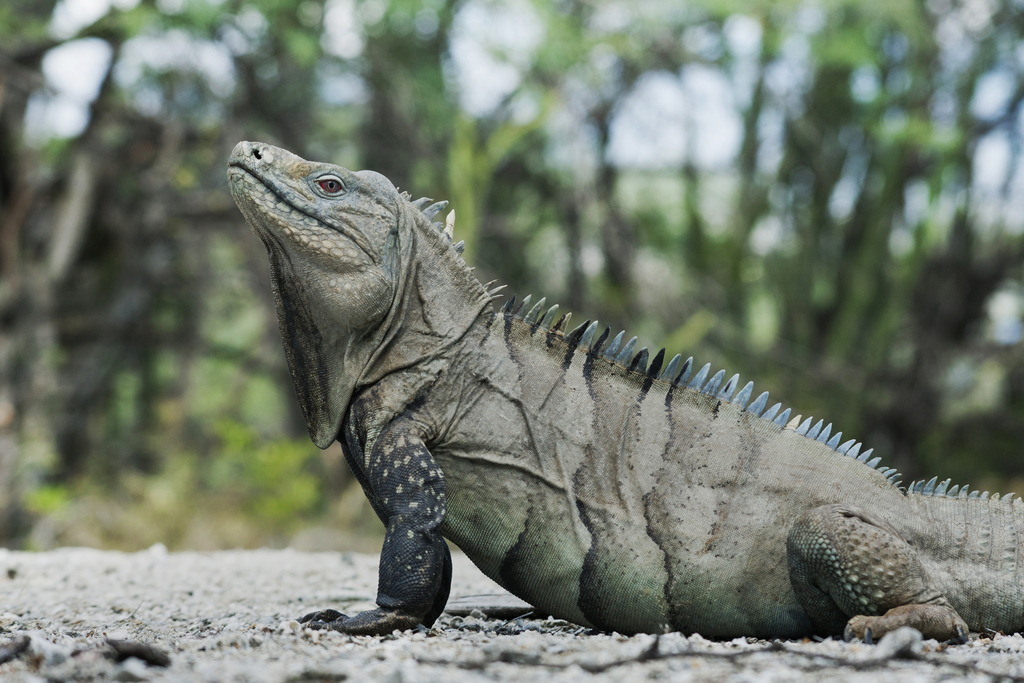
Hispaniolan Ground Iguana
Cyclura ricordii
Cyclura ricordii, also known as Ricord's ground iguana or Ricord's rock iguana, is an endangered species of medium-sized rock iguana, a large herbivorous lizard. It is endemic to the island of Hispaniola (in both Haiti and the Dominican Republic). It is known to coexist with the nominate subspecies of the rhinoceros iguana (C. cornuta cornuta); the two species are the only taxa of rock iguana to do so. The natural habitats of its three subpopulations are hot, dry, wooded savanna on limestone with access to soil and sandy flats in southern Hispaniola. It is threatened by predation by introduced predators and habitat loss, due to overgrazing and charcoal manufacture.
From the article Cyclura ricordii on Wikipedia (CC BY-SA), quoted section by section
Description
Cyclura ricordii is a species of rock iguana with a maximum snout-to-vent length in males of 460 mm (18 in), in females to 430 mm (17 in), The tail is 540 mm (21 in) long at maximum. The average snout-to-vent length at birth is 96 mm (3.8 in) with a 147 mm (5.8 in) tail. Their body color is a grayish green flat color marked by five to six bold pale gray chevrons alternating with dark gray to black chevrons. In adults, the dark chevrons are less contrasting than in juveniles. The eyes have a dark, almost black iris and red sclera.
Species of Cyclura are sexually dimorphic; males are larger than females, and have larger femoral pores on their thighs, which are used to release pheromones. Eggs from the genus Cyclura are some of the largest laid by any lizard.
Range & habitat
Until 2008, Cyclura ricordii was thought to be restricted to two populations in the southern Dominican Republic: one population in the arid Hoya de Enriquillo surrounding the hypersaline Lake Enriquillo and its lake island Isla Cabritos, and the other in the most xeric portion of the coastal lowlands of Pedernales Province. These are separated by the moister Sierra de Bahoruco, with three peaks exceeding 2,000 metres (6,600 ft) which form an ecological barrier between two populations. Past drier Pleistocene climates may have allowed genetic exchange between the two populations. It is sympatric throughout its range with C. cornuta, the rhinoceros iguana. All other Caribbean islands with rock iguanas are home to a single species. In 2008, a third population was found to exist near the town of Anse-a-Pitres in Haiti, near the southernmost coast. Hispaniola was once two islands; genetic evidence indicates C. ricordii evolved on the northern island and later dispersed southwards, while C. cornuta evolved on the southern island.
Wikipedia: “Distribution”
What it does
It is a diurnal animal, sleeping in "retreats" during the nights. They usually excavate burrows for retreats in the sandy areas of either type of habitat which they expand over time. Entrances to these retreats are generally dug under dense thorny vegetation, shrubs, stumps, or exposed rocks. They may sometimes also retreat to hollow tree trunks or rock crevices. Mating occurs from May through June. In the genus Cyclura in general, in many species copulation is preceded by numerous head-bobs on the part of the male, who then circles around behind the female and grasps the nape of her neck in order to manoeuvre his tail under hers to position himself for sex. Nest sites are built in clay or sand, in pockets of earth exposed to the sun. The Haiti population nests in a single location on a sandy beach at the coast. Anywhere from 2 to 23 eggs are usually laid in May to July, depending on the size and age of the female. The eggs go through a 95- to 100-day incubation period before hatching in July to September The average success rate is 95%. After two to three years both sexes have reached maturity. The adults of the species are primarily terrestrial whereas juveniles tend to occupy arboreal retreats. It has been observed swimming and floating in Lago Enriquillo.
Wikipedia: “Behaviour”
Where it lives
Recorded sightings
—
geo-referenced records in GBIF, from museums, herbaria and field observers.
Drag the globe to turn it. Dots are where records exist, not a range map; darker means more records.
In the stacks
Searching the stacks…
Every page naming Cyclura ricordii in the Biodiversity Heritage Library →
This page is assembled live from iNaturalist, GBIF, Wikipedia, the Source Library and the Internet Archive. It is not yet part of the hand-edited codex. iNaturalist taxon 146059.