- Animals
- ›Chordates
- ›Vertebrates
- ›Reptiles
- ›Snakes and Lizards
- ›Snakes
- ›Colubrid Snakes
- ›Dipsadine Snakes
- ›Hypsiglena
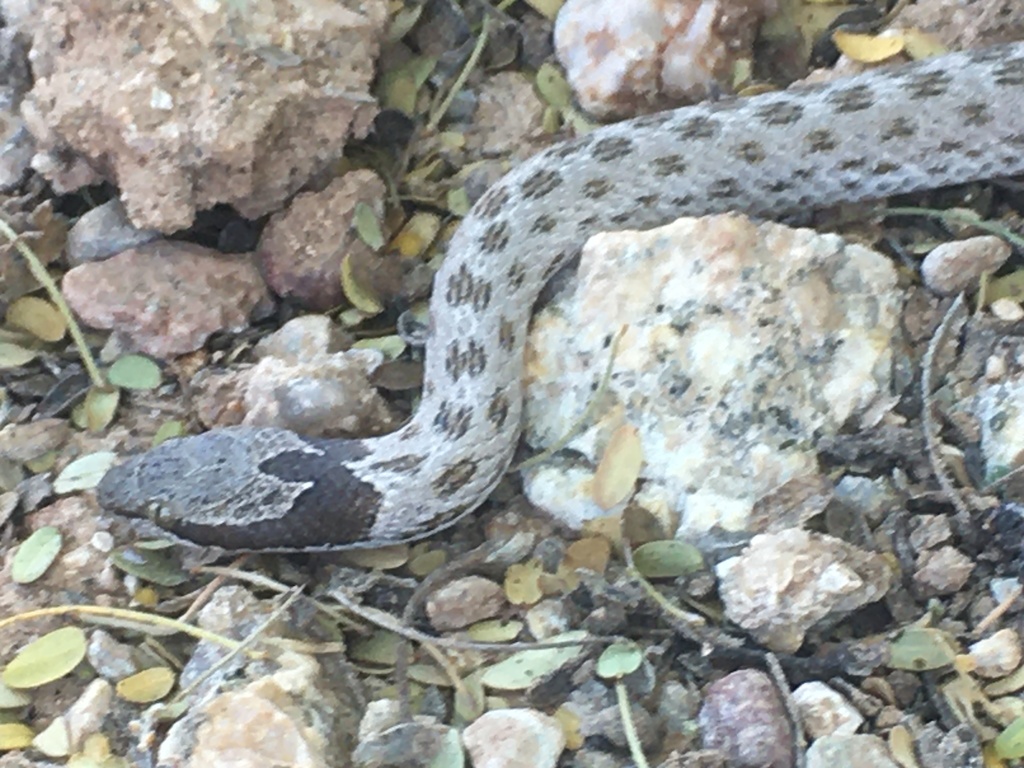
Desert Nightsnake
Hypsiglena chlorophaea
Hypsiglena chlorophaea, commonly known as the desert nightsnake, is a species of rear-fanged colubrid snake native to North America. It is found throughout regions of Mexico, the United States, and in a small, isolated population in British Columbia, Canada. Known for its highly secretive, nocturnal nature, it is a mildly venomous species that poses no danger to humans.
From the article Hypsiglena chlorophaea on Wikipedia (CC BY-SA), quoted section by section
Description
The desert nightsnake is a small, slender snake, typically measuring between 30 and 66 cm (12 to 26 inches) in total length. Females are generally longer and heavier than males. Its base coloration ranges from beige or yellowish to grey, overlaid with dark grey-brown blotches that usually form offset pairs down its back. It has three distinct, elongated dark blotches on its neck and behind each eye. Because of its triangular-shaped head, vertical pupils, and blotched patterning, it is frequently mistaken for a juvenile rattlesnake. However, the desert nightsnake lacks a rattle and possesses smooth dorsal scales. It is an opisthoglyphous (rear-fanged) snake, meaning its enlarged, grooved teeth are located at the back of the upper jaw to help subdue prey.
Range & habitat
The species is widely distributed across the western and southwestern United States (including Arizona, California, Colorado, Idaho, Nevada, Oregon, Utah, and Washington), northwestern Mexico, and reaches its northernmost limits in the Okanagan and Similkameen valleys of south-central British Columbia, Canada. Desert nightsnakes occupy a diverse range of arid and semi-arid environments. They are commonly found in desert scrub, chaparral, grasslands, oak woodlands, and rocky canyons. They heavily rely on surface cover, spending daylight hours hiding in rock crevices, talus slopes, beneath surface debris, or in abandoned mammal burrows.
Wikipedia: “Distribution and habitat”
What it does
As its name suggests, the desert nightsnake is primarily nocturnal and crepuscular. It is an ambush predator that uses its mild venom to subdue prey. Its diet predominantly consists of small lizards (such as skinks) and lizard eggs. It will also opportunistically consume small snakes, frogs, salamanders, and insects.
Wikipedia: “Behavior and diet”
Where it lives
Recorded sightings
—
geo-referenced records in GBIF, from museums, herbaria and field observers.
Drag the globe to turn it. Dots are where records exist, not a range map; darker means more records.
In the stacks
Searching the stacks…
Every page naming Hypsiglena chlorophaea in the Biodiversity Heritage Library →
This page is assembled live from iNaturalist, GBIF, Wikipedia, the Source Library and the Internet Archive. It is not yet part of the hand-edited codex. iNaturalist taxon 146173.