On eBird ↗
Sombre Greenbul
Live sightings near you, the range map, bar charts of when it is seen, and Macaulay Library photos and recordings.
Sombre Greenbul
Andropadus importunus
The sombre greenbul (Andropadus importunus) is a member of the bulbul family of passerine birds. It is a resident breeder in coastal bush, evergreen forest and dry shrub land in eastern and southern Africa. It is the only member of the genus Andropadus.
From the article Sombre greenbul on Wikipedia (CC BY-SA), quoted section by section
Description
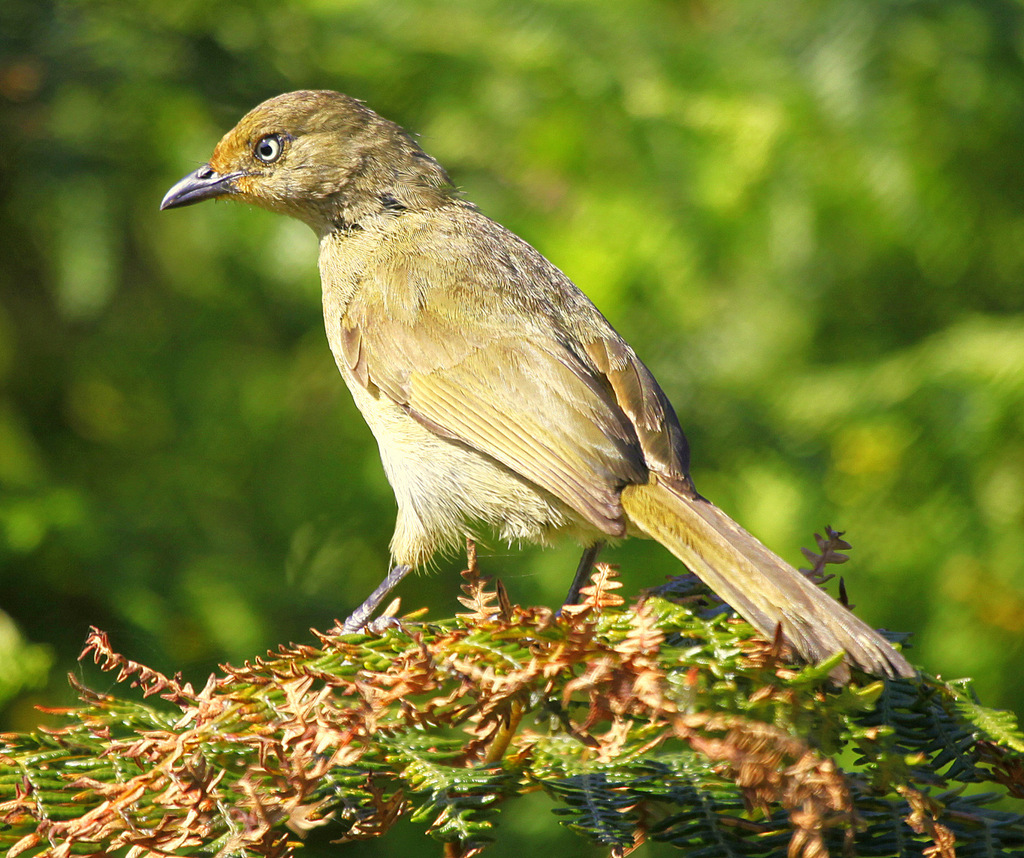
The sombre greenbul is 15–18 cm long, with mainly dull greyish olive-green plumage, paler on the underparts than above. There are variations in colour based on habitat range. Individuals located in southern Africa tend to be plain, olive-green. To the north, birds are yellower with greener upper parts. It has a white iris. The sexes are similar in plumage, but juveniles are even duller than the adult and have dark, grey eyes. There is no colour distinction among sexes. The subspecies A. i. hypoxanthus is much yellower below than the nominate subspecies. The sombre greenbul is a vocal species, and the most typical call is a monotonous, ringing phrase starting with a penetrating single whistle weeeewee, followed by a jumbled chortle and ending off with a rather plaintive, drawn-out whistle willy. If agitated, a call of peeet peeet peeet repeatedly is likely to be heard.
What it does
The sombre greenbul is a common bird, which tends to stay hidden in foliage and is more often heard than seen. It is usually found in pairs or small groups foraging for insects, fruit and small snails.
Wikipedia: “Behaviour and ecology”
Listen
Looking for field recordings…
Where it lives
Recorded sightings
—
geo-referenced records in GBIF, from museums, herbaria and field observers.
Drag the globe to turn it. Dots are where records exist, not a range map; darker means more records.
In the stacks
Searching the stacks…
Every page naming Andropadus importunus in the Biodiversity Heritage Library →
This page is assembled live from iNaturalist, GBIF, Wikipedia, the Source Library and the Internet Archive. It is not yet part of the hand-edited codex. iNaturalist taxon 14708.