On eBird ↗
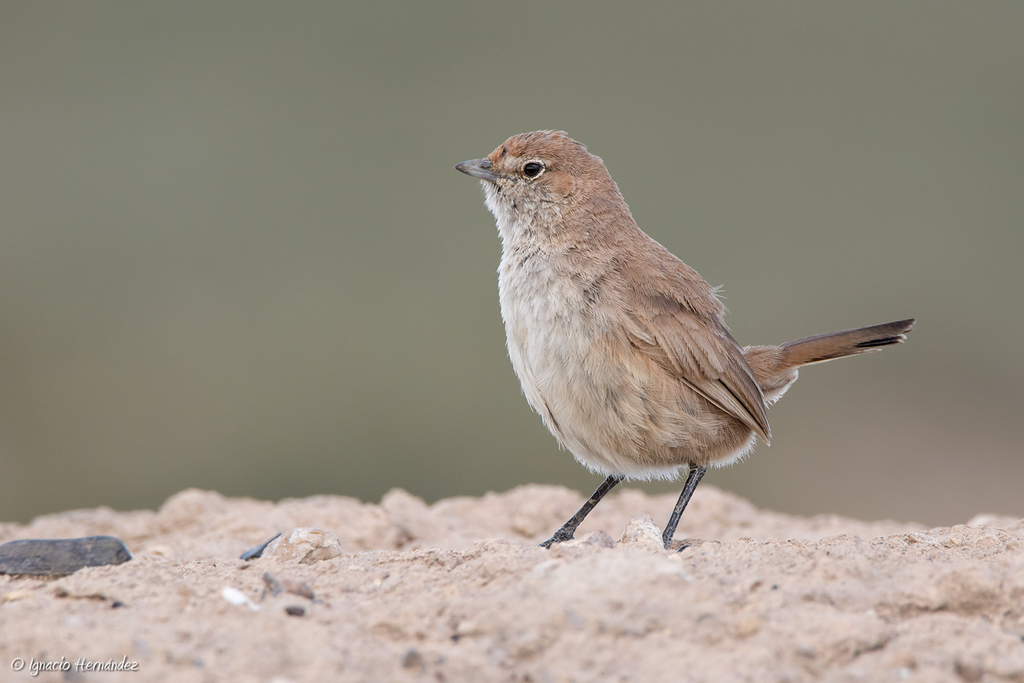
Sandy Gallito
Live sightings near you, the range map, bar charts of when it is seen, and Macaulay Library photos and recordings.
Sandy Gallito
Teledromas fuscus
The sandy gallito (Teledromas fuscus) is a species of suboscine passerine bird in the family Rhinocryptidae, the tapaculos. It is the only species placed in the genus Teledromas. It is endemic to Argentina.
From the article Sandy gallito on Wikipedia (CC BY-SA), quoted section by section
Description
The sandy gallito is 17 cm (6.7 in) long. Two male specimens weighed 35.4 and 41.8 g (1.25 and 1.47 oz) respectively; one female weighted 35.8 g (1.26 oz). In the adult, the crown of the head, back, and wings are light cinnamon as are the central feathers of the tail. The rest of the tail is blackish. The throat and chest are white, blending to light cinnamon on the flanks and vent area. The juvenile is thought to have similar plumage. The typical song of the sandy gallito is a phrase off "loud 'tchowk' notes" repeated up to five times in Río Negro and up to 10 times in other parts of the range.
Range & habitat
The sandy gallito is a year round resident of the eastern slope of the Andes of Argentina from southwestern Salta Province in the north to Río Negro Province in the south. For most of that range it is found up to 3,500 m (11,500 ft) and in Salta up to 4,000 m (13,000 ft). Its habitat is subtropical or tropical dry shrubland characterized by sparse vegetation on sand and gravel, dry washes, and ravines.
Wikipedia: “Distribution and habitat”
What it does
The sandy gallito's principal food is thought to be arthropods. It forages solely on the ground while trying to stay hidden by running between bushes.
Wikipedia: “Feeding”
Listen
Looking for field recordings…
Where it lives
Recorded sightings
—
geo-referenced records in GBIF, from museums, herbaria and field observers.
Drag the globe to turn it. Dots are where records exist, not a range map; darker means more records.
In the stacks
Searching the stacks…
Every page naming Teledromas fuscus in the Biodiversity Heritage Library →
This page is assembled live from iNaturalist, GBIF, Wikipedia, the Source Library and the Internet Archive. It is not yet part of the hand-edited codex. iNaturalist taxon 14734.