- Animals
- ›Chordates
- ›Vertebrates
- ›Amphibians
- ›Frogs and Toads
- ›Old World Tree Frogs
- ›Rhacophorinae
- ›Liuixalus
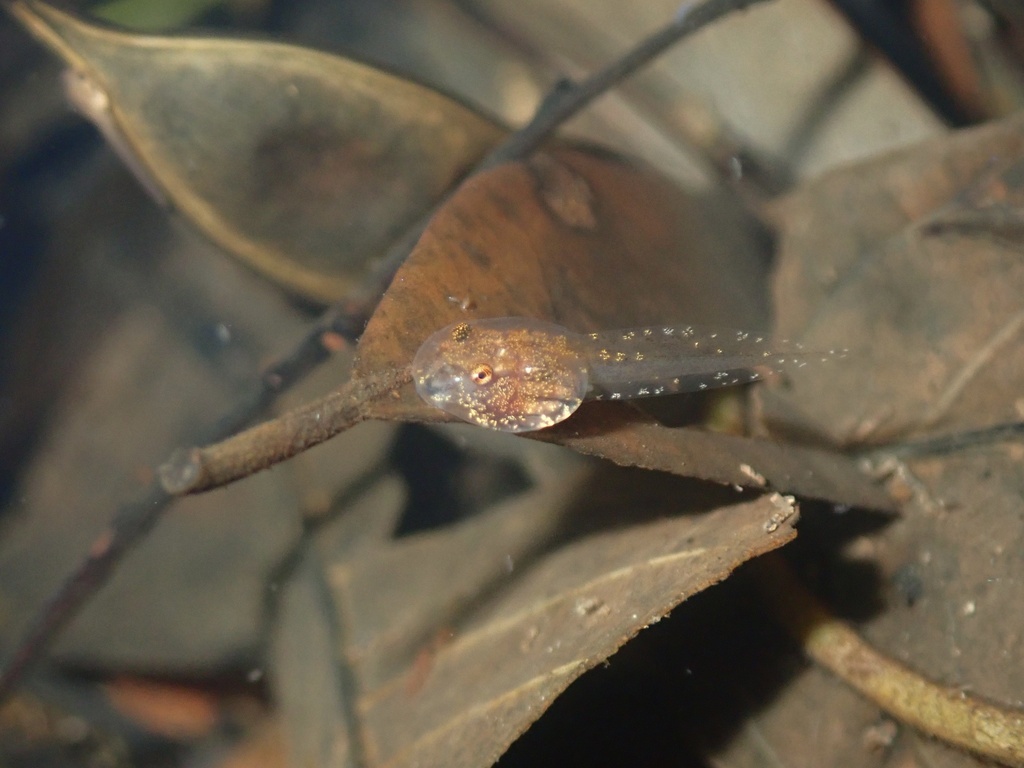
Romer's Tree Frog
Liuixalus romeri
Romer's tree frog (Liuixalus romeri) is a species of frog native to Hong Kong and a small portion of Guangxi, China. With an average snout-vent length of 1.5 – 2.5 cm, it is the smallest amphibian recorded in the territory. Despite its common name, it belongs to the family Rhacophoridae, instead of the Hylidae.
It is named for John Dudley Romer.
From the article Romer's tree frog on Wikipedia (CC BY-SA), quoted section by section
Description
The female frog is slightly larger than the male. The body is tan brown, with the underside white. An X-like marking, made up of two crooked black lines, can be seen on the dorsum. Sometimes, the lines do not meet medially, thus leading to a chevron marking posteriorly. Underneath the X-like marking lies another upside-down V-like marking. The skin is peppered with fine granules. A distinct fold extends from the eye to the foreleg. Romer's tree frog has a triangular but blunt snout with brown-spotted lips. Between the eyes is a dark bar, which extends to the eyelids. The hind legs are long, slender, and barred with irregular brown-to-black cross-bands. All digits have small toe pads, which allow the frog to hang on tree branches or leaves.
What it does
The habitat of the frog is well-wooded areas near small streams or other water sources suitable for breeding. This frog usually sits on low bushes, buries itself in fallen leaves, or rests on bare ground. The frog has been recorded solely from four of the outlying islands in Hong Kong, namely Lantau Island, Lamma Island, Po Toi Island and Chek Lap Kok. In 2007, the species was also reported from Guangxi, China, far from the Hong Kong population. Its tadpoles and eggs are susceptible to predation by the introduced mosquitofish, and it is only able to breed in places where the fish has yet to colonise. The frog breeds in shallow water from early March to September. The male has a shrill, staccato call. The female glues up to 120 eggs onto submerged plant debris, stones, or vegetation. The tadpoles, brown in colour, require 4 to 6 weeks to metamorphose in captivity. Adults feed on termites, and such small insects as crickets and arachnids such as spiders. The frog is strictly nocturnal. It lives about three years in the wild, but the female is reproductively active only for two breeding seasons.
Wikipedia: “Ecology and behaviour”
Listen
Looking for field recordings…
Where it lives
Recorded sightings
—
geo-referenced records in GBIF, from museums, herbaria and field observers.
Drag the globe to turn it. Dots are where records exist, not a range map; darker means more records.
In the stacks
Searching the stacks…
Every page naming Liuixalus romeri in the Biodiversity Heritage Library →
This page is assembled live from iNaturalist, GBIF, Wikipedia, the Source Library and the Internet Archive. It is not yet part of the hand-edited codex. iNaturalist taxon 1473426.