- Animals
- ›Chordates
- ›Vertebrates
- ›Reptiles
- ›Snakes and Lizards
- ›Snakes
- ›Colubrid Snakes
- ›Dipsadine Snakes
- ›Dipsas
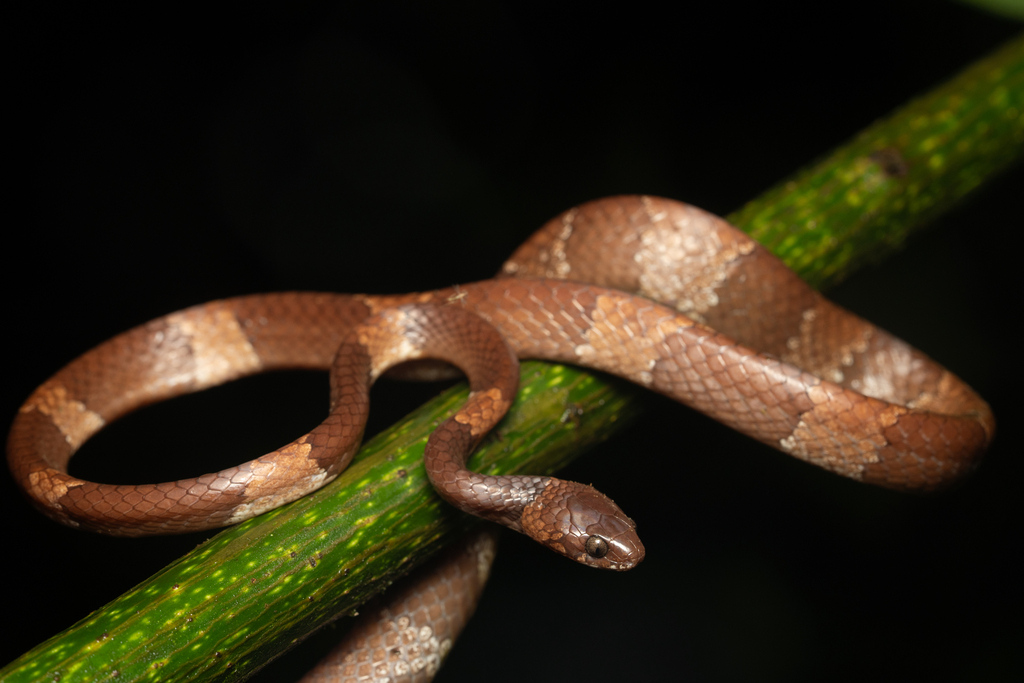
Dipsas aparatiritos
Dipsas aparatiritos, also known as the hidden snail-eating snake, is a non-venomous snake found in Panama. Formally described in 2023, its name is derived from a Greek word meaning 'unnoticed', referring to the species occurring at a well-studied herpetological study site for over 40 years before being discovered.
It is found on both the Atlantic and Pacific slopes of the Cordillera Central in western Panama, with an additional population in Chagres National Park. It inhabits inhabit mid-elevation, premontane cloud-forest and has been recorded at elevations of 597–1002 m. It feeds on snails and oligochaetes. The authors of the study describing the species recommended that the species be considered near-threatened due to its rather limited range that suffers from high levels of deforestation.
From the article Dipsas aparatiritos on Wikipedia (CC BY-SA), quoted section by section
Description
Dipsas aparatiritos can be distinguished from similar species by a number of characteristics. It has 15 dorsal scale rows, one upper preocular scale, two or three postocular scales, 1+2 temporal scales, and seven or eight supralabial scales with the fourth and fifth contacting the orbit. There are eight or nine infralabial scales, with no infralabials in contact behind the mental scale, and a moderately enlarged vertebral row. Males have 191–196 ventral scales and 129–136 subcaudals. Females have 177–197 ventral scales and 111–131 subcaudals. Alternating dark brown and tan brown bands run the length of the body, including the tail.
Range & habitat
Dipsas aparatiritos is found on both the Atlantic and Pacific slopes of the Cordillera Central in western Panama, with an additional population in Chagres National Park. The species occurs over an estimated area of 9,630 km2 and has been recorded at elevations of 597–1002 m, which makes it the most widespread species of Dipsas in Panama. Individuals collected from General de División Omar Torrijos Herrera National Park inhabit mid-elevation, premontane cloud-forest with mature secondary forest, permeated by many streams branching from Guabal River. As Donoso in Colón Province, and Quebrada Las Tres Honeras in Panamá Province are in valleys 134–197 m above sea level, a much lower elevation than all other localities, it is likely that the specimens collected there were actually found in the neighboring mountain ridges. The species is known to feed on snails and oligochaetes. Specimens have been found in vegetation, at times over one meter in height, but at other times just centimeters off the ground camouflaged with the leaf litter. Gravid females have been found in all months except February, March, October, and December, with the highest frequency in June and July. Females had either one or two ova.
Wikipedia: “Distribution and habitat”
Where it lives
Recorded sightings
—
geo-referenced records in GBIF, from museums, herbaria and field observers.
Drag the globe to turn it. Dots are where records exist, not a range map; darker means more records.
In the stacks
Searching the stacks…
Every page naming Dipsas aparatiritos in the Biodiversity Heritage Library →
This page is assembled live from iNaturalist, GBIF, Wikipedia, the Source Library and the Internet Archive. It is not yet part of the hand-edited codex. iNaturalist taxon 1474150.