On eBird ↗
Zimmer's Tapaculo
Live sightings near you, the range map, bar charts of when it is seen, and Macaulay Library photos and recordings.
Zimmer's Tapaculo
Scytalopus zimmeri
Zimmer's tapaculo (Scytalopus zimmeri) is a species of passerine bird in the family Rhinocryptidae. It is found in the Southern Andean Yungas.
From the article Zimmer's tapaculo on Wikipedia (CC BY-SA), quoted section by section
Description
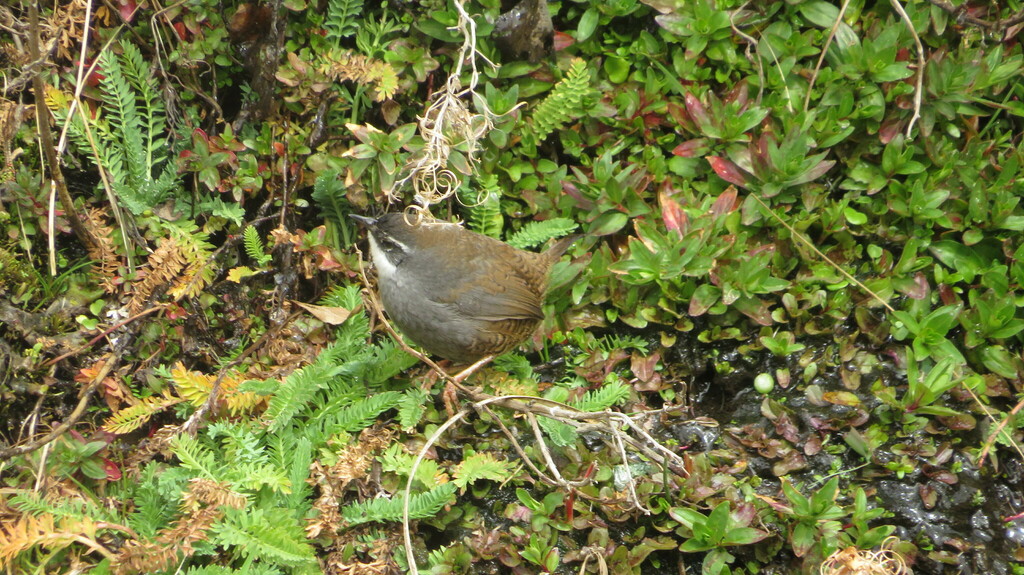
Zimmer's tapaculo is 10.5 cm (4.1 in) long. Males weigh 17.6 to 19.9 g (0.62 to 0.70 oz) and one female weighed 15.9 g (0.56 oz). The adult's most striking feature is its white supercilium, throat, and upper breast. The rest of the head, the back, and the wings are gray with a brown wash on the back. The lower breast and belly are also gray. Its flanks and vent are olive-brown and have dusky bars. The juvenile's supercilium is faint buff, its upper parts olive-brown with dusky bars, its breast and upper belly gray, and the flanks and lower belly are buff with dusky bars.
Range & habitat
Zimmer's tapaculo is found in southern Bolivia's Chuquisaca and Tarija departments and Argentina's Jujuy and Salta provinces. It ranges the Andean slopes from 1,700 to 3,200 m (5,600 to 10,500 ft) elevation. It inhabits several vegetative communities including seasonally humid Alnus, Podocarpus, and Polylepis woodlands where it frequents ravines and other shady areas, and also open wet rocky slopes with bunch grass and shrubs.
Wikipedia: “Distribution and habitat”
What it does
Zimmer's tapaculo forages on and near the ground, often staying hidden among roots, rocks, and ferns. Its diet is not well known but it appears to favor seeds.
Wikipedia: “Feeding”
Listen
Looking for field recordings…
Where it lives
Recorded sightings
—
geo-referenced records in GBIF, from museums, herbaria and field observers.
Drag the globe to turn it. Dots are where records exist, not a range map; darker means more records.
In the stacks
Searching the stacks…
Every page naming Scytalopus zimmeri in the Biodiversity Heritage Library →
This page is assembled live from iNaturalist, GBIF, Wikipedia, the Source Library and the Internet Archive. It is not yet part of the hand-edited codex. iNaturalist taxon 14747.