On eBird ↗
Puna Tapaculo
Live sightings near you, the range map, bar charts of when it is seen, and Macaulay Library photos and recordings.
Puna Tapaculo
Scytalopus simonsi
The puna tapaculo (Scytalopus simonsi) is a species of bird in the Rhinocryptidae family. It is found in Bolivia and Peru.
From the article Puna tapaculo on Wikipedia (CC BY-SA), quoted section by section
Description
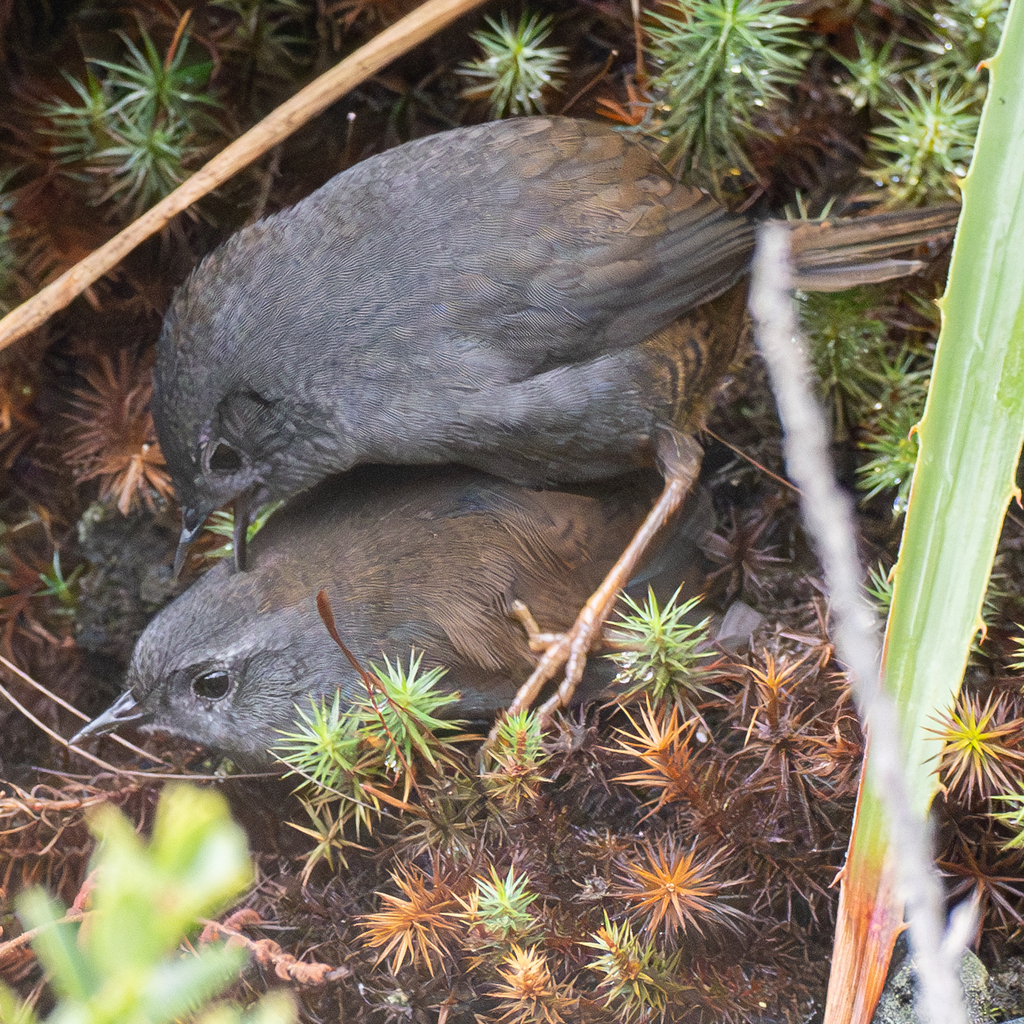
The puna tapaculo is 10 to 12 cm (3.9 to 4.7 in) long. Three males weighed 15.7 to 20 g (0.55 to 0.71 oz) and a female 15.7 g (0.55 oz). The adult male's upper parts are gray, often washed with brown on the neck and back. It has a narrow pale supercilium. The throat and breast are also gray. The rump, flanks, and belly can be cinnamon or olive-buff and have dark bars. The adult female is similar to the males that have the brown wash; otherwise they may be paler. Immatures are paler overall but have a heavier brown wash on the upper parts. The entire underside is barred.
Range & habitat
The puna tapaculo is found on the eastern slope of the Andes at elevations of 2,900 to 4,300 m (9,500 to 14,100 ft) from Cordillera Vilcanota in Peru's Department of Cuzco southeast to Bolivia's Cochabamba Department. It inhabits elfin forest at tree line and above there is in small shrubs and trees among grass tussocks. It can also be found in Polylepis woodlands.
Wikipedia: “Distribution and habitat”
What it does
Though very little is known about the puna tapaculo's diet, the species is probably insectivorous though seeds are also eaten.
Wikipedia: “Feeding”
Listen
Looking for field recordings…
Where it lives
Recorded sightings
—
geo-referenced records in GBIF, from museums, herbaria and field observers.
Drag the globe to turn it. Dots are where records exist, not a range map; darker means more records.
In the stacks
Searching the stacks…
Every page naming Scytalopus simonsi in the Biodiversity Heritage Library →
This page is assembled live from iNaturalist, GBIF, Wikipedia, the Source Library and the Internet Archive. It is not yet part of the hand-edited codex. iNaturalist taxon 14756.