On eBird ↗
Stresemann's Bristlefront
Live sightings near you, the range map, bar charts of when it is seen, and Macaulay Library photos and recordings.
Stresemann's Bristlefront
Merulaxis stresemanni
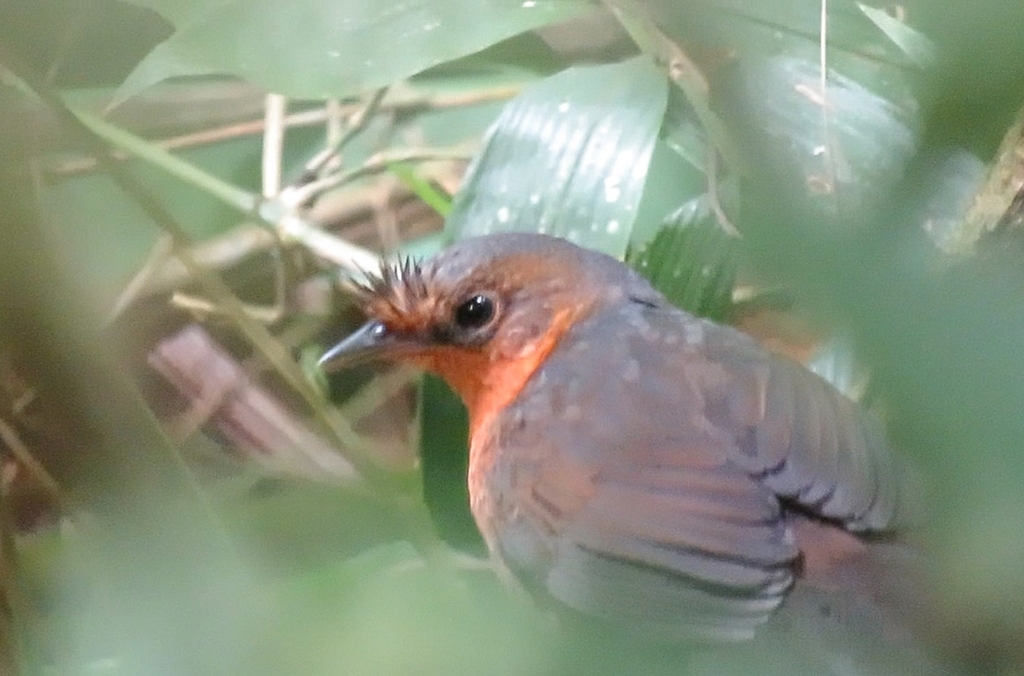
Stresemann's bristlefront (Merulaxis stresemanni) is a critically endangered species of bird in the family Rhinocryptidae, commonly known as tapaculos. It is endemic to Brazil, where there are 50 or fewer individuals living exclusively in the Mata do Passarinho Reserve.
From the article Stresemann's bristlefront on Wikipedia (CC BY-SA), quoted section by section
Description
Stresemann's bristlefront is a medium-sized, long-tailed bird with distinctive forehead bristles. It measures 20 cm (7.9 in) long. The male is all slaty gray with a dark rufous-chestnut rump, uppertail-coverts, and vent. The namesake features are long, pointed bristles on the forehead. The female is cinnamon-brown above, with a duskier tail, and is bright cinnamon below.
Range & habitat
The Stresemann's bristlefront is endemic to the heavily fragmented Atlantic Forest biome of eastern Brazil. The species inhabits moist lowland forest, especially in areas characterized by dense understory and thick leaf litter. Due to the ongoing destruction of the Atlantic Forest, one of the world’s most critically endangered biodiversity hotspots, the Stresemann's bristlefront faces an extreme risk of extinction. Approximately 90% of the original forest cover in the region has been cleared, leaving populations of endemic species like the bristlefront highly isolated and vulnerable.
Conservation efforts. In 2013, American Bird Conservancy estimated the world population to be 15 or fewer individuals. This makes the Stresemann's Bristlefront one of the rarest birds on Earth. It is classified as Critically Endangered by the International Union for Conservation of Nature (IUCN). …
Wikipedia: “Distribution and habitat”
What it does
The Stresemann's bristlefront is a cryptic and ground-dwelling species with secretive habits, making it difficult to observe in the wild. Much of its behavioral ecology remains poorly documented due to the scarcity of field encounters.
Feeding. Very little is known about the feeding behavior of Stresemann's bristlefront, but it has been observed to forage near fallen tree trunks, seemingly for arthropods.
Breeding. Breeding data on the Stresemann's bristlefront is extremely limited. The first known Stresemann's bristlefront nest site was a tunnel estimated to be 6 ft (1.8 m) long. The nest itself was not described.
Vocalization. The Stresemann's bristlefront song starts with clicks followed by a trill. It is similar to that of the closely related slaty bristlefront but lower pitched. It readily responds to playback.
Wikipedia: “Behavior”
Listen
Looking for field recordings…
Where it lives
Recorded sightings
—
geo-referenced records in GBIF, from museums, herbaria and field observers.
Drag the globe to turn it. Dots are where records exist, not a range map; darker means more records.
In the stacks
Searching the stacks…
Every page naming Merulaxis stresemanni in the Biodiversity Heritage Library →
This page is assembled live from iNaturalist, GBIF, Wikipedia, the Source Library and the Internet Archive. It is not yet part of the hand-edited codex. iNaturalist taxon 14776.