On eBird ↗
Ochre-flanked Tapaculo
Live sightings near you, the range map, bar charts of when it is seen, and Macaulay Library photos and recordings.
Ochre-flanked Tapaculo
Eugralla paradoxa
The ochre-flanked tapaculo (Eugralla paradoxa) is a species of bird in the family Rhinocryptidae. It is monotypic within the genus Eugralla. It is found in central Chile and adjacent western Argentina, where its natural habitat is temperate forest.
From the article Ochre-flanked tapaculo on Wikipedia (CC BY-SA), quoted section by section
Description
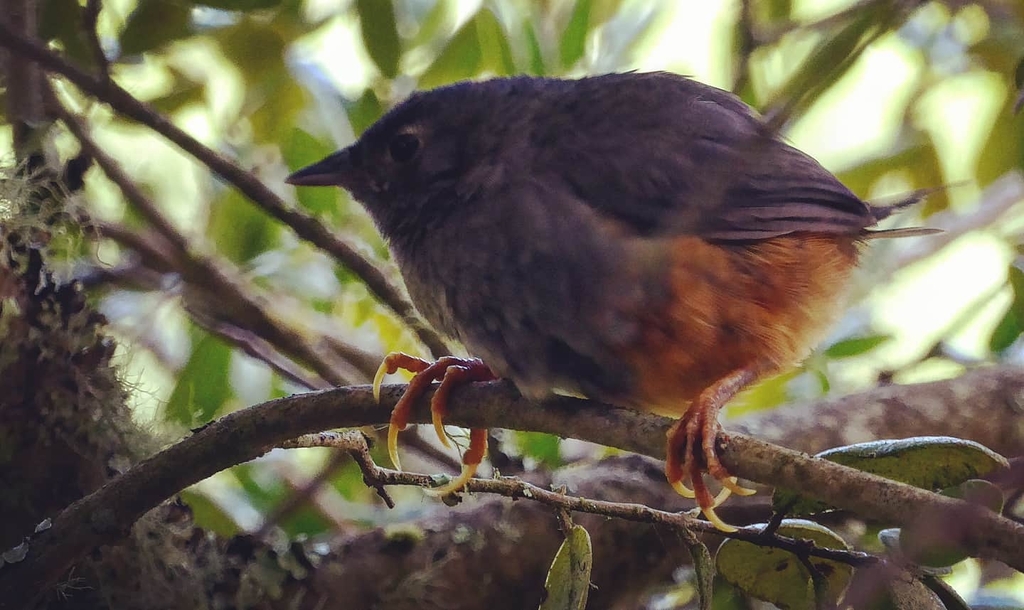
The ochre-flanked tapaculo is 14.5 cm (5.7 in) long. Two males weighed 28.6 and 30.5 g (1.01 and 1.08 oz) and other specimens of unknown sex weighed 25.5 to 29 g (0.90 to 1.02 oz). The adults' upper parts are dark gray, the underparts as far as the abdomen paler gray, and the abdomen and vent are clay brown. The flanks are tawny brown The juvenile is barred throughout with cinnamon to rufous over dusky gray. Unusual for a tapaculo, it has a "Roman nose" facial profile.
Range & habitat
The ochre-flanked tapaculo is a year round resident of south-central Chile (Maule Region to Los Lagos Region) and the western parts of the adjoining Argentinian provinces of Neuquén, Río Negro, and Chubut. It is found from sea level to 900 m (3,000 ft) and perhaps higher, where it inhabits dense undergrowth and bamboo in Nothofagus and mature secondary forest.
Wikipedia: “Distribution and habitat”
What it does
The ochre-flanked tapaculo forages in pairs on and near the ground in dense cover. Its primary prey is thought to be arthropods.
Wikipedia: “Feeding”
Listen
Looking for field recordings…
Where it lives
Recorded sightings
—
geo-referenced records in GBIF, from museums, herbaria and field observers.
Drag the globe to turn it. Dots are where records exist, not a range map; darker means more records.
In the stacks
Searching the stacks…
Every page naming Eugralla paradoxa in the Biodiversity Heritage Library →
This page is assembled live from iNaturalist, GBIF, Wikipedia, the Source Library and the Internet Archive. It is not yet part of the hand-edited codex. iNaturalist taxon 14781.