On eBird ↗
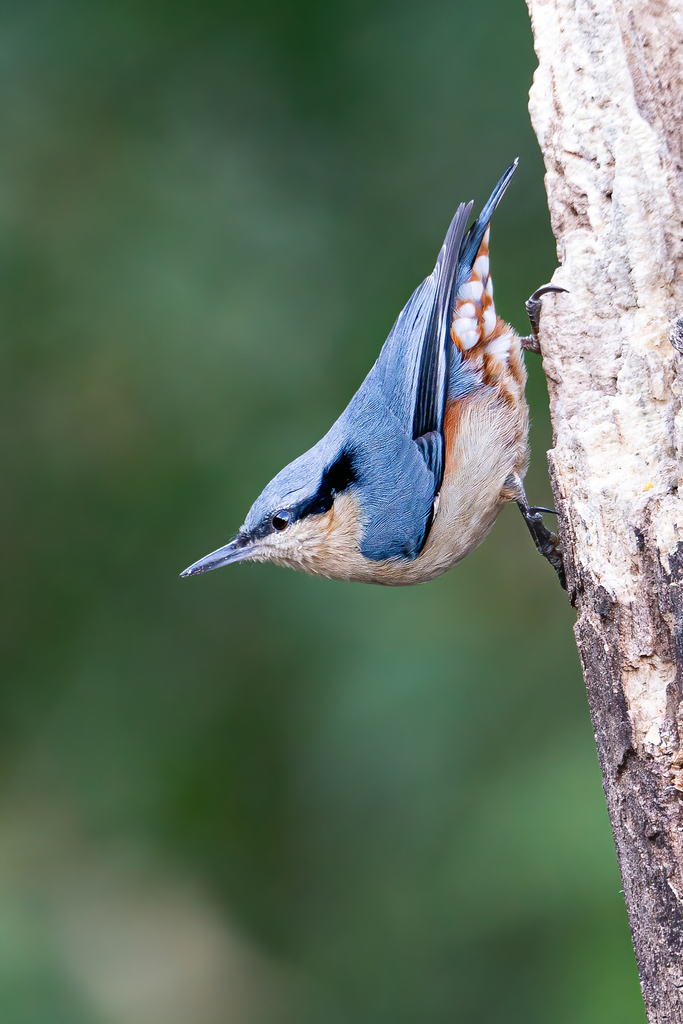
Chestnut-vented Nuthatch
Live sightings near you, the range map, bar charts of when it is seen, and Macaulay Library photos and recordings.
Chestnut-vented Nuthatch
Sitta nagaensis
The chestnut-vented nuthatch (Sitta nagaensis) is a species of bird in the nuthatch family Sittidae. It is a medium-sized nuthatch, measuring 12.5–14 cm (4.9–5.5 in) in length. The upperparts are a solid grey-blue, with a markedly black loral stripe. The underparts are uniform grey to buff from the throat to belly, with brick red on the flanks. The undertail is white with a rufous border. The chestnut-vented nuthatch utters different kinds of calls, which can sometimes sound like a wren alarm, and its song is a monotonous, stereotypical crackle, typically chichichichi. Its ecology is poorly known, but it probably feeds on small arthropods and seeds, and the breeding season begins between March and May. The nest is typically located in a hole in the trunk of a tree, and the clutch has two to five eggs.
Chestnut-vented nuthatches are found in the northeast of India, in parts of Tibet and south-central China, descending into eastern Myanmar and northwestern Thailand. Isolated populations also live in southern Laos and Vietnam. It mainly lives in evergreen forests or pine forests, but can also live in mixed or deciduous forests. Its natural habitats are subtropical or tropical moist lowland forests and subtropical or tropical moist montane forests. Its altitudinal distribution varies according to the localities, but ranges from 915–4,570 m (3,002–14,993 ft). The species was described in 1874 by the British naturalist Henry Haversham Godwin-Austen, who named it Sitta nagaensis after the Naga Hills, where the type material was collected. It belongs to the S.
From the article Chestnut-vented nuthatch on Wikipedia (CC BY-SA), quoted section by section
Range & habitat
The chestnut-vented nuthatch lives from Tibet to the mountains of Lâm Đồng province in southern Vietnam. In India, it is found only in the far eastern states of Arunachal Pradesh, Nagaland, Manipur, Assam and Meghalaya. The species lives in the Chin Hills of western Myanmar, but most of its distribution in Myanmar is in the eastern half of the country, from Kachin State to at least Shan State, and also into northwestern Thailand. It also nests in Tibet and south-central China, from western Sichuan to Yunnan and marginally in southwestern Guizhou. An isolated Chinese population also lives in northwestern Fujian, on Mount Huanggang. Two other isolated populations from the southernmost part of the species' distribution, one occurring in southern Vietnam on the Đà Lạt Plateau, another being reported in Laos on the Bolaven Plateau. The chestnut-vented nuthatch usually inhabits evergreen forests of the uplands, or forests and pine patches growing on dry ridges in the middle of evergreen forests. Locally, it also occurs in deciduous forests in northeastern India, in Quercus subsericea oak forests and alder groves in northeastern Myanmar, spruce forests (Picea sp.), fir forests (Abies sp.) or rhododendron stands in Yunnan, or poplar (Populus sp.) and walnut (Juglans sp.) in Sichuan. …
Wikipedia: “Distribution and habitat”
What it does
The chestnut-vented nuthatch generally lives alone or in pairs, but joins mixed-species foraging flocks outside of the breeding season. In winter, it can thus be observed in the company of different species of tits (Paridae) such as the yellow-cheeked tit (Maclolophus spilonotus), bushtits, woodpeckers, alcippes, and minlas.
Vocalisations. The chestnut-vented nuthatch's calls are varied, with squeaky sit or sit-sit sounds, repeated more or less rapidly with various inflections and in irregular series. Similar but drier tchip or tchit sounds are sometimes made, often in a trill reminiscent of the alarm of a Eurasian wren (Troglodytes troglodytes). The alarm calls of the chestnut-vented nuthatch are reported in English-language literature as nasal sounds in quir, kner or mew, as well as an emphatic, metallic tsit, sometimes doubled or repeated in quick series. The song is a stereotyped, monotonous rattle or tremolo in chichichichichi ... or trr-rrrrrrr-ri ..., lasting less than a second or sometimes slowed down to chi-chi-chi-chi-chi ... or diu-diu-diu- diu-diu reminiscent of the song of the Eurasian nuthatch.
Food. The chestnut-vented nuthatch often forages for food on the ground, on rocks, old stumps, or in trees. No specific information about the diet is known, but the species probably feeds on small arthropods and seeds.
Breeding. …
Wikipedia: “Ecology and behaviour”
Listen
Looking for field recordings…
Where it lives
Recorded sightings
—
geo-referenced records in GBIF, from museums, herbaria and field observers.
Drag the globe to turn it. Dots are where records exist, not a range map; darker means more records.
In the stacks
Searching the stacks…
Every page naming Sitta nagaensis in the Biodiversity Heritage Library →
This page is assembled live from iNaturalist, GBIF, Wikipedia, the Source Library and the Internet Archive. It is not yet part of the hand-edited codex. iNaturalist taxon 14831.