On eBird ↗
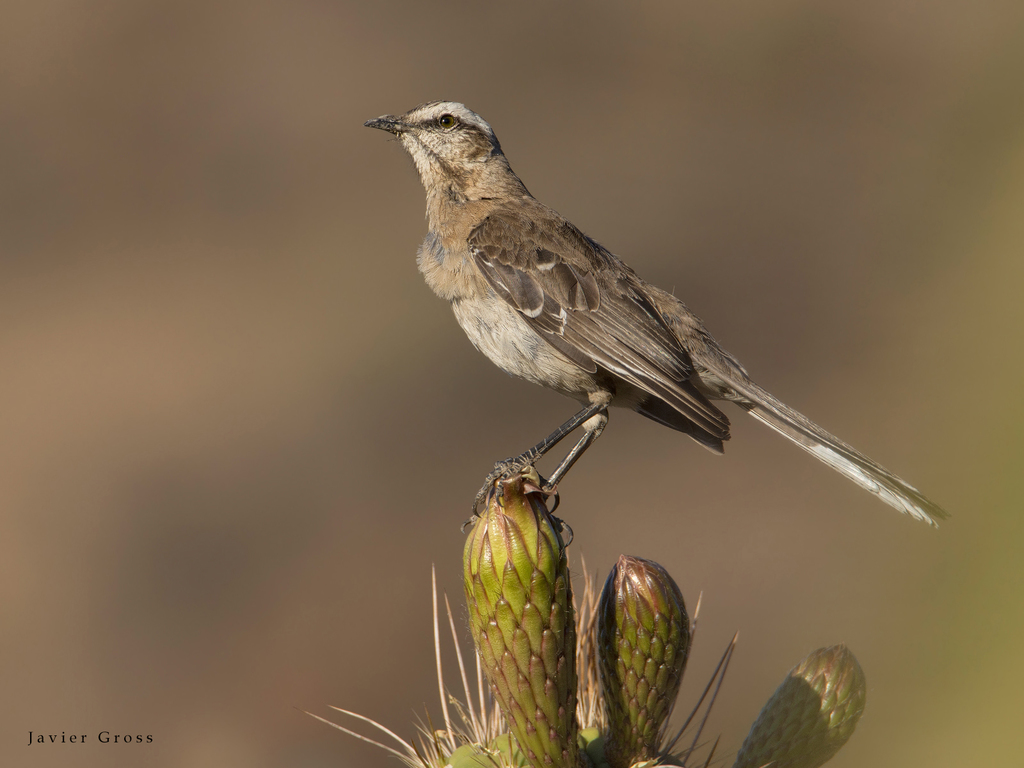
Chilean Mockingbird
Live sightings near you, the range map, bar charts of when it is seen, and Macaulay Library photos and recordings.
Chilean Mockingbird
Mimus thenca
The Chilean mockingbird (Mimus thenca), locally known as tenca, is a species of bird in the family Mimidae. It primarily inhabits Chile's northern half, though there are sightings in Argentina.
From the article Chilean mockingbird on Wikipedia (CC BY-SA), quoted section by section
Description
The Chilean mockingbird is 28 to 29 cm (11.0 to 11.4 in) long and weighs 66 g (2.3 oz). The male is somewhat larger than the female. Adults have a wide whitish supercilium. Their crown, neck, and back are brownish gray with darker streaks and their rump browner. The wings and tail are blackish. The wings show two narrow bars when folded. The outermost tail feathers have white edges and most of the others have white tips. The throat is whitish, the chest brownish gray, the belly dirty white, and the flanks buffy with blackish streaks. The juvenile is similar but more buffy below with more streaks.
Range & habitat
The Chilean mockingbird is found in Chile from Copiapó Province in the Atacama Region south to Los Lagos, Puerto Montt, and Chiloé Island. A small population also exists in Neuquén Province, Argentina. The Chilean mockingbird inhabits a wide variety of biomes, most of which are characterized by scrub, shrubs, or widely spaced trees. Examples include succulent coastal scrub, inland savanna bushland, and evergreen Chilean matorral. It also occurs at the edges of low relict woodland patches such as those in Bosque de Fray Jorge National Park and in disturbed habitats, though only rarely in urban areas. It shuns Nothofagus and Cryptocarya woodlands in the south and plantations of introduced pines in central Chile. In elevation it ranges from sea level to 2,200 m (7,200 ft).
Wikipedia: “Distribution and habitat”
What it does
The Chilean mockingbird forages mainly on the ground, turning over leaf litter and digging under fallen branches and around plant stems. It also hunts in vegetation up to 3 m (9.8 ft) above ground. It is omnivorous; it has been documented feeding on insects, wild and cultivated fruits, nectar, and a small lizard.
Wikipedia: “Feeding”
Listen
Looking for field recordings…
Where it lives
Recorded sightings
—
geo-referenced records in GBIF, from museums, herbaria and field observers.
Drag the globe to turn it. Dots are where records exist, not a range map; darker means more records.
In the stacks
Searching the stacks…
Every page naming Mimus thenca in the Biodiversity Heritage Library →
This page is assembled live from iNaturalist, GBIF, Wikipedia, the Source Library and the Internet Archive. It is not yet part of the hand-edited codex. iNaturalist taxon 14879.