On eBird ↗
Brown Thrasher
Live sightings near you, the range map, bar charts of when it is seen, and Macaulay Library photos and recordings.
Brown Thrasher
Toxostoma rufum
The brown thrasher (Toxostoma rufum), sometimes erroneously called the brown thrush or fox-coloured thrush, is a bird in the family Mimidae, which also includes the New World catbirds and mockingbirds. The brown thrasher is abundant throughout the eastern and central United States and southern and central Canada, and it is the only thrasher to live primarily east of the Rockies and central Texas. It is the state bird of Georgia.
As a member of the genus Toxostoma, the bird is relatively large-sized among the other thrashers. It has brown upper parts with a white under part with dark streaks. Because of this, it is often confused with the smaller wood thrush (Hylocichla mustelina), among other species. The brown thrasher is noted for having over 1,000 song types, and the largest song repertoire of birds. However, each note is usually repeated in two or three phrases.
From the article Brown thrasher on Wikipedia (CC BY-SA), quoted section by section
Description
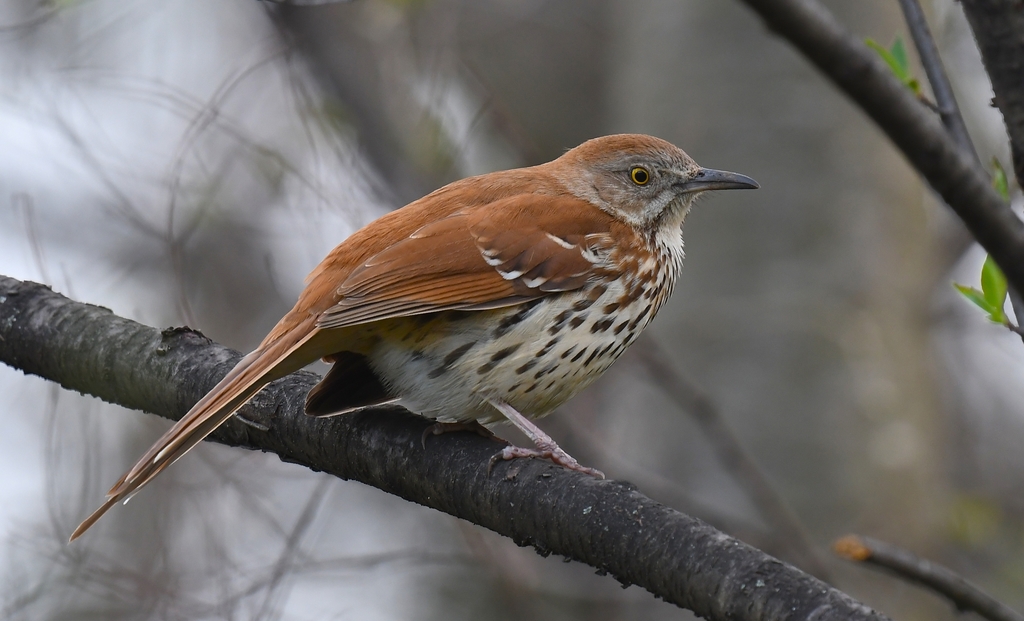
The brown thrasher is bright reddish-brown above with thin, dark streaks on its buffy underparts. It has a whitish-colored chest with distinguished teardrop-shaped markings on its chest. Its long, rufous tail is rounded with paler corners, and eyes are a brilliant yellow. Its bill is brownish, long, and curves downward. Both male and females are similar in appearance. The juvenile appearance of the brown thrasher from the adult is not remarkably different, except for plumage texture, indiscreet upper part markings, and the irises having an olive color.
The brown thrasher is a fairly large passerine, although it is generally moderate in size for a thrasher, being distinctly larger than the sage thrasher (Oreoscoptes montanus) but similar or somewhat smaller in size than the more brownish Toxostoma species found further west. Adults measure around 23.5 to 30.5 cm (9.3 to 12.0 in) long with a wingspan of 29 to 33 cm (11 to 13 in), and weigh 61 to 89 g (2.2 to 3.1 oz), with an average of 68 g (2.4 oz). Among standard measurements, the wing chord is 9.5 to 11.5 cm (3.7 to 4.5 in), the tail is 10.9 to 14.1 cm (4.3 to 5.6 in), the culmen is 2.2 to 2.9 cm (0.87 to 1.14 in) and the tarsus is 3.2 to 3.6 cm (1.3 to 1.4 in). There are two subspecies: the 'brown thrasher' (T. rufum rufum), which lies in the eastern half of Canada and the United States, and the 'western brown thrasher' (T. …
Range & habitat
The brown thrasher resides in various habitats. It prefers to live in woodland edges, thickets and dense brush, often searching for food in dry leaves on the ground. It can also inhabit areas that are agricultural and near suburban areas, but is less likely to live near housing than other bird species. The brown thrasher often vies for habitat and potential nesting grounds with other birds, which is usually initiated by the males. The brown thrasher is a strong, but partial migrant, as the bird is a year-round resident in the southern portion of its range. The breeding range includes the United States and Canada east of the Rocky Mountains, but has been occasionally spotted West of the Rockies. The increase in trees throughout the Great Plains during the past century due to fire suppression and tree planting facilitated a westward range expansion of the brown thrasher as well as range expansions of many other species of birds. Studies indicate that thrashers that reside in the New England region of the United States during the breeding season fly toward the Carolinas and Georgia, birds located in the east of the Mississippi winter from Arkansas to Georgia, and birds located in the Dakotas and the central Canadian provinces head towards eastern Texas and Louisiana. When the species does migrate, it is typically for short distances and during the night. …
Wikipedia: “Distribution and habitat”
What it does
The brown thrasher has been observed either solo or in pairs. The brown thrasher is usually an elusive bird, and maintains its evasiveness with low-level flying. When it feels bothered, it usually hides into thickets and gives cackling calls. Thrashers spend most of their time on ground level or near it. When seen, it is commonly the males that are singing from unadorned branches. The brown thrasher has been noted for having an aggressive behavior, and is a staunch defender of its nest. However, the name does not come from attacking perceived threats, but is believed to have come from the thrashing sound the bird makes when digging through ground debris. It is also thought that the name comes from the thrashing sound that is made while it is smashing large insects to kill and eventually eat.
Feeding. This bird is omnivorous, and has a diet that includes insects, berries, nuts and seeds, as well as earthworms, snails, and sometimes lizards and frogs. Across seasons and its breeding range, it was found 63% of stomach contents were made of animal matter, the remaining 37% being plant material. During the breeding season, the diet consists primarily of beetles, grasshoppers, and other arthropods, and fruits, nuts and seeds. More than 80% of the diet of brown thrasher from Illinois is made of animal matter, about 50% being beetles. …
Wikipedia: “Behavior”
Listen
Looking for field recordings…
Where it lives
Recorded sightings
—
geo-referenced records in GBIF, from museums, herbaria and field observers.
Drag the globe to turn it. Dots are where records exist, not a range map; darker means more records.
In the old herbals & bestiaries

In the stacks
Searching the stacks…
Every page naming Toxostoma rufum in the Biodiversity Heritage Library →
This page is assembled live from iNaturalist, GBIF, Wikipedia, the Source Library and the Internet Archive. It is not yet part of the hand-edited codex. iNaturalist taxon 14898.