On eBird ↗
California Thrasher
Live sightings near you, the range map, bar charts of when it is seen, and Macaulay Library photos and recordings.
California Thrasher
Toxostoma redivivum
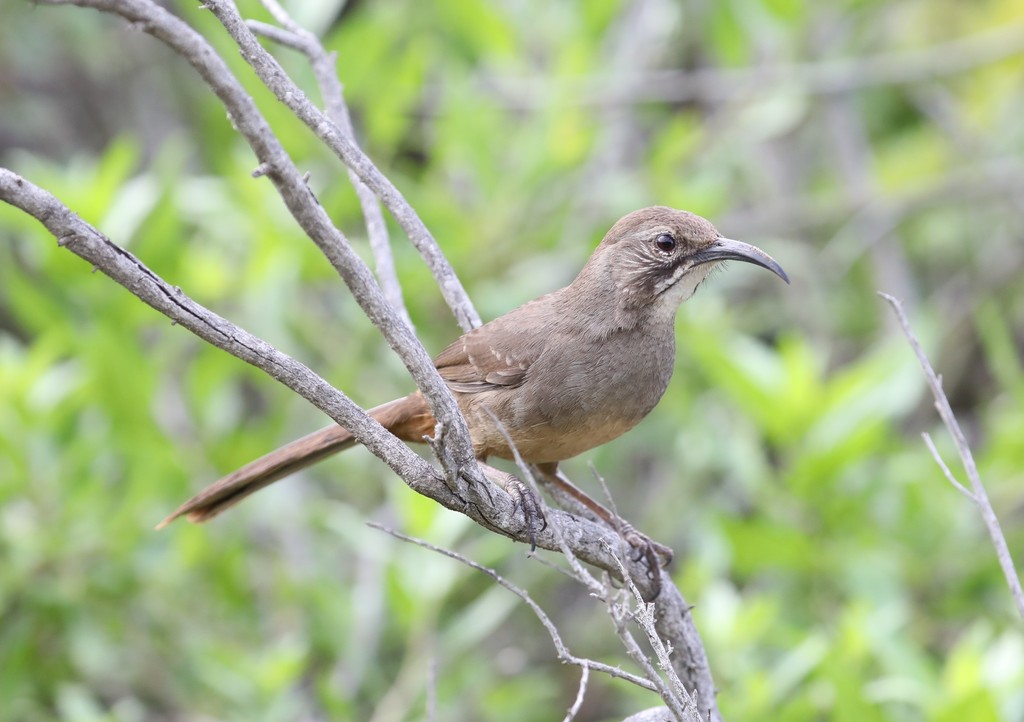
The California thrasher (Toxostoma redivivum) is a large thrasher found primarily in chaparral habitat in California and Baja California. Similar to the crissal and Le Conte's thrashers in habit, the California thrasher is the only species of Toxostoma throughout most of its limited range. Like most thrashers, it rarely flies in the open, preferring to keep hidden in dense brush. Therefore, while it is common throughout much of its range, it is rarely seen.
From the article California thrasher on Wikipedia (CC BY-SA), quoted section by section
Description
The California thrasher is about 32 cm (13 in) long and weighs up to 90 g (3.2 oz); it is the largest thrasher. It has a distinctive long, decurved beak and a long tail. It is generally deep grayish brown above with olive tones on the tail. It has a grayish buff supercilium, a dark cheek pattern and eye line, and unlike most thrashers, has dark eyes. The underparts are mostly buffy to tawny brown, with the upper breast and flanks a smoky gray. The two subspecies differ only slightly.
Range & habitat
The nominate subspecies of California thrasher is found from Santa Cruz and Placer counties, California, south into northwestern Baja California, Mexico. T. r. sonomae is found from Trinity and adjoining counties in northern California southwards to the range of the nominate subspecies. There appears to be slight overlap allowing gene flow between them. The California thrasher is a year round resident of both slopes of the California Coast Ranges and the western slope of the Sierra Nevada. It is only rarely found in the Central Valley between them. Its primary habitat is chaparral. It also inhabits sagebrush, juniper bushland, and riparian and oak woodlands with a dense understory. It is sometimes found in suburban parks and yards that have dense cover. In elevation it ranges generally as high as 1,600 m (5,200 ft) and as high as 2,000 m (6,600 ft) in southern California mountains. The California thrasher primarily inhabits the great interior valleys of California, where it forages mainly beneath dense and continuous cover. Approximately two-thirds of its foraging activities are conducted on the ground. This bird's range is notably restricted, extending slightly beyond the state of California only towards the south.
Wikipedia: “Distribution and habitat”
What it does
This species' behavior is difficult to observe because it tends to keep hidden in dense cover. In the open it runs swiftly with its tail raised. The California thrasher has a distinct foraging behavior, often seeking food under dense and continuous cover. It primarily forages on the ground, making up approximately two-thirds of its foraging activity. Studies involving color-banded thrashers have shown more about how they interact with each other socially. A male thrasher will defend his territory by chasing away rivals, and will drive out his own young from his own previous broods before a new breeding season can start. While males are the primary singers, females have also been observed to sing, especially in response to the song of a male. Confrontations between thrashers and other wildlife have also been recorded. A thrasher will repeatedly attack from the air, or defensively posture against animals if it feels threatened. However, if a threat is deemed too large then the thrasher prefers to escape by running into cover and hiding rather than flying away. This is largely due to its physical build of having strong legs and a tail which are ideal for running away.
Feeding. The California thrasher forages mostly on the ground, by digging and sweeping leaf litter and soil with its bill. It walks or hops between foraging stops. …
Wikipedia: “Behavior”
Listen
Looking for field recordings…
Where it lives
Recorded sightings
—
geo-referenced records in GBIF, from museums, herbaria and field observers.
Drag the globe to turn it. Dots are where records exist, not a range map; darker means more records.
In the stacks
Searching the stacks…
Every page naming Toxostoma redivivum in the Biodiversity Heritage Library →
This page is assembled live from iNaturalist, GBIF, Wikipedia, the Source Library and the Internet Archive. It is not yet part of the hand-edited codex. iNaturalist taxon 14906.