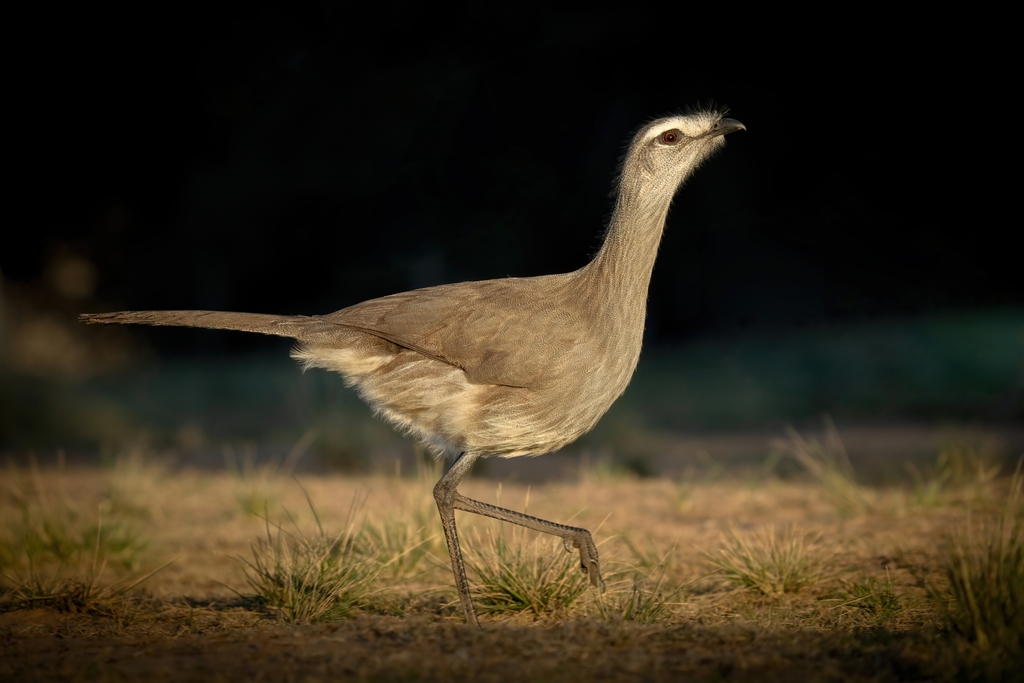
Black-legged Seriemas
Chunga
The black-legged seriema (Chunga burmeisteri) is one of two living species of seriemas in the family Cariamidae. It is found from southeastern Bolivia and northern Paraguay south into north-central Argentina. It is a large, mostly grey bird with a long neck, a long tail, and long, slender black legs. Its belly, vent and thighs are yellowish-white. The sexes look similar, as do immature birds, though the latter are more patterned on head, neck and back. First described for science by Gustav Hartlaub in 1860, it is monotypic, with no subspecies. Like its red-legged cousin, it is an omnivore. It seldom flies, instead pursuing prey and eluding danger on foot. Its loud calls, said to sound like kookaburras, turkeys or yelping dogs, are often given in duet. Little is known about its breeding ecology. It is known to breed in November and December, building a platform nest of sticks and laying two white eggs, which are sometimes marked with a few brownish or purple spots. The International Union for Conservation of Nature rates the species as one of least concern, due to its large range and apparently stable numbers.
1 branches of this genus, most-observed first · about 1 known species
See this branch on the Wheel of Life →
Where it lives
Recorded sightings
—
geo-referenced records in GBIF, from museums, herbaria and field observers.
Drag the globe to turn it. Dots are where records exist, not a range map; darker means more records.
In the stacks
Searching the stacks…
Every page naming Chunga in the Biodiversity Heritage Library →
This page is assembled live from iNaturalist, GBIF, Wikipedia, the Source Library and the Internet Archive. It is not yet part of the hand-edited codex. iNaturalist taxon 15.