On eBird ↗
Blue Mockingbird
Live sightings near you, the range map, bar charts of when it is seen, and Macaulay Library photos and recordings.
Blue Mockingbird
Melanotis caerulescens
The blue mockingbird (Melanotis caerulescens) is a species of bird in the family Mimidae. It is endemic to Mexico, but has occurred as a vagrant in the southern United States. Its natural habitats are subtropical or tropical dry forests, subtropical or tropical moist montane forests, and heavily degraded former forest.
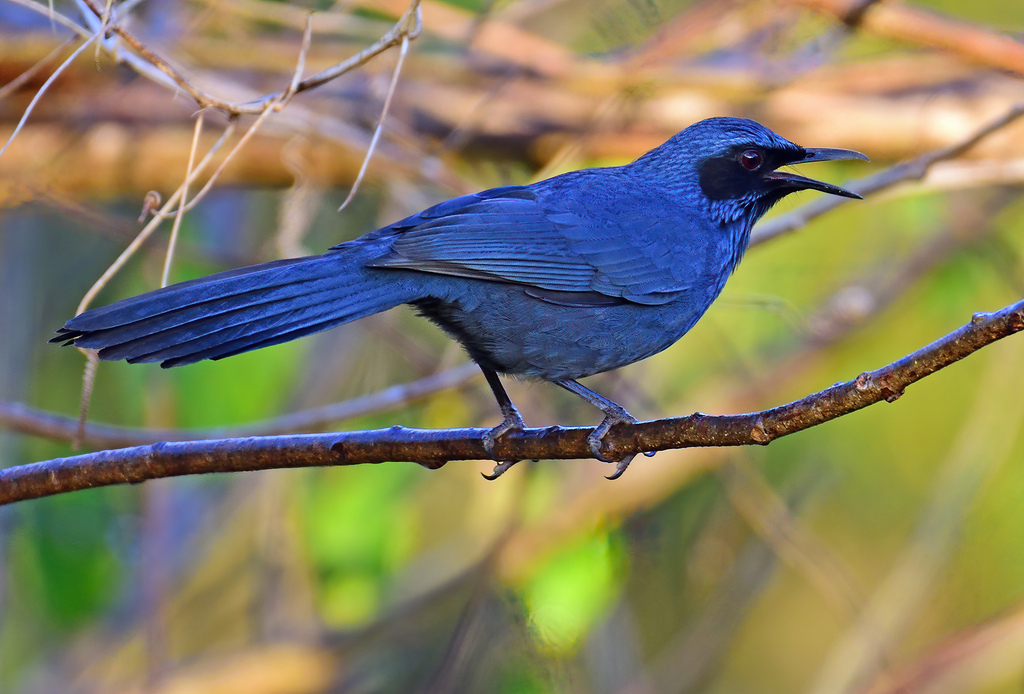
The blue mockingbird is uniformly blue on its back, tail, wings, head and underbelly. This color is a result of feather structure rather than pigment, and therefore can look gray in the shade. It has a black "mask" surrounding its reddish-brown eyes. It has a rather long, slightly graduated tail, and dark blue streaks over its breast. Its bill is long, thin and slightly curved, and its legs and feet are black.
From the article Blue mockingbird on Wikipedia (CC BY-SA), quoted section by section
Description
Measuring 9.5–10.5 in (24–27 cm) in length, and weighing between 50.2 and 59.7 g (1.77 and 2.11 oz), the blue mockingbird is a medium-sized mimid. Individuals of the subspecies caerulescens have a mean body mass slightly higher than that for individuals of the subspecies longirostris — 63.5 g (2.24 oz) for the former and 59.7 g (2.11 oz) for the latter.
Range & habitat
The blue mockingbird lives in a variety of woodlands: humid forest, riparian thickets, scrub, pine-oak forests and second growth. It is found at elevations ranging from lowlands to 2,450 m (8,040 ft).
Wikipedia: “Habitat and range”
What it does
The blue mockingbird is an omnivore; it feeds primarily on invertebrates, but also on some vegetable matter.
Wikipedia: “Food and feeding”
Listen
Looking for field recordings…
Where it lives
Recorded sightings
—
geo-referenced records in GBIF, from museums, herbaria and field observers.
Drag the globe to turn it. Dots are where records exist, not a range map; darker means more records.
In the stacks
Searching the stacks…
Every page naming Melanotis caerulescens in the Biodiversity Heritage Library →
This page is assembled live from iNaturalist, GBIF, Wikipedia, the Source Library and the Internet Archive. It is not yet part of the hand-edited codex. iNaturalist taxon 15035.