On eBird ↗
Arrow-marked Babbler
Live sightings near you, the range map, bar charts of when it is seen, and Macaulay Library photos and recordings.
Arrow-marked Babbler
Turdoides jardineii
The arrow-marked babbler (Turdoides jardineii) is a species of bird in the family Leiothrichidae. It is native to woodlands in the southern Afrotropics.
From the article Arrow-marked babbler on Wikipedia (CC BY-SA), quoted section by section
Description
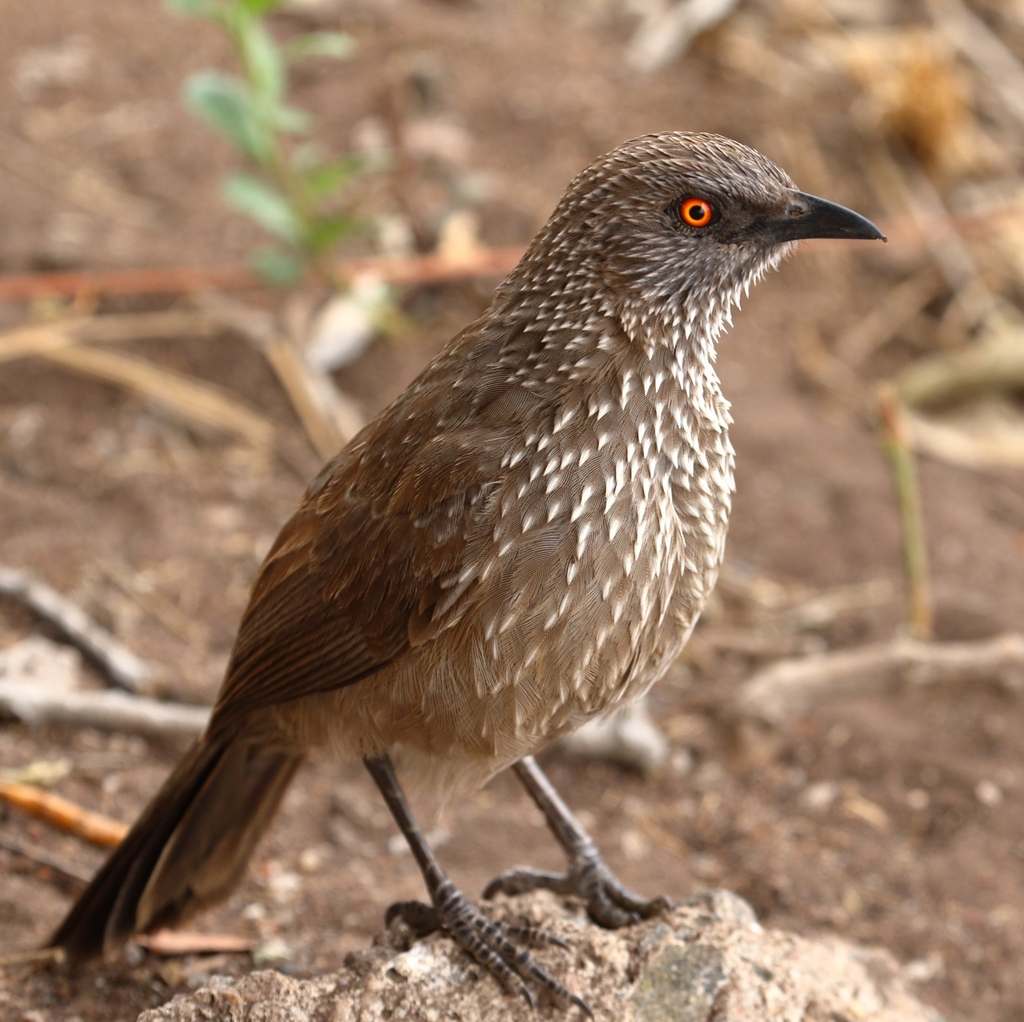
The arrow-marked babbler is a medium-sized babbler, 22 to 25 cm (8.7–9.8 in) in length and weighing 56 to 85 g (2.0–3.0 oz). The common name for the species is derived from its plumage, which is brownish-grey above and lighter below, with white tips to the feathers on the throat, neck and head. The outer iris is bright red and the inner bright yellow or orange. Males and females are identical in appearance. Juveniles have brown eyes and less arrow-shaped streaking on the breast.
Range & habitat
It is found in Angola, Botswana, Burundi, Republic of the Congo, DRC, Eswatini, Gabon, Kenya, Malawi, Mozambique, Namibia, Rwanda, South Africa, Tanzania, Uganda, Zambia, and Zimbabwe. Its natural habitats are subtropical or tropical dry forest, dry savanna, and subtropical or tropical moist shrubland.
Wikipedia: “Distribution and habitat”
What it does
The arrow-marked babbler lives in social groups of between 3 and 15 birds (six being the average) that defend large territories, with the size of the territory being dependent upon the number of individuals in the group. They feed on insects, spiders and sometimes snails and lizards, as well as fruits. Foraging occurs near the ground, sometimes in association with other babblers or bulbuls.
Wikipedia: “Behaviour”
Listen
Looking for field recordings…
Where it lives
Recorded sightings
—
geo-referenced records in GBIF, from museums, herbaria and field observers.
Drag the globe to turn it. Dots are where records exist, not a range map; darker means more records.
In the stacks
Searching the stacks…
Every page naming Turdoides jardineii in the Biodiversity Heritage Library →
This page is assembled live from iNaturalist, GBIF, Wikipedia, the Source Library and the Internet Archive. It is not yet part of the hand-edited codex. iNaturalist taxon 15052.