On eBird ↗
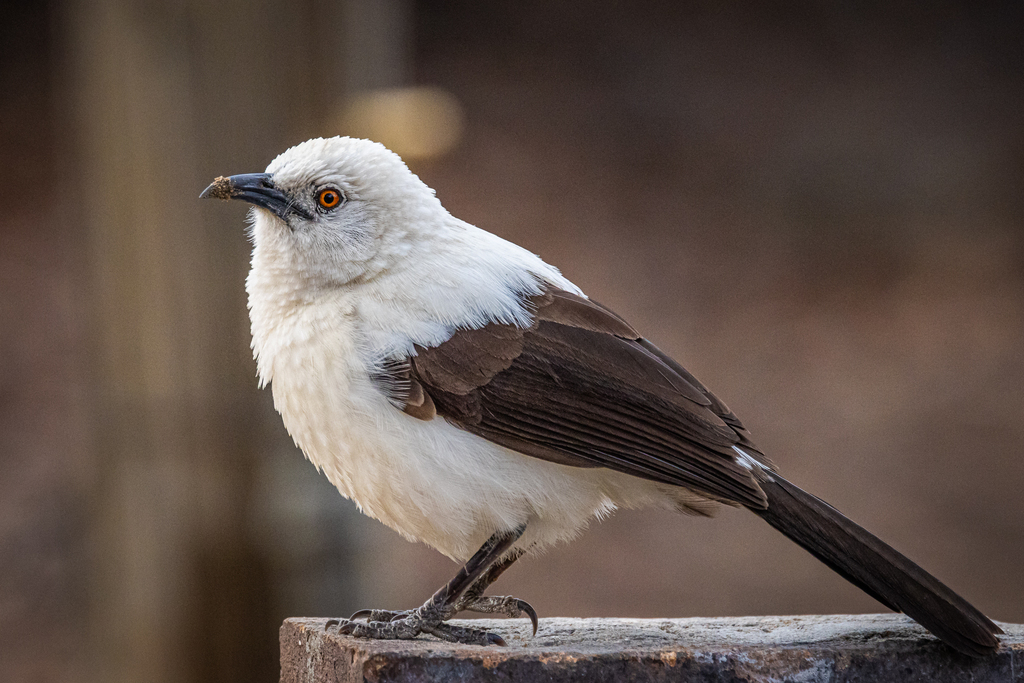
Southern Pied-Babbler
Live sightings near you, the range map, bar charts of when it is seen, and Macaulay Library photos and recordings.
Southern Pied-Babbler
Turdoides bicolor
The southern pied babbler (Turdoides bicolor) is a species of bird in the Leiothrichidae family, found in dry savannah of Botswana, Namibia, South Africa, and Zimbabwe.
From the article Southern pied babbler on Wikipedia (CC BY-SA), quoted section by section
Description
The southern pied babbler is a medium-sized 75 to 95 grams (2.6 to 3.4 oz) cooperatively breeding passerine bird. Groups range in size from 2-16 adults, but pairs are rare. The species is sexually monomorphic, with males and females indistinguishable from physical characteristics. Each group comprises a dominant breeding pair that monopolise access to breeding opportunities. Recent genetic research has confirmed that these dominant pairs are responsible for more than 95% of young hatched. Occasional mixed parentage has been observed, but is predictable in most cases: subordinates primarily gain parentage when a new (unrelated) immigrant disperses into the group, or a new group is founded. All group members cooperate to help raise the young hatched from a single clutch. Clutch size varies between two and five, with a modal clutch size of three. Cooperative behaviours include: provisioning young (both in the nest and post-fledging), sentinel behaviour, territory border defense, teaching behaviour and babysitting behaviour (where semi-independent fledglings follow adults between foraging sites and away from predators). The breeding season extends from late-September to early April, although this varies between years and is strongly rain-dependent. Groups can raise up to three successful clutches per breeding season. …
What it does
Aggression toward fledglings is most commonly observed when the dominant pair have begun to incubate another brood. During this period, begging fledglings will be punished by parents using aggressive behaviour such as jumping on the youngster. In all cases, fledglings stop begging immediately following attack. Brood overlap results in a distinctive division of labour, with subordinate adults continuing to care for fledglings while the dominant pair concentrate their effort on the new brood. Owing to the extended period of post-fledging care in this species, this can result in dependent young from multiple broods being raised simultaneously. Pied babblers are strongly territorial, and defend their borders using wing and vocal displays on a near daily basis. These fights rarely lead to physical aggression and injury from such fights is very rare. Groups defend the same territory year-round and small groups tend to lose portions of their territory to larger neighbouring groups. Research on pied babblers has provided the first evidence of teaching behaviour in an avian species. Pied babblers teach their young by giving a specific purr call each time they deliver food. Young learn to associate this call with food and reach out of the nest each time they hear it. …
Wikipedia: “Behaviour”
Listen
Looking for field recordings…
Where it lives
Recorded sightings
—
geo-referenced records in GBIF, from museums, herbaria and field observers.
Drag the globe to turn it. Dots are where records exist, not a range map; darker means more records.
In the stacks
Searching the stacks…
Every page naming Turdoides bicolor in the Biodiversity Heritage Library →
This page is assembled live from iNaturalist, GBIF, Wikipedia, the Source Library and the Internet Archive. It is not yet part of the hand-edited codex. iNaturalist taxon 15054.