On eBird ↗
Puna Plover
Live sightings near you, the range map, bar charts of when it is seen, and Macaulay Library photos and recordings.
Puna Plover
Anarhynchus alticola
The puna plover (Anarhynchus alticola) is a species of bird in subfamily Charadriinae of family Charadriidae. It is found in Argentina, Bolivia, Chile, and Peru.
From the article Puna plover on Wikipedia (CC BY-SA), quoted section by section
Description
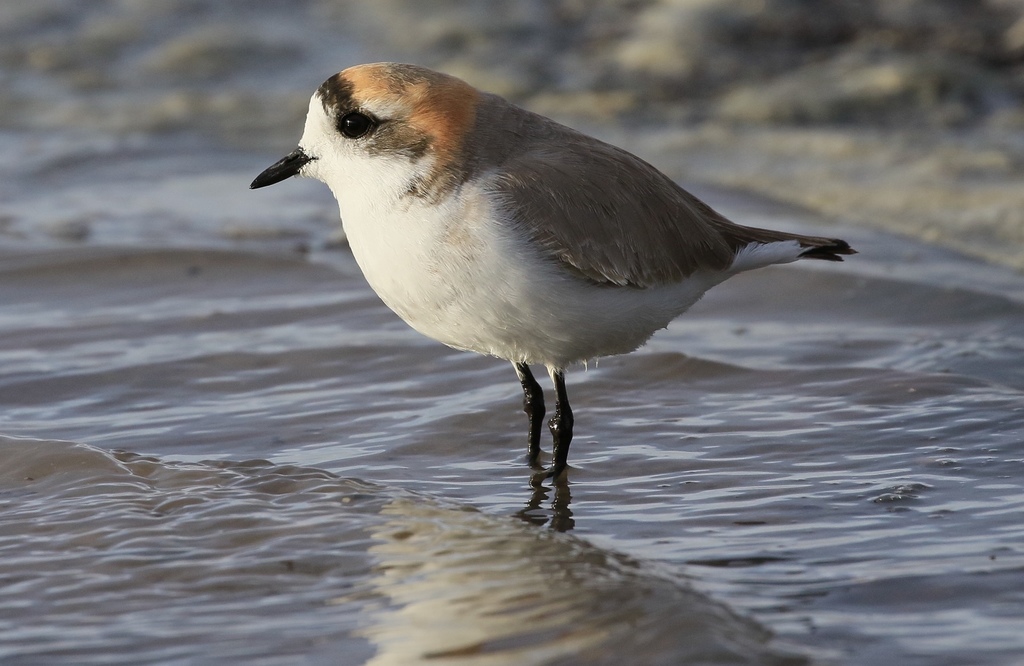
The puna plover is 16.5 to 17.5 cm (6.5 to 6.9 in) long and weighs 41 to 49 g (1.4 to 1.7 oz). It has a short thick neck and its bill and legs are black. Adult males have a white face. They have a black bar on the forecrown and a black strip behind the eye that connects to black patches on the sides of the breast. They have a pale chestnut crown, hindneck, and breast band. Their upperparts are dull brown and their underparts white but for the breast band. Adult females are duller; their breast band can be grayish and the areas that are black on the male can be brownish. Juveniles are essentially brown above and white below, with little or none of the adults' black and chestnut.
Range & habitat
The puna plover is found in the high Andes from Peru's Department of Junín south through western Bolivia into northern Chile as far as the Atacama Region and into northwestern Argentina to Catamarca Province. It inhabits the plateaus of the puna zone, where it is typically found in short grassland around both salt- and freshwater lakes. In elevation it mostly ranges between 3,000 and 4,500 m (9,800 and 14,800 ft) but is found as low as 2,400 m (7,900 ft) and as high as 5,000 m (16,000 ft). The puna plover is probably resident in most of its range but some move to lower elevations, even as far as the coast, during the austral winter.
Wikipedia: “Distribution and habitat”
What it does
Almost nothing is known about the puna plover's foraging techniques or diet, but the latter does include small crustaceans. In the non-breeding season it can forage in loose flocks of up to about 30 birds.
Wikipedia: “Feeding”
Listen
Looking for field recordings…
Where it lives
Recorded sightings
—
geo-referenced records in GBIF, from museums, herbaria and field observers.
Drag the globe to turn it. Dots are where records exist, not a range map; darker means more records.
In the stacks
Searching the stacks…
Every page naming Anarhynchus alticola in the Biodiversity Heritage Library →
This page is assembled live from iNaturalist, GBIF, Wikipedia, the Source Library and the Internet Archive. It is not yet part of the hand-edited codex. iNaturalist taxon 1505665.