On eBird ↗
Two-banded Plover
Live sightings near you, the range map, bar charts of when it is seen, and Macaulay Library photos and recordings.
Two-banded Plover
Anarhynchus falklandicus
The two-banded plover (Anarhynchus falklandicus) is a species of bird in subfamily Charadriinae of family Charadriidae. It is found in Argentina, Brazil, Chile, the Falkland Islands, and Uruguay.
From the article Two-banded plover on Wikipedia (CC BY-SA), quoted section by section
Description
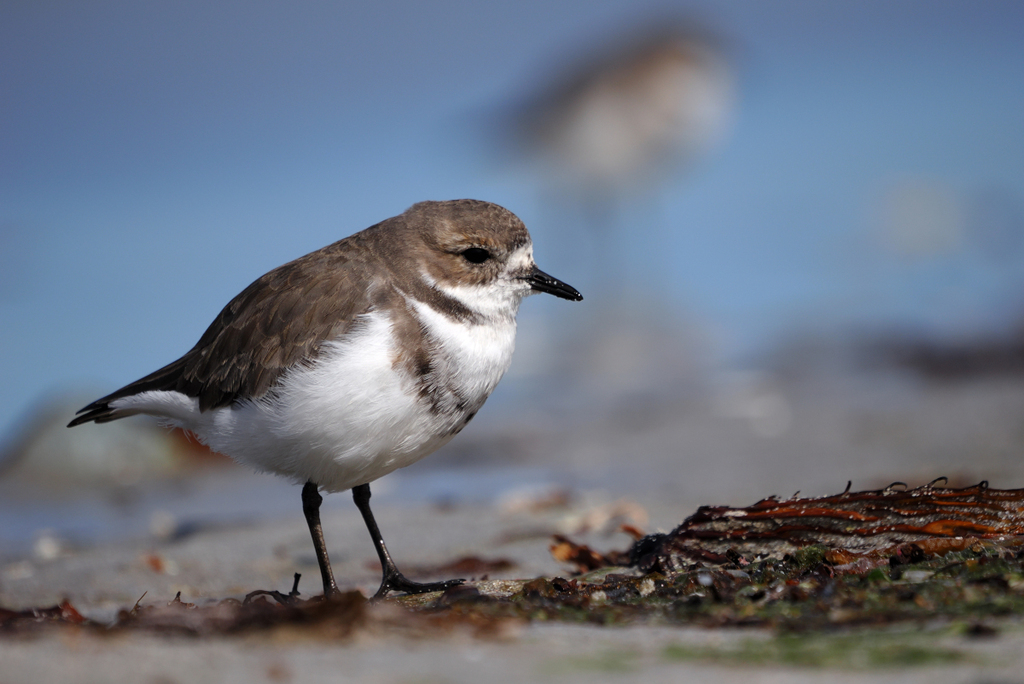
The two-banded plover is 17 to 19 cm (6.7 to 7.5 in) long and weighs 62 to 72 g (2.2 to 2.5 oz). It has a potbellied appearance and its bill and legs are black. Adult males in breeding have a white forehead, lower face, breast, and belly. They have a black bar on the forecrown and a chestnut crown and hindneck. Their upperparts are brown. They have two black breastbands, the upper one of which is frequently incomplete. (This feature is more prevalent in the Falklands population.) Adult females' crown is duller than the male's, what is black on the male is brownish on the female, and the upper breastband has white flecks throughout. Non-breeding adults have gray instead of black and gray-brown instead of chestnut. Juveniles resemble non-breeding adults but with brown breastbands, a darker face, and buffy fringes on the upperparts feathers.
Range & habitat
The two-banded plover is found on the Falkland Islands and coastally to somewhat inland in Argentina, Uruguay, extreme southeastern Brazil, and central and southern Chile. It inhabits gravel shores, sand beaches, wet savanna, and short grasslands, usually near streams or ponds both fresh and brackish. Outside the breeding season it is also found on tidal mudflats. It is mostly coastal but breeds as high as 1,200 m (3,900 ft) in southern Argentina.
Wikipedia: “Distribution and habitat”
What it does
The two-banded plover forages at the edge of the surf, on stranded kelp mats, in short grass, and on the edges of freshwater ponds. Its diet is mostly small invertebrates including polychaetes, bivalves, gastropods, insects, and spiders.
Wikipedia: “Feeding”
Listen
Looking for field recordings…
Where it lives
Recorded sightings
—
geo-referenced records in GBIF, from museums, herbaria and field observers.
Drag the globe to turn it. Dots are where records exist, not a range map; darker means more records.
In the stacks
Searching the stacks…
Every page naming Anarhynchus falklandicus in the Biodiversity Heritage Library →
This page is assembled live from iNaturalist, GBIF, Wikipedia, the Source Library and the Internet Archive. It is not yet part of the hand-edited codex. iNaturalist taxon 1505666.