On eBird ↗
Vinous-throated Parrotbill
Live sightings near you, the range map, bar charts of when it is seen, and Macaulay Library photos and recordings.
Vinous-throated Parrotbill
Suthora webbiana
The vinous-throated parrotbill (Suthora webbiana) is a species of parrotbill in the family Paradoxornithidae; formerly, it was placed in the closely related Sylviidae or Timaliidae. It is found in China, Japan, Korea, Mongolia, Russia, Taiwan, and Vietnam. Its natural habitat is subtropical or tropical moist montane forests.
From the article Vinous-throated parrotbill on Wikipedia (CC BY-SA), quoted section by section
Description
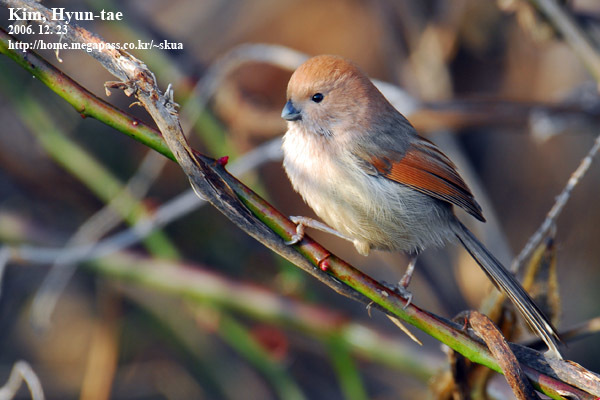
The vinous-throated parrotbill is a relatively small and long-tailed parrotbill. It measures between 11 and 12.5 cm (4.3–4.9 in) in length. The weight varies slightly by sex, with males weighing between 8.5 to 11 g (0.30–0.39 oz) and the females weighing 7 to 12 g (0.25–0.42 oz). The tail is graduated and like other parrotbills the bill is short and has the nostrils concealed by feather bristles. The plumage is similar for both sexes, which in the nominate is warm brown on the upperparts, dark brown on the wings (tinged with chestnut on the flight feathers). The upper breast and throat are pinkish-cream with brown streaks on the throat. The flanks are similar to the upperparts but slightly buffy, and the belly is cream-buff merging into the breast. The crown and forehead are rufescent brown, with a pale grey iris and the bill is either slate grey or brown with a paler or yellow tip.
Range & habitat
The vinous-throated parrotbill occurs from northern Vietnam to southern Manchuria, and occupies a wide range of habitats across its range. It is generally found in somewhat open wooded habitats, including scrub, woodland of early successional to late mature secondary stages, forest edges, thickets and bamboo stands. It also occurs in hedges, reeds and marshes. They also will adapt to human modified habitats such as tea plantations and plant nurseries. In China it is found in lower montane areas. In Sichuan it is replaced at 1,000 m (3,300 ft) above sea level by the ashy-throated parrotbill, whereas in Taiwan, where it is the only species of parrotbill, it occurs from sea level to 3,100 m (10,200 ft) and occupies the widest niche of any bird on that island.
Wikipedia: “Habitat and movements”
What it does
Like other parrotbills and indeed related babblers, the vinous-throated parrotbill is a highly social species, usually encountered in groups. These flocks vary in size through the year, being at their smallest during the breeding season and increasing to as many as 140 individual birds in the winter. The members of winter flocks in Taiwan were described by a study as having four categories of member: core members, which never left the flock; regular members, which generally stayed in the flock but visited or briefly joined other flocks; floaters, which moved around between flocks; and peripheral members, which were only seen for less than two months and were assumed to be visitors from other areas. The ranges of large winter flocks can overlap with that of other flocks and flocks passing close together retain their cohesion.
Wikipedia: “Behaviour”
Listen
Looking for field recordings…
Where it lives
Recorded sightings
—
geo-referenced records in GBIF, from museums, herbaria and field observers.
Drag the globe to turn it. Dots are where records exist, not a range map; darker means more records.
In the stacks
Searching the stacks…
Every page naming Suthora webbiana in the Biodiversity Heritage Library →
This page is assembled live from iNaturalist, GBIF, Wikipedia, the Source Library and the Internet Archive. It is not yet part of the hand-edited codex. iNaturalist taxon 1505899.