On eBird ↗
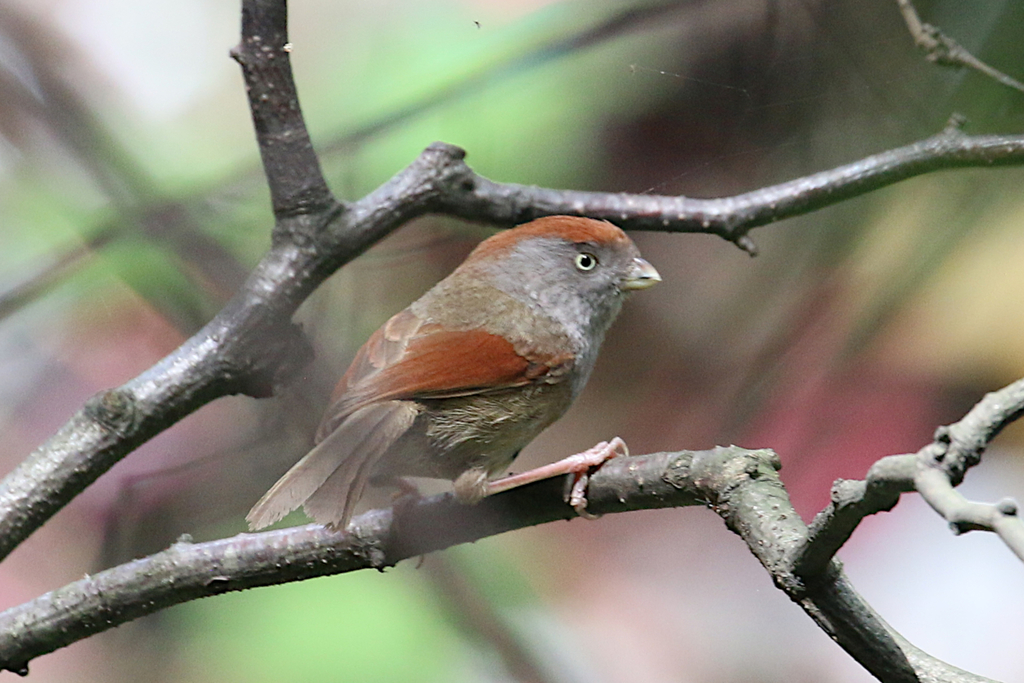
Ashy-throated Parrotbill
Live sightings near you, the range map, bar charts of when it is seen, and Macaulay Library photos and recordings.
Ashy-throated Parrotbill
Suthora alphonsiana
The ashy-throated parrotbill (Suthora alphonsiana) is a parrotbill. In old sources, it may be called Alphonse's crow-tit; though superficially resembling a tit it is not a member of the Paridae. The native range of this species extends from south-west China to northern Vietnam, and it might have become naturalised in one area in Italy.
From the article Ashy-throated parrotbill on Wikipedia (CC BY-SA), quoted section by section
Description
This is a medium-sized tawny-coloured parrotbill with the large bill typical of these birds. The specific epithet commemorates the French ornithologist Alphonse Milne-Edwards. Formerly placed with the typical warblers (Sylvia) in the Sylviidae, the Old World babblers in the Timaliidae, or the tits and chickadees in the Paridae, they are now thought to belong to a distinct parrotbill family Paradoxornithidae. They might be less close to the great parrotbill (Conostoma oemodium) than to Chrysomma, or to the fulvettas (Fulvetta) which were often included in the wastebin genus Alcippe. Another relative might be the wrentit (Chamaea fasciata), the only known American member of the Paradoxornithidae in the modern circumscription. The former two, and occasionally also the wrentit, were traditionally considered typical warblers or Old World babblers. Together with the other lineages of parrotbills, these and the golden-breasted fulvetta (Lioparus chrysotis) and species in the genus Rhopophilus form an Asian counterpart to the westward radiation of the typical warblers. Rather than two genera – Paradoxornis and the monotypic Conostoma – the parrotbills are better considered several independent lineages which show pronounced convergent evolution, due to adaptation to reedbed habitat and a more granivorous diet than their skulking warbler-like ancestor. …
Wikipedia: “Description and systematics”
What it does
Contrary to their western Eurasian relatives (the typical warblers), these East Asian birds are small omnivores adapted to living in reed beds. In its native range, the ashy-throated parrotbill inhabits bamboo stands and areas with tall grasses. The parrotbills in Brabbia Swamp Nature Reserve inhabit common reed (Phragmites australis) beds and drier land overgrown with meadowsweet (Filipendula ulmaria), grey willow (Salix cinerea) and giant goldenrod (Solidago gigantea). It feeds on arthropods, seeds and buds; in winter, the Italian birds seem to sustain themselves on insects that hibernate in reed stalks. As in its relatives in (sub)genus Sinoparadoxornis, its eggs are small by parrotbill standards, whitish- to light-blue and unspotted. This bird will disappear if wetlands are drained, but its range is considerable and much of its habitat is remote and little accessed. It is thus considered a Species of Least Concern by the IUCN.
Wikipedia: “Ecology”
Listen
Looking for field recordings…
Where it lives
Recorded sightings
—
geo-referenced records in GBIF, from museums, herbaria and field observers.
Drag the globe to turn it. Dots are where records exist, not a range map; darker means more records.
In the stacks
Searching the stacks…
Every page naming Suthora alphonsiana in the Biodiversity Heritage Library →
This page is assembled live from iNaturalist, GBIF, Wikipedia, the Source Library and the Internet Archive. It is not yet part of the hand-edited codex. iNaturalist taxon 1505906.