On eBird ↗
Buff-crested Bustard
Live sightings near you, the range map, bar charts of when it is seen, and Macaulay Library photos and recordings.
Buff-crested Bustard
Lophotis gindiana
The buff-crested bustard (Lophotis gindiana) is a medium-sized bird of East Africa; Somalia, Ethiopia, Kenya belonging to the family Otididae. The populations are stable and the species is of least concern.
From the article Buff-crested bustard on Wikipedia (CC BY-SA), quoted section by section
Description
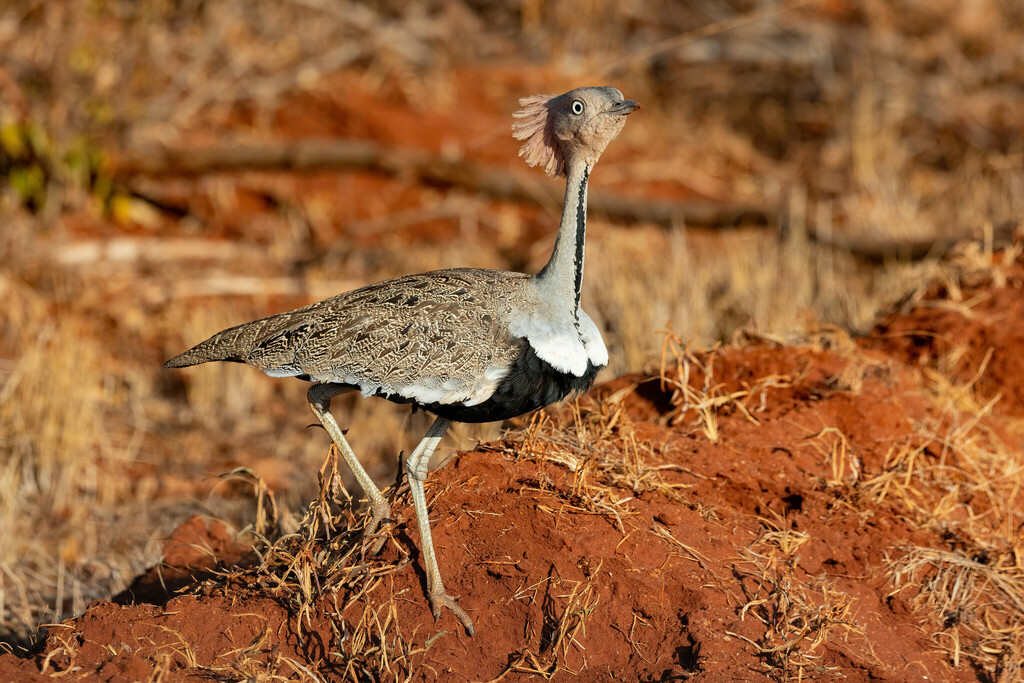
The buff-crested bustard is a medium-sized East African bird that can reach up to 60 cm (24 in) in height. Compared to other African bustards, this species is relatively small. Male buff-crested bustards weigh between 675 and 900 grams (24 and 32 oz). Mature males display a black stripe that extends from the throat to the breast. The male plumage is grey or buff, except for the black stripe and dark underside of the body. Most bustards of this family are sexually dimorphic; the male and female differ in plumage coloration and size. On the female, the line visible on the throat is duller and the overall grey coloration seen in the male is replaced by a light brown. As a result of ground-dwelling behaviour, the birds lack a hind toe and do not perch. The species gets its name from the coloured feather crest shown in males, but which is not present in females. When the bird's wings are extended, a large white patch is visible under each wing.
Range & habitat
Although they exist throughout East Africa, buff-crested bustards are most common in Ethiopia. There, they can be seen throughout the southern regions, east of the Rift Valley. The bird is a non-migrating resident in Sudan, Somalia, Eritrea, Uganda, Tanzania, and Kenya. The buff-crested bustard is sedentary and can be found in thorny scrub and arid stony desert habitats. In Kenya, it favours arid to semiarid climates, and is absent from sub-humid areas in the coastal strip. It is different from most bustards in that it is less likely to be seen in high grasses, preferring ecosystems established on stony or sandy soils. The female's coloration offers optimal camouflage in these habitats.
Wikipedia: “Habitat and distribution”
What it does
In captivity, buff-crested bustards have been fed mice, mealworms, crickets, apple, cabbage, chopped greens, bustard pellets, and game bird pellets. Their diet in the wild is inadequately studied.
Wikipedia: “Diet”
Listen
Looking for field recordings…
Where it lives
Recorded sightings
—
geo-referenced records in GBIF, from museums, herbaria and field observers.
Drag the globe to turn it. Dots are where records exist, not a range map; darker means more records.
In the stacks
Searching the stacks…
Every page naming Lophotis gindiana in the Biodiversity Heritage Library →
This page is assembled live from iNaturalist, GBIF, Wikipedia, the Source Library and the Internet Archive. It is not yet part of the hand-edited codex. iNaturalist taxon 1505964.