On eBird ↗
Black Bustard
Live sightings near you, the range map, bar charts of when it is seen, and Macaulay Library photos and recordings.
Southern Black Korhaan
Afrotis afra
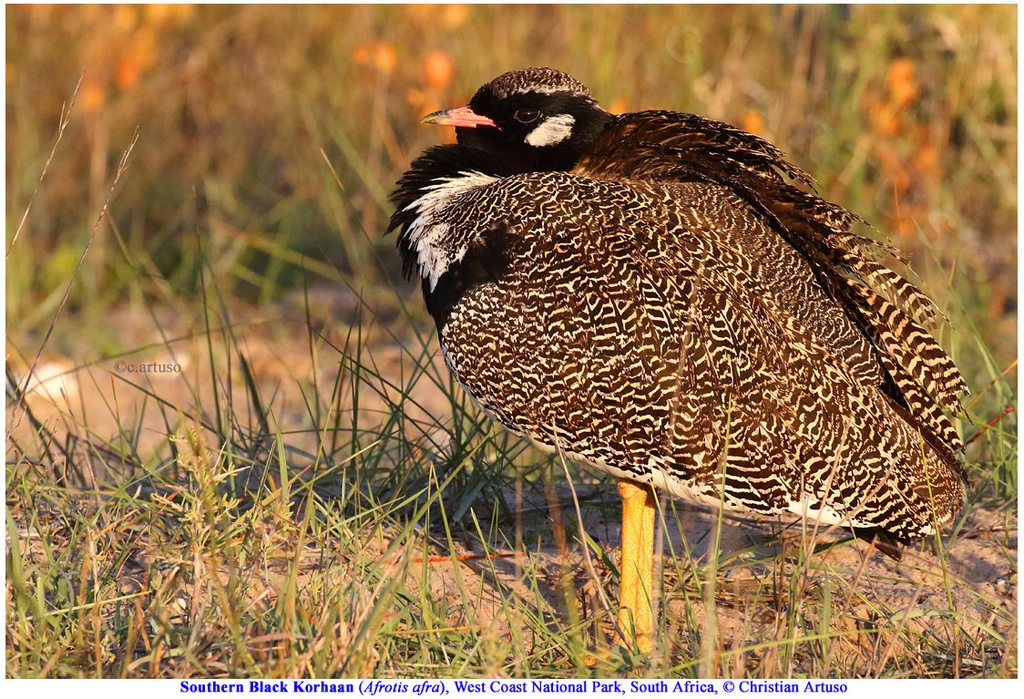
The southern black korhaan (Afrotis afra), also known as the black bustard, is a species of bird in the bustard family, Otididae. This small bustard is found in southwestern South Africa, from Namaqualand, south to Cape Town and east to Makhanda. It prefers semi-arid habitats such as grasslands, shrublands and savannas where it can easily prey on ground-dwelling arthropods and eat seeds. It reproduces yearly in the spring and will lay about one or two eggs per breeding season.
Numbers have declined rapidly as much of its habitat has been converted to agricultural land and remaining tracts are often fragmented. Due to this habitat destruction, the species is considered vulnerable by the IUCN Red List.
From the article Southern black korhaan on Wikipedia (CC BY-SA), quoted section by section
Description
The southern black korhaan is a ground-dwelling bird with some sexual dimorphism. The male's main body plumage is of a checkered black and white with a black underbelly and neck. It also displays some white on the underwings, on the cheeks and in stripes over the eyes. The female, in contrast, has the whole of her head, neck and breast the same colour as her body, which is checkered brown and white. Both the female and the male have bright yellow legs. The male is slightly larger than the female. The male has a wingspan of 27 cm (10.6 in) to 28 cm (11.0 in) and the female a wingspan of 25 cm (9.8 in) to 26 cm (10.2 in). The tail is about 12 cm (4.7 in) to 13 cm (5.1 in) long. The male's bill is larger with a length of 3.8 cm to 3.9 cm (1.5 in), while the female's is about 3.5 cm (1.4 in) long. The bill is of a reddish colour with a black tip. Lifespan averages 10 years.
Range & habitat
The southern black korhaan is endemic to southwestern South Africa, ranging from Namaqualand, south to Cape Town, and east to Makhanda. As of 2020, its estimated suitable habitat throughout its range is approximately 20,355 km2 (7,859 sq mi). It prefers open, semi-arid habitats such as shrub-lands and savannahs where it can easily prey on grass-dwelling arthropods, also grasslands adjoining marshland.
Wikipedia: “Distribution and habitat”
What it does
This is an omnivorous species. Two-thirds of its diet is made up of arthropods, and it will eat termites, beetles, grasshoppers and ants. The rest of its diet is composed of plant matter, mostly seeds. It partakes in a mutualistic relationship with Acacia cyclops, a species of Acacia; the southern black korhaan benefits from the seeds as they are a readily available food source, and in return, disperses the seeds to good germination sites. The southern black korhaan will also ingest grit and other small rocks to help in digestion by assisting the grinding process in the gizzard. A study has also shown that two thirds of birds have nematode parasites in their intestinal tract.
Wikipedia: “Diet”
Listen
Looking for field recordings…
Where it lives
Recorded sightings
—
geo-referenced records in GBIF, from museums, herbaria and field observers.
Drag the globe to turn it. Dots are where records exist, not a range map; darker means more records.
In the stacks
Searching the stacks…
Every page naming Afrotis afra in the Biodiversity Heritage Library →
This page is assembled live from iNaturalist, GBIF, Wikipedia, the Source Library and the Internet Archive. It is not yet part of the hand-edited codex. iNaturalist taxon 1505970.