On eBird ↗
Northern Royal Albatross
Live sightings near you, the range map, bar charts of when it is seen, and Macaulay Library photos and recordings.
Northern Royal Albatross
Diomedea sanfordi
The northern royal albatross or toroa, (Diomedea sanfordi) is a large seabird in the albatross family. It was split from the closely related southern royal albatross as recently as 1998, though not all scientists support that conclusion and some consider both of them to be subspecies of the royal albatross.
From the article Northern royal albatross on Wikipedia (CC BY-SA), quoted section by section
Description
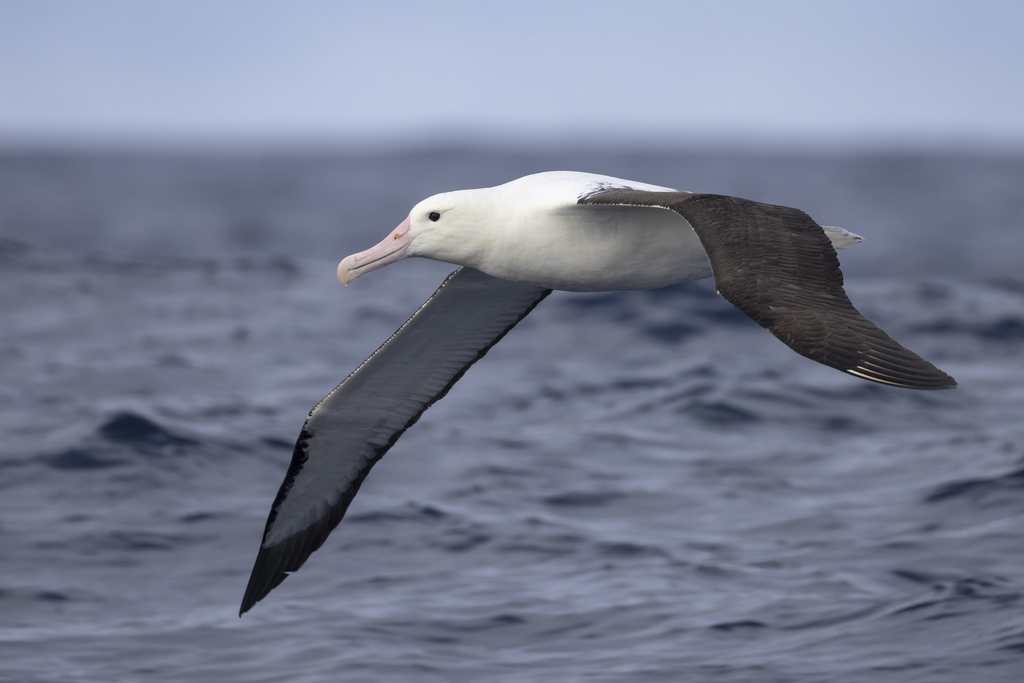
The northern royal albatross is typically about 115 cm (45 in) tall, weighs 6.2 to 8.2 kg (14–18 lb), and has a wingspan from 270 to 305 cm (106–120 in). The juvenile has a white head, neck, upper mantle, rump, and underparts. There is dark speckling on the crown and rump. Its lower mantle and back are white with more black speckling than the crown, and it has dark black-brown upper wings with white flecks on its coverts. Its tail is white with a black-brown tip, as are its underwings. There is a black band behind the leading edge of its wings between the carpal joint and the tip. As they age, their head, back, rump, tail, and scapular region whiten. All ages have a pink bill with a black cutting edge on the upper mandible, along with pale pink legs. The northern royal albatross can be distinguished from the southern at sea by its upper wings, the plumage of which is all dark compared to the large areas of white on the southern. The two species also differ in behavior.
Range & habitat
Northern royal albatrosses nest on the Chatham Islands (Forty-fours Island, Big Sister Island, and Little Sister Island), Enderby Island in the Auckland Islands, and Taiaroa Head on the Otago Peninsula of New Zealand. The Taiaroa Head colony is the only albatross colony found on a human-inhabited mainland in the Southern Hemisphere. When they are not breeding, northern royal albatrosses undertake circumpolar flights in the southern oceans, and in particular like the Humboldt Current and the Patagonian Shelf.
Wikipedia: “Range”
What it does
The northern royal albatross feeds on cephalopods, fish, crustaceans, salps, and carrion. Squids can make up 85% of their diet.
Wikipedia: “Feeding”
In human culture
Diomedea sanfordi breaks into Diomedea, referring to Diomedes, whose companions turned to birds, and sanfordi, in honor of Leonard Cutler Sanford (1868–1950), ornithologist, and trustee of the American Museum of Natural History.
Wikipedia: “Etymology”
Listen
Looking for field recordings…
Where it lives
Recorded sightings
—
geo-referenced records in GBIF, from museums, herbaria and field observers.
Drag the globe to turn it. Dots are where records exist, not a range map; darker means more records.
In the stacks
Searching the stacks…
Every page naming Diomedea sanfordi in the Biodiversity Heritage Library →
This page is assembled live from iNaturalist, GBIF, Wikipedia, the Source Library and the Internet Archive. It is not yet part of the hand-edited codex. iNaturalist taxon 1506470.