- Animals
- ›Chordates
- ›Vertebrates
- ›Birds
- ›Perching Birds
- ›Ovenbirds and Woodcreepers
- ›Typical Ovenbirds
- ›Furnarius
On eBird ↗
Pacific Hornero
Live sightings near you, the range map, bar charts of when it is seen, and Macaulay Library photos and recordings.
Pacific Hornero
Furnarius cinnamomeus
The Pacific hornero (Furnarius cinnamomeus) is a species of bird in the Furnariinae subfamily of the ovenbird family Furnariidae. It is found in Colombia, Ecuador, and Peru.
From the article Pacific hornero on Wikipedia (CC BY-SA), quoted section by section
Description
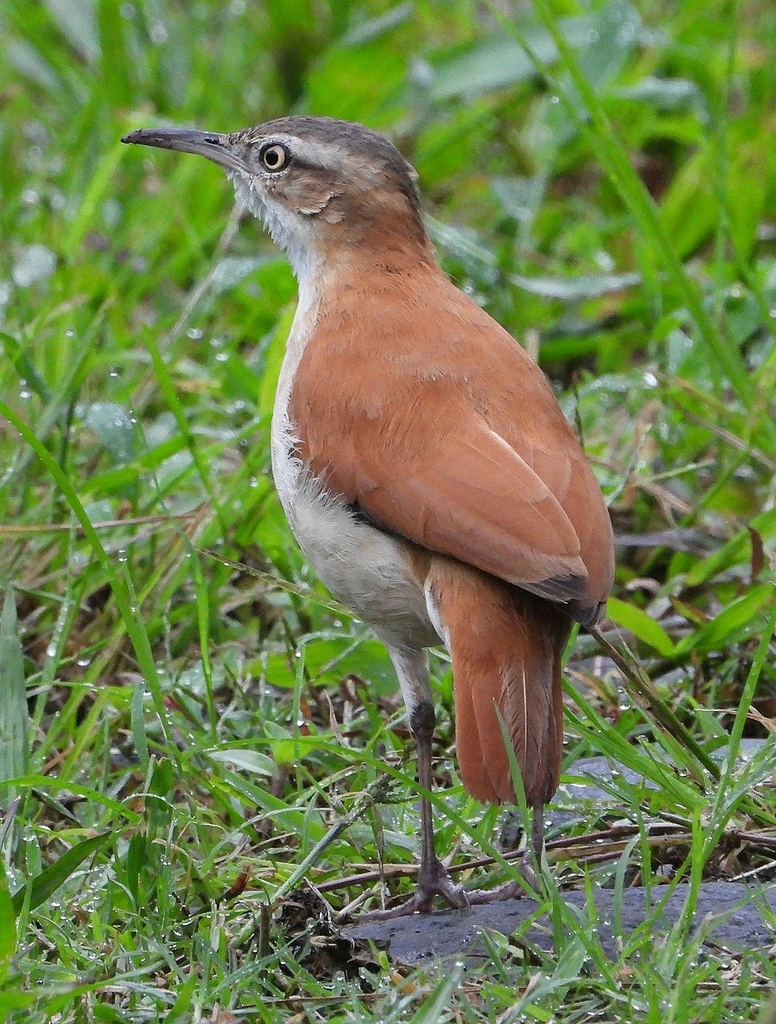
The Pacific hornero is 19 to 20 cm (7.5 to 7.9 in) long and weighs about 45 to 63 g (1.6 to 2.2 oz). It is a medium-sized hornero with a long and somewhat decurved bill. The sexes' plumages are alike. Adults have a wide whitish supercilium, a narrow brownish gray stripe through the eye, tawny ear coverts, and a tawny-rufous malar area. Their crown is gray-brown. Their back, rump, and wing and uppertail coverts are bright orange rufous. Their tail is chestnut. Their flight feathers are blackish with a wide rufous band. Their throat is white and the rest of their underparts pale cinnamon-buff. Their iris is yellow to whitish, their maxilla mostly dark, their mandible pale, and their legs and feet pale brownish gray.
Range & habitat
The Pacific hornero is found from far southwestern Colombia's Nariño Department south through western Ecuador and into northwestern Peru as far as Ancash Department. It first appeared in Colombia in 2012 and is possibly expanding its range even further north. The Pacific hornero inhabits a wide variety of semi-open to open landscapes, mostly in the lowlands. These include forest and woodlands along rivers (gallery forest), the edges of secondary forest, agricultural areas, and parks and gardens in towns. It favors areas of middling humidity, usually near water, and shuns very humid and very arid areas. In elevation it mostly occurs below 1,500 m (4,900 ft), though in Ecuador's Loja Province it reaches 2,300 m (7,500 ft) in the subtropic zone.
Wikipedia: “Distribution and habitat”
What it does
The Pacific hornero's diet is mostly a variety of arthropods. It also includes other small invertebrates like snails and there are records of the species catching small fish in shallow pools near the end of the dry season. It forages singly or in pairs while walking on the ground, turning over leaves to glean and probe for its prey.
Wikipedia: “Feeding”
Listen
Looking for field recordings…
Where it lives
Recorded sightings
—
geo-referenced records in GBIF, from museums, herbaria and field observers.
Drag the globe to turn it. Dots are where records exist, not a range map; darker means more records.
In the stacks
Searching the stacks…
Every page naming Furnarius cinnamomeus in the Biodiversity Heritage Library →
This page is assembled live from iNaturalist, GBIF, Wikipedia, the Source Library and the Internet Archive. It is not yet part of the hand-edited codex. iNaturalist taxon 1507412.