On eBird ↗
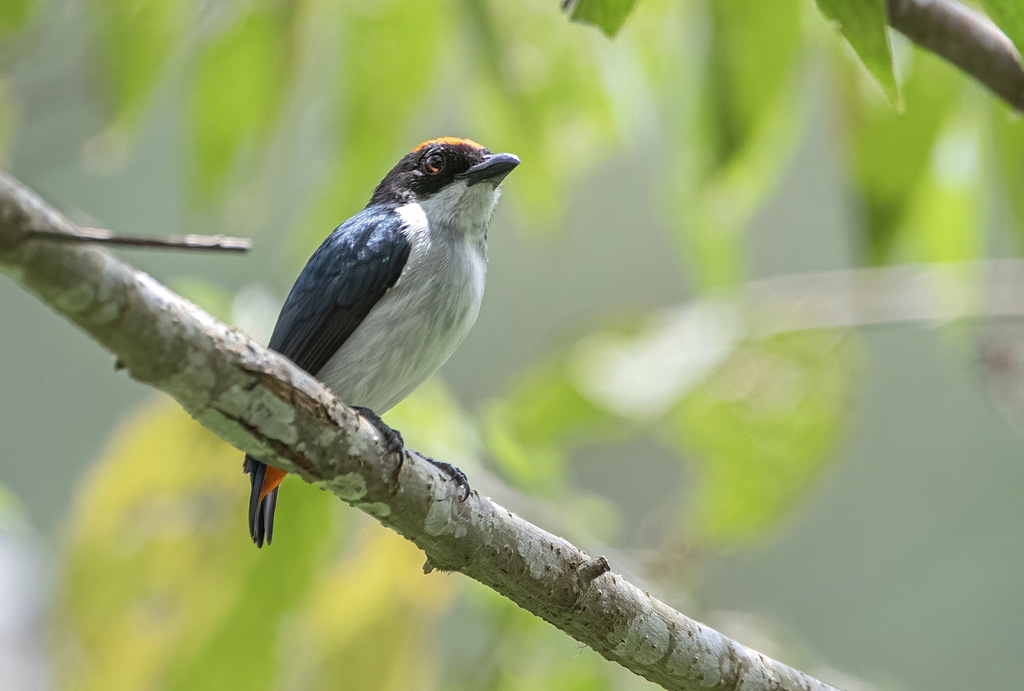
Flame-crowned Flowerpecker
Live sightings near you, the range map, bar charts of when it is seen, and Macaulay Library photos and recordings.
Flame-crowned Flowerpecker
Dicaeum kampalili
The flame-crowned flowerpecker (Dicaeum kampalili) is a species of bird in the family Dicaeidae. It is endemic to Mindanao in the Philippines. The yellow-crowned flowerpecker (Dicaeum anthonyi), which is endemic to Luzon, was formerly considered conspecific.
From the article Flame-crowned flowerpecker on Wikipedia (CC BY-SA), quoted section by section
Description
Exhibits sexual dimorphism in which males have the eponymous flame orange crown and vent while females are much more dull and have uniform olive color and does not the black upperparts This species was formerly conspecific with the Yellow-crowned flowerpecker but is now recognized as distinct species. It differs mostly in the males with its orange crown, gray throat, grayish white belly and scarlet undertail and smaller size.
Subspecies. Two subspecies are recognized:
D. k. kampalili – Found on Mindanao except Western area D. k. masawan – Found on West Mindanao; yellow tinge on breast and flanks and the abdomen is yellowish white
Wikipedia: “Description and taxonomy”
Range & habitat
It inhabits tropic moist montane forest at mossy forest above 1,300 meters above sea level. IUCN has assessed this bird as least-concern with its population being estimated as 10,000 to 19,999 mature individuals. While not considered threatened, it is still thought to be declining. Forest loss is a threat especially in its lower altitude limits which are more prone to legal and illegal logging, mining and conversion into farmland. It is recommended to investigate potential threats and quantify more precisely the population size of the species. Protect areas of suitable habitat and safeguard against deforestation.
== References ==
Wikipedia: “Habitat and conservation status”
What it does
Feeds on small fruits, the nectar of mistletoes and flowers.Found singly, in pairs or mixed species flocks with other flowerpeckers and small birds. Often observed near fruiting and flowering trees. Nest is undescribed. Juveniles have been seen from April to October.
Wikipedia: “Ecology and behavior”
Listen
Looking for field recordings…
Where it lives
Recorded sightings
—
geo-referenced records in GBIF, from museums, herbaria and field observers.
Drag the globe to turn it. Dots are where records exist, not a range map; darker means more records.
In the stacks
Searching the stacks…
Every page naming Dicaeum kampalili in the Biodiversity Heritage Library →
This page is assembled live from iNaturalist, GBIF, Wikipedia, the Source Library and the Internet Archive. It is not yet part of the hand-edited codex. iNaturalist taxon 1508346.