On eBird ↗
Cryptic Becard
Live sightings near you, the range map, bar charts of when it is seen, and Macaulay Library photos and recordings.
Cryptic Becard
Pachyramphus salvini
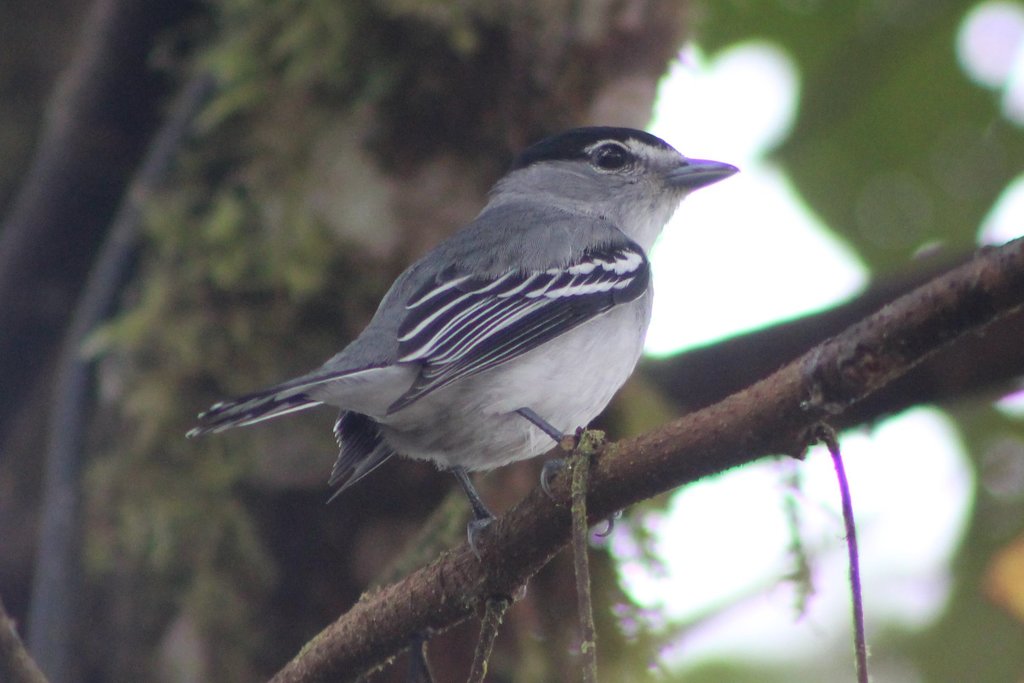
The cryptic becard (Pachyramphus salvini) is a species of bird in the family Tityridae. It is found in Ecuador and Peru. Its natural habitats are subtropical or tropical dry forests and subtropical or tropical moist montane forests.
From the article Cryptic becard on Wikipedia (CC BY-SA), quoted section by section
Description
The cryptic becard is about 14 cm (5.5 in) long and weighs an average of about 17 g (0.60 oz). Adult males have a glossy bluish black crown. They have blackish lores, a wide white stripe from above the lores to above the eye, and a thin partial white eye-ring on an otherwise grayish face. Their nape and upperparts through their uppertail coverts are gray. Their wings are mostly black with wide white edges on the secondaries, tertials, and median and greater coverts; the last two show as wing bars. Their tail has a black upper surface and a white-tipped pale gray lower surface. Their throat and underparts are whitish to pale gray that is somewhat darker on the sides. Adult females have a chestnut-brown crown with a wide black band below it. They have a white stripe from above the lores to a partial white eye-ring and a black stripe through the eye on an otherwise pale gray and yellowish olive face. Their nape is pale grayish yellow-green and their back, rump, and uppertail coverts olive. Their wings are mostly blackish with wide cinnamon edges on the secondaries and coverts and thinner cinnamon edges on the primaries. Their tail has a dusky cinnamon-brown upper surface and a darker underside with wide cinnamon feather tips. Their chin and throat are white and their underparts pale yellow to greenish yellow. …
Range & habitat
The cryptic becard is found along the western slope of the Andes from southern Antioquia Department in Colombia south through western Ecuador and on both the western and eastern slopes in northwestern Peru to La Libertad and San Martín departments. It also occurs in small numbers on the eastern slope from central Ecuador south. It inhabits rather dry thorn forest, somewhat moister semi-deciduous forest, and humid foothill and montane forest. It also occurs in secondary forest and agricultural areas like coffee plantations and pastures. In elevation it ranges between 500 and 2,400 m (1,600 and 7,900 ft) in Colombia, from sea level to 2,000 m (6,600 ft) in Ecuador, and between 1,500 and 3,200 m (4,900 and 10,500 ft) in Peru.
Wikipedia: “Distribution and habitat”
What it does
The cryptic becard feeds on arthropods and small fruits. It usually forages singly or in pairs in the upper levels of the forest and sometimes joins mixed-species feeding flocks. It takes food from foliage and twigs with short fluttery sallies from a perch or by briefly hovering at the end of a sally.
Wikipedia: “Feeding”
Listen
Looking for field recordings…
Where it lives
Recorded sightings
—
geo-referenced records in GBIF, from museums, herbaria and field observers.
Drag the globe to turn it. Dots are where records exist, not a range map; darker means more records.
In the stacks
Searching the stacks…
Every page naming Pachyramphus salvini in the Biodiversity Heritage Library →
This page is assembled live from iNaturalist, GBIF, Wikipedia, the Source Library and the Internet Archive. It is not yet part of the hand-edited codex. iNaturalist taxon 1508945.