On eBird ↗
Wrentit
Live sightings near you, the range map, bar charts of when it is seen, and Macaulay Library photos and recordings.
Wrentit
Chamaea fasciata
The wrentit (Chamaea fasciata) is a small bird that lives in chaparral, oak woodlands, and bushland on the western coast of North America, from Oregon south through California to northern Baja California. It is the only species in the genus Chamaea.
Its systematics have been the subject of much debate, the wrentit having been placed in many different families by different authors for as long as it has been known to science. Its common name reflects the uncertainty, and its external resemblance to both tits and wrens. It is not related to either, however. More recent and comprehensive phylogenetic studies support it belonging to the parrotbill family Paradoxornithidae.
From the article Wrentit on Wikipedia (CC BY-SA), quoted section by section
Description
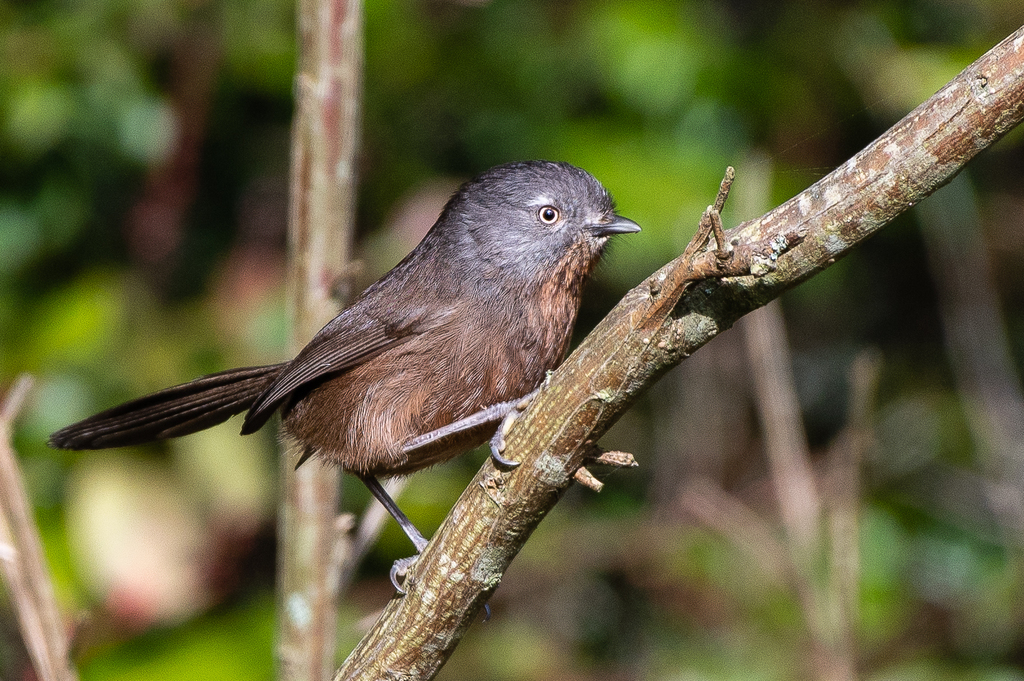
The wrentit is a small, 14–16 cm (5.5–6.3 in) bird with uniform dull olive, brown, or grayish plumage. It has short wings and a long tail often held high (hence the comparison to wrens). It has a short bill and a pale iris. Given its retiring nature and loud voice, the wrentit is more likely to be detected by its call than by sight. The distinct sound that it makes is similar to the sound of a ping-pong ball falling on the table.
Range & habitat
The wrentit is a sedentary (non-migratory) resident of a narrow strip of coastal habitat along the western coast of North America, being found from Oregon south through California, to Baja California, the northern state of the Baja California peninsula. It is usually restricted to certain chaparral and woodland habitats. It nests in 1 meter (3 ft) high shrubs such as poison oak (Toxicodendron diversilobum), coyote bush (Baccharis pilularis) and California blackberry (Rubus ursinus). Logging and other changes in habitat have led to this species expanding its range recently, particularly northwards. Although present along the entire Oregon coast right up to the north end of Clatsop Spit, its poor dispersive ability has resulted in it never crossing the Columbia River into Washington.
Subspecies. Five subspecies are accepted:
Chamaea fasciata phaea Osgood, WH, 1899 — coastal western Oregon (Columbia River to California border) Chamaea fasciata margra Browning, MR, 1992 — interior western Oregon (Willamette Valley) Chamaea fasciata rufula Ridgway, R, 1903 — coastal northern California (Del Norte to Marin counties) Chamaea fasciata fasciata (Gambel, W, 1845) — interior California from Lake County (northern Central Valley) south to the San Francisco Bay region, then south along the coast to San Luis Obispo County Chamaea fasciata henshawi Ridgway, R, 1882 — interior of northern Cal …
Wikipedia: “Distribution”
What it does
Wrentits mate for life, forming pair bonds only a few months after hatching. Both sexes sing; the faster rhythm of the male's song is one of the few ways to differentiate the sexes. Both sexes also defend their territory year-round and participate in building the nest, a four-stage process that takes about two weeks. The three or four eggs are incubated for 14 days, again by both sexes. The chicks fledge after 15 days (at which stage they are unable to fly) and are fed by their parents for another 40 days. The wrentit feeds by skulking through dense scrub gleaning exposed insects found by sight. It feeds primarily on beetles, caterpillars, bugs, and ants, but also takes small berries and seeds.
Wikipedia: “Ecology”
Listen
Looking for field recordings…
Where it lives
Recorded sightings
—
geo-referenced records in GBIF, from museums, herbaria and field observers.
Drag the globe to turn it. Dots are where records exist, not a range map; darker means more records.
In the stacks
Searching the stacks…
Every page naming Chamaea fasciata in the Biodiversity Heritage Library →
This page is assembled live from iNaturalist, GBIF, Wikipedia, the Source Library and the Internet Archive. It is not yet part of the hand-edited codex. iNaturalist taxon 15256.