- Animals
- ›Chordates
- ›Vertebrates
- ›Ray-finned Fishes
- ›Salmons, Pikes and Mudminnows
- ›Salmons, Trouts, and Whitefishes
- ›Salmons, Trouts, and Whitefishes
- ›Salmons and Trouts
- ›Oncorhynchus
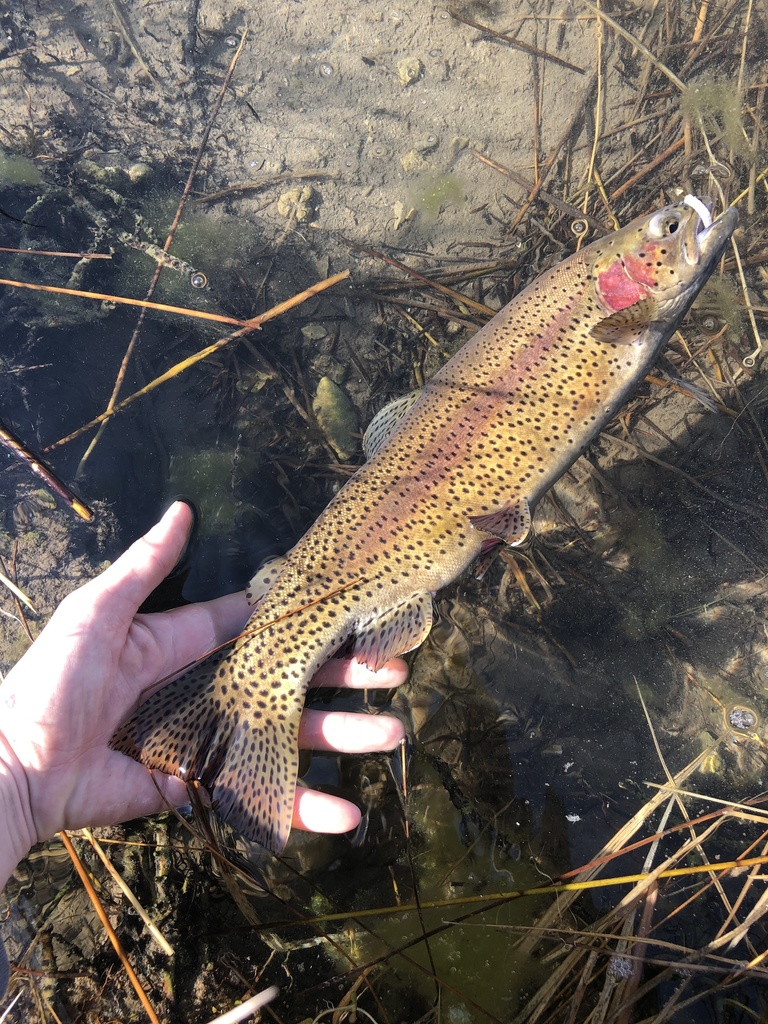
Lahontan Cutbow
Oncorhynchus mykiss × henshawi
A cutbow (Oncorhynchus clarkii × mykiss) is an interspecific fertile hybrid between a rainbow trout (Oncorhynchus mykiss) and a cutthroat trout (O. clarkii). Cutbow hybrids may occur naturally where the native ranges of both species overlap, such as between coastal rainbow trout (O. mykiss irideus) and coastal cutthroat trout (O. clarkii clarkii) and between Columbia River redband trout (O. mykiss gardineri) and westslope cutthroat trout (O. clarkii lewisi). While natural separation of spawning habitat limited hybridization...
From the article Cutbow on Wikipedia (CC BY-SA), quoted section by section
Description
Like most fish hybrids, cutbow are difficult to identify based on external characteristics alone. This is further complicated by phenotypic variation of cutthroat trout across their range. Subsequently, many anglers confuse cutbow with rainbow or cutthroat trout. Cutbow generally have a reddish or orange slash under the jaw like cutthroat trout, but the slash is usually fainter than would be expected in a pure cutthroat trout. In some populations such as Yellowstone cutthroat trout (Oncorhynchus virginalis bouvierii), a white leading edge on the anal or dorsal fin suggests hybridization with rainbow trout. In crosses between coastal cutthroat trout and rainbow trout, the presence of hyoid teeth and jaw slash intensity can be useful external traits to identify potential hybridization.
What it does
In a hatchery setting, cutbow are created when the female cutthroat trout's eggs are fertilized by a male rainbow trout. Spawning cutthroat trout may experience prolonged spatial and temporal overlap with spawning rainbow trout, thus increasing the likelihood for hybridization.
Wikipedia: “Reproduction”
In human culture
Cutbow can occur naturally where the native ranges of both parent species overlap, such as between coastal rainbow trout (O. mykiss irideus) and coastal cutthroat trout (O. clarkii) and between Columbia River redband trout (O. mykiss gardineri) and westslope cutthroat trout (O. lewisi). However, stocking of nonnative rainbow trout in watersheds that contained cutthroat trout throughout the 19th and 20th centuries increased the occurrence of cutbow in North America. Increased hybridization imperiled or extirpated many populations of cutthroat trout, and hybridization was recognized as problematic by early North American ichthyologists and fishery scientists.
Wikipedia: “History”
Where it lives
Recorded sightings
—
geo-referenced records in GBIF, from museums, herbaria and field observers.
Drag the globe to turn it. Dots are where records exist, not a range map; darker means more records.
In the stacks
This page is assembled live from iNaturalist, GBIF, Wikipedia, the Source Library and the Internet Archive. It is not yet part of the hand-edited codex. iNaturalist taxon 1529902.