On eBird ↗
Garden Warbler
Live sightings near you, the range map, bar charts of when it is seen, and Macaulay Library photos and recordings.
Garden Warbler
Sylvia borin
The garden warbler (Sylvia borin) is a common and widespread small bird that breeds in most of Europe and in the Palearctic to western Siberia. It is a plain, long-winged and long-tailed warbler with brown upperparts and dull white underparts; the sexes are similar and juveniles resemble the adults. Its two subspecies differ only slightly and interbreed where their ranges overlap. Due to its lack of distinguishing features, this species can be confused with a number of other unstreaked warblers. The garden warbler's rich melodic song is similar to that of the blackcap, its closest relative, which competes with it for territory when nesting in the same woodland.
The preferred breeding habitat in Eurasia is open woodland with dense low cover for nesting; despite its name, gardens are rarely occupied by this small passerine bird. The clutch of four or five blotched cream or white eggs is laid in a robust cup-shaped nest built near the ground and concealed by dense vegetation. The eggs are incubated for 11–12 days. The chicks are altricial, hatching naked and with closed eyes, and are fed by both parents. They fledge about 10 days after hatching. Only about a quarter of young birds survive their first year. The garden warbler is strongly migratory, wintering in sub-Saharan Africa. A wide range of habitats are used in Africa, but closed forest and treeless Sahel are both shunned. Insects are the main food in the breeding season, although fruit predominates when birds are fattening prior to migration, figs being a particular favourite where available.
From the article Garden warbler on Wikipedia (CC BY-SA), quoted section by section
Description
The garden warbler is 14 cm (5.5 in) long with a 7.6–8.4 cm (3.0–3.3 in) wing length. The weight is typically 16–22 g (0.56–0.78 oz), but can be up to 35.5 g (1.25 oz) for birds preparing to migrate. It is a plain, long-winged and long-tailed bird with unstreaked olive-brown upperparts and dull white underparts. It has a whitish eyering and a faint pale supercilium, and there is a buff wash to the throat and flanks. The eye is black, the legs are bluish-grey and the strong bill has a grey upper and paler grey lower mandible. The male and female are indistinguishable by external appearance including size. Juveniles have a looser plumage than an adult, with paler and greyer upperparts and a buff tone to the underparts. The eastern subspecies S. b. woodwardi is slightly larger and paler than the nominate form with a greyer tone to the upperparts and whiter underparts. The subspecies are hard to distinguish visually where they occur together in Africa, but a wing length greater than 80 mm (3.1 in) confirms S. b. woodwardi when birds are trapped. The plain appearance of the garden warbler means that it can be confused with several other species. The melodious and icterine warblers usually have long bills and a yellowish tint to their plumage. The booted warbler is similar in colour, although it is smaller, more delicately built and has a flesh-coloured bill. …
Range & habitat
The garden warbler breeds in most of Europe between the 12–28 °C (54–82 °F) isotherms and east across temperate Asia to the Yenisei River in Siberia. Its range extends further north than any other Sylvia warbler. All populations are migratory, wintering in sub-Saharan Africa as far south as South Africa. Birds from central Europe initially migrate to the southwest, reorientating to the south or southeast once in Africa, although Scandinavian migrants may head south through the Alps and across the Mediterranean Sea. S. b. woodwardi reaches Africa by a more easterly route, many birds passing through the Arabian Peninsula. When garden warblers cross the Sahara, they fly at night, resting motionless and without feeding in suitable shade during the day. During their journey, they can metabolise not only body fat but also up to 19% of their breast and leg muscles and 39% of their digestive tract. Many birds pause for a few days to feed after the desert crossing before continuing further south. The nominate subspecies occurs in the western and central parts of the winter range, although some birds occur as far east as Kenya. S. b. woodwardi winters in eastern and southern Africa. Movements in Africa are poorly known, although at least some birds return to the same location in subsequent years. …
Wikipedia: “Distribution and habitat”
What it does
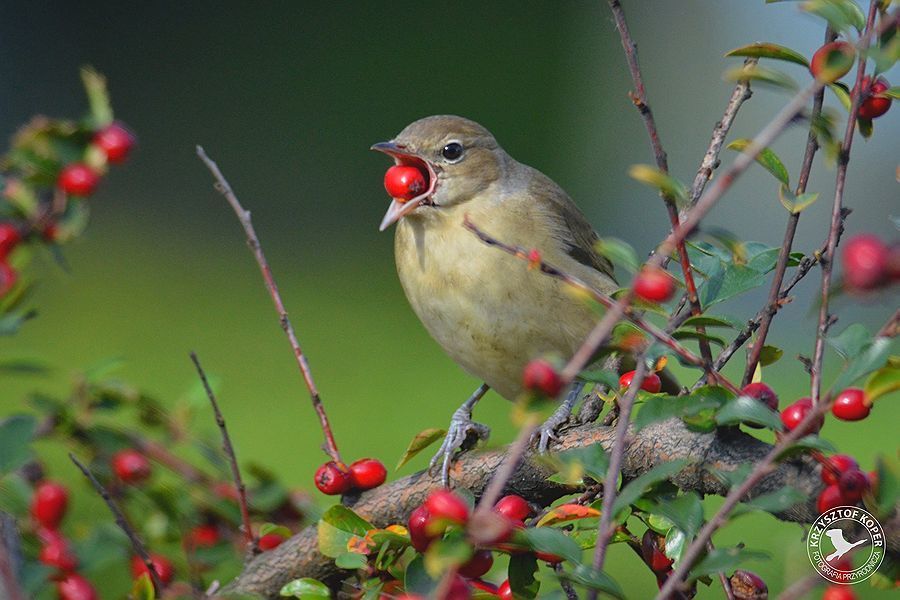
The garden warbler feeds mainly on insects in the breeding season, although other small invertebrates such as spiders are also eaten. It picks its prey off leaves and twigs, sometimes hovering to do so. It normally forages at less than 6 m (20 ft) above the ground. After nesting, there is a genetically controlled switch to a fruit diet, although insects are still consumed while the birds fatten prior to migration; birds gain weight more rapidly from a diet containing both fruit and insects than either alone. Berries and other soft fruit are preferred, and figs are particularly important for birds preparing to migrate. This predilection gives rise to the Italian beccafico (fig pecker) and Portuguese felosa-das-figueiras (fig-tree warbler) as names for this species. On this diet a bird can gain weight quickly and the liver increases the rate at which it produces fatty acids for storage in adipose tissue. In Africa, the warbler eats insects as well as berries, and the fruits of the introduced Spanish flag is a favourite where present. An increase in body mass occurs again before the northward migration, birds fattening even more rapidly than prior to their southward journey. …
Wikipedia: “Feeding”
In human culture
In his History of Animals, Aristotle considered that the garden warbler eventually metamorphosed into a blackcap. The composer Olivier Messiaen used the song of the garden warbler as the basis for his 1971 solo piano piece La fauvette des jardins, the title being the French name of the species. His Turangalîla-Symphonie, a major work inspired by the legend of Tristan and Iseult, has a summer garden scene as its sixth movement. This features the song of the warbler, along with those of the nightingale and blackbird. The garden warbler is prized as a gastronomic delicacy in Mediterranean countries. French epicure Jean Anthelme Brillat-Savarin said of the warbler when cooked like ortolan bunting "if it were the size of a pheasant, it would be worth an acre of land". An Italian stuffed sardine dish sarde a beccafico derives its name from its supposed resemblance to the cooked birds, known in that country as beccafico, fig-pecker. Old names for the garden warbler, such as strawsmear, small straw and haychat, are often derived from its choice of nesting material, although the commonest of the English folk names was "pettychaps". These names were often shared with other warblers including the blackcap, common whitethroat and common chiffchaff.
Wikipedia: “In culture”
Listen
Looking for field recordings…
Where it lives
Recorded sightings
—
geo-referenced records in GBIF, from museums, herbaria and field observers.
Drag the globe to turn it. Dots are where records exist, not a range map; darker means more records.
In the stacks
Searching the stacks…
Every page naming Sylvia borin in the Biodiversity Heritage Library →
This page is assembled live from iNaturalist, GBIF, Wikipedia, the Source Library and the Internet Archive. It is not yet part of the hand-edited codex. iNaturalist taxon 15302.