On eBird ↗
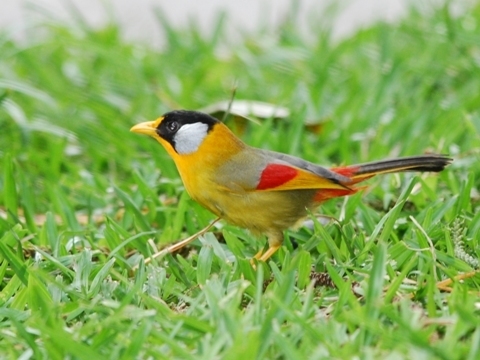
Silver-eared Mesia
Live sightings near you, the range map, bar charts of when it is seen, and Macaulay Library photos and recordings.
Silver-eared Mesia
Leiothrix argentauris
The silver-eared mesia (Leiothrix argentauris) is a species of bird from South East Asia.
From the article Silver-eared mesia on Wikipedia (CC BY-SA), quoted section by section
Range & habitat
The species was once placed in the large Old World babbler family Timaliidae, but that family has recently been split with this species being placed with the laughingthrushes in the new family Leiothrichidae. The species is sometimes placed in its own genus Mesia, or in the genus Leiothrix with the red-billed leiothrix. There are seven described subspecies, with considerable variation in plumage between them. Further research is needed to establish if this represents a single species or not. The subspecies and their distributions are:
M argentauris argentauris (Hodgson, 1837) - Northern and eastern India, Bhutan, northern Burma and southern China. M argentauris galbana (Mayr & Greenway, 1938) - Southern Burma and northern Thailand M argentauris ricketti (La Touche, 1923) - China (Yunnan, Guixhou & Guangxi), and northern Laos and Vietnam. M argentauris cunhaci (Robinson & Kloss, 1919) - Southern Laos & Vietnam, Cambodia. M argentauris tahanensis (Yen Kwokyung, 1934) - Southern Thailand and Peninsular Malaysia. M argentauris rookmakeri (Junge, 1948) - Northern Sumatra. M argentauris laurinae (Salvadori, 1879) - Southern Sumatra. The species is generally resident although it has been reported as a winter migrant to Nameri National Park in Assam, India, which implies that the species may be an altitudinal migrant. …
Wikipedia: “Taxonomy and distribution”
What it does
The diet of the silver-eared mesia is dominated by insects and their larvae, as well as fruit and to a lesser extent seeds. A study of the diet of feral birds in Hong Kong found that 87% of the faecal samples studied had the remains of insects in them, and 97% had the remains of fruit. The species will often associate in large groups of up to thirty individuals while foraging, and even forms groups during the breeding season. They will also join large flocks of other species in the forest, known as waves, which include other species of babblers. They generally feed closer to the ground, but may go as high as 5 metres up into the canopy.
Wikipedia: “Diet”
Listen
Looking for field recordings…
Where it lives
Recorded sightings
—
geo-referenced records in GBIF, from museums, herbaria and field observers.
Drag the globe to turn it. Dots are where records exist, not a range map; darker means more records.
In the stacks
Searching the stacks…
Every page naming Leiothrix argentauris in the Biodiversity Heritage Library →
This page is assembled live from iNaturalist, GBIF, Wikipedia, the Source Library and the Internet Archive. It is not yet part of the hand-edited codex. iNaturalist taxon 15559.