- Animals
- ›Chordates
- ›Vertebrates
- ›Ray-finned Fishes
- ›Spiny-rayed fishes
- ›Gobies, cardinalfishes and allies
- ›Gobies and allies
- ›Mudskippers and Allies
- ›Estuarine Gobies
- ›Triaenopogon
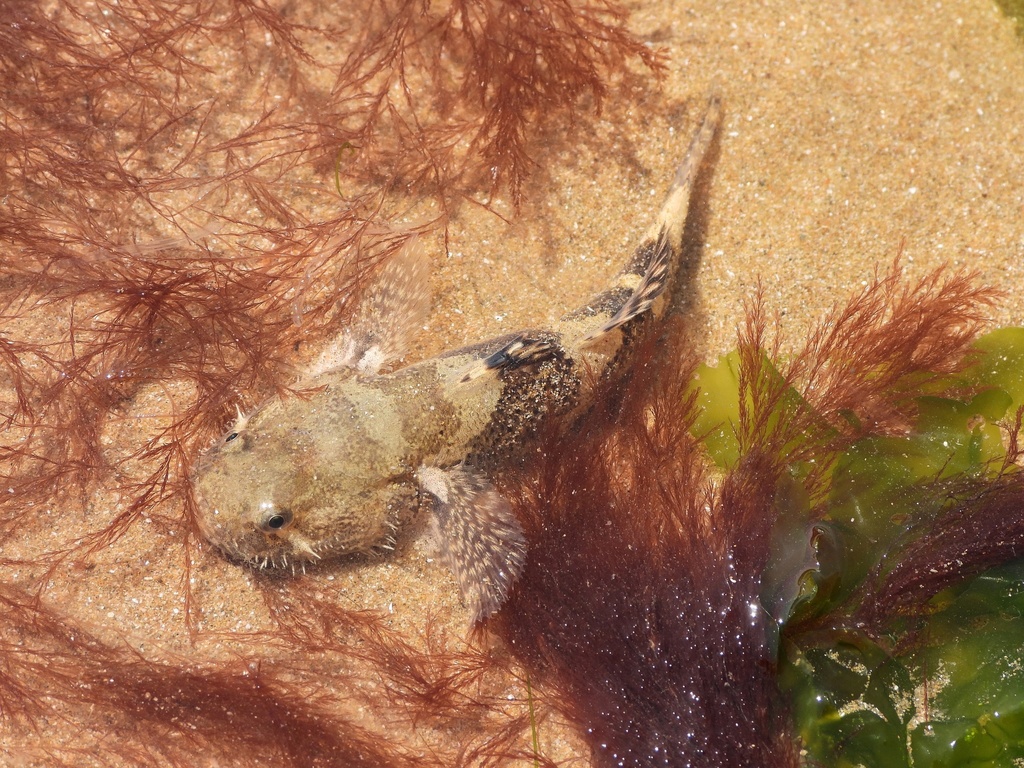
Shokihaze Goby
Triaenopogon barbatus
The Shokihaze goby (Triaenopogon barbatus) is a small fish species that bears a superficial resemblance to sculpins but can be distinguished by specific morphological features. One notable characteristic is the presence of fused pelvic fins, which form a suction cup, a feature not found in sculpins. Additionally, Shokihaze gobies have barbels on their heads, specifically below the eyes and along the lower jaw which help differentiate them from other similar species.
From the article Shokihaze goby on Wikipedia (CC BY-SA), quoted section by section
Description
The Shokihaze goby can be further distinguished from other introduced species in the Tridentiger genus, such as the Shimofuri goby (T. bifasciatus) and the Chameleon goby (T. trigonocephalus). While the Shokihaze goby displays approximately six vertical or diagonal dusky bars along its body, the other two species feature dark horizontal stripes instead of bars. The presence of barbels is also unique to T. barbatus compared to its counterparts.
Typical size. This species can reach a length of 5.2 centimetres (2.0 in) SL. Juvenile and adult of the Shokihaze Goby have total length (TL) ranging from 13 to 121 mm (0.51 to 4.76 in).
Wikipedia: “Morphology”
Range & habitat
Shokihaze goby is a species of goby native to marine and brackish waters along the coasts of eastern Asia, specifically it is native to China. It has also been introduced to the San Francisco Bay in California, United States. Both the State Water Project (SWP) and Central Valley Project (CVP) export water from the Sacramento-San Joaquin Delta. These water conveyance systems provide potential pathways for species dispersal into southern California. One notable example of this is the expansion of the shimofuri goby, which was facilitated by the State Water Project.
Wikipedia: “Geographical Range”
What it does
Triaenopogon barbatus is a benthic species primarily feeding on invertebrates and small fish. Its diet mainly consists of benthic invertebrates such as polychaete worms and crustaceans, as well as small fishes. In California, the shokihaze goby's diet is more diverse, including gammarid amphipods, copepods, mysids, isopods, and clam siphons. Notably, it has been observed to consume polyps of the non-native hydrozoan Cordylophora caspia, which can make up to 10% of the total gut content weight during certain seasons.
Wikipedia: “Diet”
Where it lives
Recorded sightings
—
geo-referenced records in GBIF, from museums, herbaria and field observers.
Drag the globe to turn it. Dots are where records exist, not a range map; darker means more records.
In the stacks
Searching the stacks…
Every page naming Triaenopogon barbatus in the Biodiversity Heritage Library →
This page is assembled live from iNaturalist, GBIF, Wikipedia, the Source Library and the Internet Archive. It is not yet part of the hand-edited codex. iNaturalist taxon 1556600.