On eBird ↗
Blackish-gray Antshrike
Live sightings near you, the range map, bar charts of when it is seen, and Macaulay Library photos and recordings.
Blackish-gray Antshrike
Thamnophilus nigrocinereus
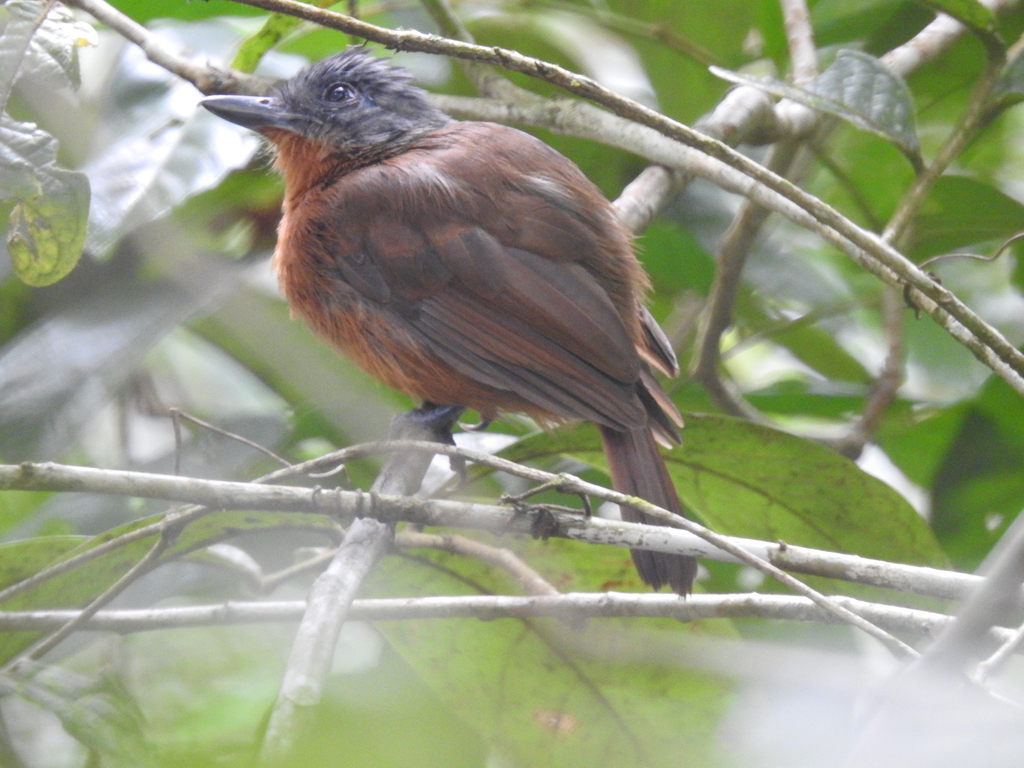
The blackish-grey antshrike (Thamnophilus nigrocinereus) is a species of bird in subfamily Thamnophilinae of family Thamnophilidae, the "typical antbirds". It is found in Brazil, Colombia, French Guiana and Venezuela.
From the article Blackish-grey antshrike on Wikipedia (CC BY-SA), quoted section by section
Description
The blackish-grey antshrike is 15 to 17 cm (5.9 to 6.7 in) long and weighs 28 to 32 g (0.99 to 1.1 oz). Members of genus Thamnophilus are largish members of the antbird family; all have stout bills with a hook like those of true shrikes. This species exhibits sexual dimorphism. Adult males of the nominate subspecies T. n. nigrocinereus are generally blackish gray. Their crown is black; their back is lighter than their crown, darker than their rump, and has a hidden white patch between their scapulars. Their wings have a brownish tinge. Their scapulars, wing coverts, and flight feathers have white edges and their tail feathers have white tips. Their rump and belly are lighter than their back. Adult females have a blackish gray crown and face. Their upperparts are dark gray with a reddish brown tinge, their wings and tail are brown, and their underparts are a reddish brown that is darkest across their breast. The other subspecies of the blackish-grey antshrike differ from the nominate and each other thus:
T. n. cinereoniger: males paler overall than the nominate with a slaty gray back with black mixed in and white tips on their crissum feathers; females have dark rufous-brown upperparts and orange-rufous underparts T. n. kulczynskii: males like the nominate; females have a blackish head, olive-brown upperparts, and a grayish belly and crissum T. n. …
Range & habitat
The blackish-grey antshrike is a bird of the northern Amazon Basin. The subspecies are found thus:
T. n. cinereoniger: Meta River drainage in east-central Colombia, upper Orinoco River and its tributary Caura River in southwestern Venezuela, and the Negro River and its tributary the Vaupés River in northwestern Brazil T. n. kulczynskii: eastern French Guiana and adjoining extreme northern Amapá state in Brazil T. n. nigrocinereus: eastern Brazil from lower Tapajós River east along the Amazon and its tributaries to the Amazon Delta in Amapá T. n. tschudii: lower Madeira River drainage in eastern Amazonas state of west-central Brazil T. n. huberi: lower Tapajós River in western Pará state of east-central Brazil The blackish-grey antshrike inhabits a variety of landscapes, most of which are forested and closely tied to rivers. In all habitats it favors the understorey to mid-storey. In Colombia and Venezuela it mostly occurs in seasonally flooded savanna woodland on white-sand soils and in gallery forest. In coastal French Guiana it occurs in mangroves and further inland along river edges. In the Brazilian Amazon basin it occurs on river islands and riverside "mainland" várzea and igapó forest and also around the edges of clearings near rivers. On larger island in the Amazon Delta it occurs on higher ground that is surrounded by seasonally flooded lower areas. …
Wikipedia: “Distribution and habitat”
What it does
The blackish-grey antshrike feeds on insects and other arthropods. It usually forages singly or in pairs and seldom joins mixed-species feeding flocks. The best-known subspecies, T. n. cinereoniger, usually forages within 0.3 m (1 ft) of the ground but does feed as high as 3 m (10 ft). It forages while hopping among branches and with short flights, commonly reaching or making short jumps from a perch. It often drops onto prey on the ground. Subspecies T. n. kulczynskii more often forages between 3 and 10 m (10 and 33 ft) in mangroves. In Brazilian Amazonia the species forages up into the forest's mid-storey.
Wikipedia: “Feeding”
Listen
Looking for field recordings…
Where it lives
Recorded sightings
—
geo-referenced records in GBIF, from museums, herbaria and field observers.
Drag the globe to turn it. Dots are where records exist, not a range map; darker means more records.
In the stacks
Searching the stacks…
Every page naming Thamnophilus nigrocinereus in the Biodiversity Heritage Library →
This page is assembled live from iNaturalist, GBIF, Wikipedia, the Source Library and the Internet Archive. It is not yet part of the hand-edited codex. iNaturalist taxon 15755.