On eBird ↗
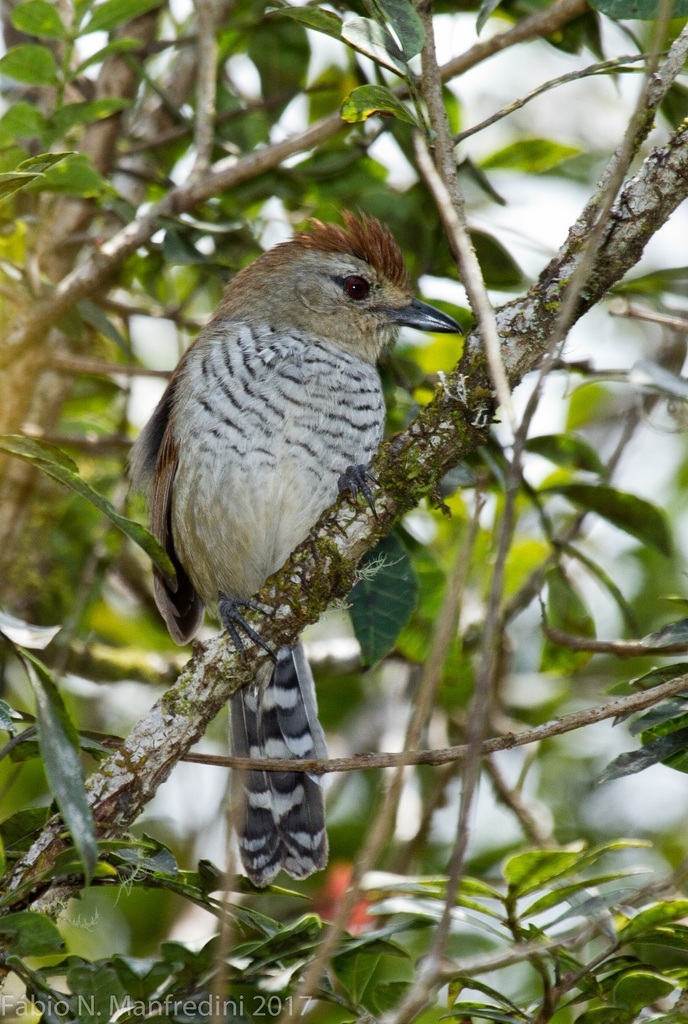
Rufous-capped Antshrike
Live sightings near you, the range map, bar charts of when it is seen, and Macaulay Library photos and recordings.
Rufous-capped Antshrike
Thamnophilus ruficapillus
The rufous-capped antshrike (Thamnophilus ruficapillus) is a species of bird in the family Thamnophilidae. It is found in Argentina, Bolivia, Brazil, Paraguay, Peru, and Uruguay. Its natural habitats are subtropical or tropical moist montane forests, subtropical or tropical moist shrubland, and subtropical or tropical high-altitude shrubland.
From the article Rufous-capped antshrike on Wikipedia (CC BY-SA), quoted section by section
Description
The rufous-capped antshrike is 15 to 17 cm (5.9 to 6.7 in) long and weighs 16.3 to 25 g (0.57 to 0.88 oz). Members of genus Thamnophilus are largish members of the antbird family; all have stout bills with a hook like those of true shrikes. This species exhibits significant sexual dimorphism. Adult males of the nominate subspecies T. r. ruficapillus have a chestnut crown and a buffy gray face and throat with faint dusky mottling and bars. Their upperparts are dark brown. Their wings are rufous-brown. Their tail is brownish black with white tips and bars on the inner webs of the outer feathers. Their underparts are mostly buff-tinged white, with black bars on the breast and sides. Their flanks and undertail coverts are buff with an olive tinge. Adult females are much like males but have a cinnamon-brown crown, a rufous-brown tail with no white, and faint or no barring on their breast. Males of subspecies T. r. cochabambae have a chestnut crown, a buffy white face and throat with light gray streaks, medium gray upperparts, and a more extensively barred tail than the nominate. Their breast and sides are buffy with black bars, their belly buffish white, and their flanks and undertail coverts a mix of light buff and gray. Females have olivaceous upperparts. …
Range & habitat
The rufous-capped antshrike has a disjunct distribution. The subspecies are found thus:
Thamnophilus ruficapillus jaczewskii: Andes of northern Peru in the departments of Cajamarca, Amazonas, and San Martín Thamnophilus ruficapillus marcapatae: eastern slope of the Andes of southern Peru in Cuzco and Puno departments Thamnophilus ruficapillus subfasciatus: eastern slope of the Andes of northwestern Bolivia's La Paz and western Cochabamba departments Thamnophilus ruficapillus cochabambae: eastern slope of the Andes from eastern Cochabamba in Bolivia southeast through Santa Cruz Department into northwestern Argentina as far as Tucumán Province Thamnophilus ruficapillus ruficapillus: southeastern Brazil from eastern Minas Gerais and Espírito Santo south and west into eastern Paraguay, northeastern Argentina as far as Buenos Aires Province, and Uruguay The rufous-capped antshrike inhabits a variety of landscapes that differ geographically. In the Andes of Peru and northern Bolivia it occurs in semi-humid montane forest, secondary forest, and scrublands. It favors the forest edge but in northern Peru it also occurs in its interior. In the Andes from southern Bolivia into Argentina it continues in those habitats but also occurs in scrub and forest along watercourses in more open areas. …
Wikipedia: “Distribution and habitat”
What it does
The rufous-capped antshrike's diet has not been detailed but is mostly insects; fruits are also eaten. It usually forages singly and in pairs, mostly in the understorey within 2 m (7 ft) of the ground though sometimes as high as 7 m (23 ft). It hops through vegetation, gleaning prey from leaves, stems, vines, and branches by reaching and sometimes making short upward sallies from a perch. It has been observed dropping to the ground to pick prey from the surface of leaf litter.
Wikipedia: “Feeding”
Listen
Looking for field recordings…
Where it lives
Recorded sightings
—
geo-referenced records in GBIF, from museums, herbaria and field observers.
Drag the globe to turn it. Dots are where records exist, not a range map; darker means more records.
In the stacks
Searching the stacks…
Every page naming Thamnophilus ruficapillus in the Biodiversity Heritage Library →
This page is assembled live from iNaturalist, GBIF, Wikipedia, the Source Library and the Internet Archive. It is not yet part of the hand-edited codex. iNaturalist taxon 15758.