On eBird ↗
Black Antshrike
Live sightings near you, the range map, bar charts of when it is seen, and Macaulay Library photos and recordings.
Black Antshrike
Thamnophilus nigriceps
The black antshrike (Thamnophilus nigriceps) is a species of insectivorous bird in subfamily Thamnophilinae of family Thamnophilidae, the "typical antbirds". It is found in Colombia and Panama.
From the article Black antshrike on Wikipedia (CC BY-SA), quoted section by section
Description
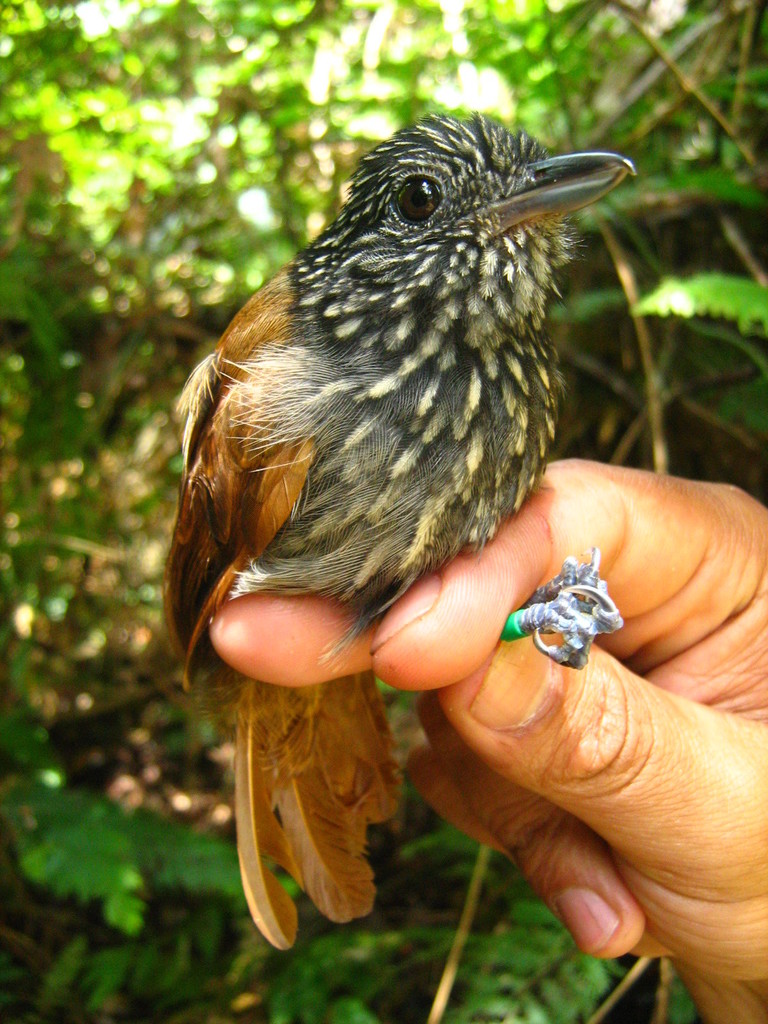
The black antshrike is 15 to 16 cm (5.9 to 6.3 in) long and weighs 23 to 24 g (0.81 to 0.85 oz). Members of genus Thamnophilus are largish members of the antbird family; all have stout bills with a hook like those of true shrikes. This species exhibits some sexual dimorphism. Adult males are almost entirely black. They have dark gray flanks and their underwing coverts and edges of the underside of their flight feathers are white. Adult females have a blackish gray head and upper breast with buff-white streaks. Their upperparts, wings, and tail are rufous-brown. Their lower breast and belly are gray with buff-white streaks and their crissum is unstreaked buff. The width of the streaks varies among individuals, and the amount of streaking increases from nearly none in the north to a significant amount in the south. Subadult males resemble adult females but with pale edges on the wing coverts and black bars on the crissum. Subadult females have wider streaks on their breast than adults.
Range & habitat
The black antshrike is found in Panama from eastern Panamá Province south through Darién Province into northern Colombia. In that country it is found from northern Chocó Department east to, but not into, the Sierra Nevada de Santa Marta in western La Guajira Department and south in the Magdalena River valley to Tolima Department. It primarily inhabits the edges and regrowing clearings of evergreen forest, and also secondary forest and semi-open woodlands. It greatly favors dense thickets of vines, thorns, and Heliconia. In elevation it ranges from sea level to 600 m (2,000 ft).
Wikipedia: “Distribution and habitat”
What it does
The black antshrike's diet is not known but is assumed to be insects and other arthropods. It usually forages singly or in pairs and seldom joins mixed-species feeding flocks. It forages in dense vegetation, usually within 2 m (7 ft) of the ground but sometimes as high as 7 m (25 ft) above it. It hops among branches to glean prey.
Wikipedia: “Feeding”
Listen
Looking for field recordings…
Where it lives
Recorded sightings
—
geo-referenced records in GBIF, from museums, herbaria and field observers.
Drag the globe to turn it. Dots are where records exist, not a range map; darker means more records.
In the stacks
Searching the stacks…
Every page naming Thamnophilus nigriceps in the Biodiversity Heritage Library →
This page is assembled live from iNaturalist, GBIF, Wikipedia, the Source Library and the Internet Archive. It is not yet part of the hand-edited codex. iNaturalist taxon 15772.