On eBird ↗
Large-billed Antwren
Live sightings near you, the range map, bar charts of when it is seen, and Macaulay Library photos and recordings.
Large-billed Antwren
Herpsilochmus longirostris
The large-billed antwren (Herpsilochmus longirostris) is a species of bird in the family Thamnophilidae. It is found in Bolivia and Brazil. Its natural habitat is subtropical or tropical moist lowland forests.
From the article Large-billed antwren on Wikipedia (CC BY-SA), quoted section by section
Description
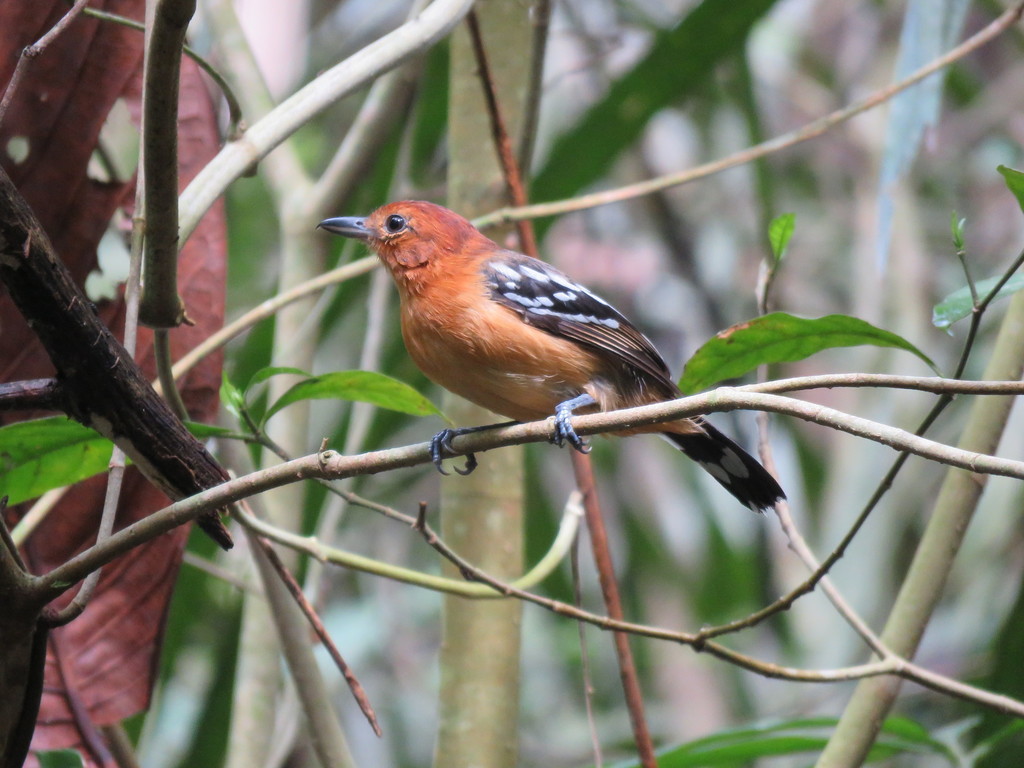
The large-billed antwren is 12 to 13 cm (4.7 to 5.1 in) long and weighs 12 to 14 g (0.42 to 0.49 oz). As its English name and specific epithet imply, its bill is heavier than those of most other Herpsilochmus antwrens. Adult males have a black crown and nape, a long whitish supercilium, a narrow black streak through the eye, and grayish ear coverts. Their back and rump are gray with a black and white patch between the scapulars and white-tipped black uppertail coverts. Their wings are black with white-tipped coverts and flight feathers with white edges towards the end. Their innermost tail feathers are black with white edges, the outermost entirely white, and those in between black with white tips. Their throat and underparts are mostly white with tiny black spots on the sides of the breast and grayish sides and flanks. Adult females have a rufous-cinnamon crown, cinnamon-tinged gray ear coverts and upperparts, and cinnamon neck, throat, and underparts. Their wings and tail are like the male's.
Range & habitat
The large-billed antwren is found south of most of Amazonia. It occurs in the northern parts of Bolivia's Beni and Santa Cruz departments and in south-central to northeastern Brazil. Its Brazilian range is roughly bounded by the states of Mato Grosso, Tocantins, and Paraná though it is found locally as far northeast as southern Ceará and Piauí. It inhabits deciduous and semi-deciduous forest, gallery forest, and palm groves, and does not favor any particular level of the forest. In Bolivia it also often inhabits small patches of forest in otherwise open cerrado. In elevation it ranges from about 150 to 1,100 m (500 to 3,600 ft).
Wikipedia: “Distribution and habitat”
What it does
The large-billed antwren's diet has not been detailed but includes insects and probably spiders. It forages singly, in pairs, and in family groups, and often as a member of a mixed-species feeding flock. It typically feeds between 1.5 and 10 m (5 and 35 ft) above the ground and sometimes as high as 15 m (50 ft). It forages actively and methodically, and usually captures prey by gleaning from leaves, stems, and vines by reaching and sometimes lunging from a perch. It also makes short sallies to access leaves and occasionally takes prey from atop leaf litter on the ground. It is not known to follow army ants.
Wikipedia: “Feeding”
Listen
Looking for field recordings…
Where it lives
Recorded sightings
—
geo-referenced records in GBIF, from museums, herbaria and field observers.
Drag the globe to turn it. Dots are where records exist, not a range map; darker means more records.
In the stacks
Searching the stacks…
Every page naming Herpsilochmus longirostris in the Biodiversity Heritage Library →
This page is assembled live from iNaturalist, GBIF, Wikipedia, the Source Library and the Internet Archive. It is not yet part of the hand-edited codex. iNaturalist taxon 15783.