On eBird ↗
Long-billed Plover
Live sightings near you, the range map, bar charts of when it is seen, and Macaulay Library photos and recordings.
Long-billed Plover
Thinornis placidus
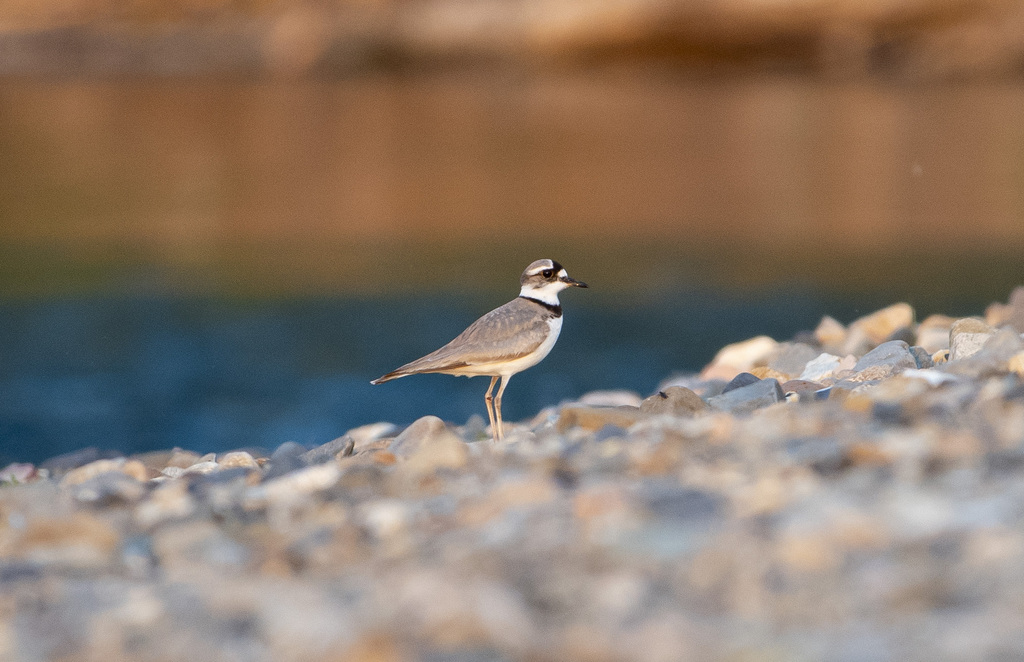
The long-billed plover (Thinornis placidus) is a species of wading bird in the family Charadriidae. It can be found in Bangladesh, Bhutan, Brunei, Cambodia, China, Hong Kong, India, Indonesia, Japan, Laos, Malaysia, Mongolia, Myanmar, Nepal, North Korea, Russia, South Korea, Sri Lanka, Taiwan, Thailand, and Vietnam. The long-billed plover is a migratory bird, so it breeds and spends the winter in different parts of its range. This bird can often be spotted along the shores of rivers, streams, in wetlands, and rice fields. It forages on the shoreline primarily for aquatic insects, insect larvae, and other invertebrates. It is difficult to distinguish between male and female individuals because of their similar plumage. The breeding season starts at the end of February or early March and ends in July. A male and a female forms a monogamous pair and maintains their territory throughout the breeding season. A global population survey in 2016 assessed the long-billed plover as a species of least concern on the International Union for Conservation of Nature (IUCN) Red List.
From the article Long-billed plover on Wikipedia (CC BY-SA), quoted section by section
Range & habitat
The long-billed plover is widely distributed throughout South and East Asia. It is quite uncommon throughout its range and occurs in small numbers. Breeding ground generally includes western, northern, and central parts of China, Japan, North Korea, and South Korea. Many instances of breeding activity have been reported in the Bureya river and other parts of far east Russia, Honshu island in Japan, southeastern China, and in the western Arunachal Pradesh in India near the Himalayas. This species has also been spotted during its breeding season in Singapore. The long-billed plover travels south of its breeding range to spend the winter. It generally winters throughout eastern Nepal, northeast India to Indochina, southern China, South Korea, Honshu, Shikoku, and Kiyushu islands of Japan, Taiwan, Myanmar, Malaysia, and Thailand. Populations on the three main islands of Japan do not generally migrate south, and are year-round residents. Only the population in Hokkaido travel south to winter in warmer climates.
Long-billed plovers prefer to inhabit the shores of rivers, streams, and lakes with small, round pebbles and rocks. They tend to nest on small temporary shingle islands or pebble spits that form between the different branches of meandering mountain rivers. These islands cannot be prone to frequent flooding, and need to be at least 600 square metres (6,500 ft2) in area. …
Wikipedia: “Distribution and habitat”
What it does
Very little information is available on the feeding habit of the long-billed plover. Its diet is thought to primarily include aquatic insects and other invertebrates. These birds have been observed to prey on midges, dragonflies, larvae of beetles, flies, and earthworms. Long-billed plovers forage along the shoreline and when they spot a prey, they move towards it quickly and capture it with their long bill. They do not seem to consume any plant material. Similar species in the genus Charadrius such as the common ringed plover and the Kentish plover have been observed to prey on mysid shrimps. The diet of long-billed plovers may also consist of similar crustaceans.
Wikipedia: “Food and feeding”
Listen
Looking for field recordings…
Where it lives
Recorded sightings
—
geo-referenced records in GBIF, from museums, herbaria and field observers.
Drag the globe to turn it. Dots are where records exist, not a range map; darker means more records.
In the stacks
Searching the stacks…
Every page naming Thinornis placidus in the Biodiversity Heritage Library →
This page is assembled live from iNaturalist, GBIF, Wikipedia, the Source Library and the Internet Archive. It is not yet part of the hand-edited codex. iNaturalist taxon 1580337.