On eBird ↗
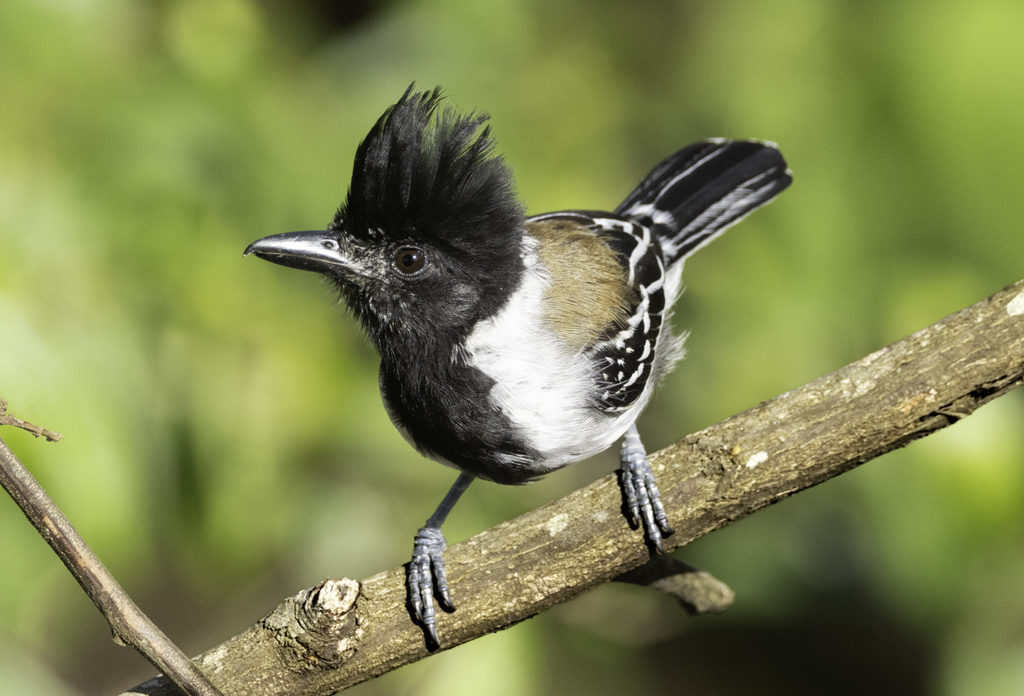
Black-crested Antshrike
Live sightings near you, the range map, bar charts of when it is seen, and Macaulay Library photos and recordings.
Black-crested Antshrike
Sakesphorus canadensis
The black-crested antshrike (Sakesphorus canadensis) is a passerine bird in subfamily Thamnophilinae of family Thamnophilidae, the "typical antbirds". It is found in tropical South America in Trinidad, Colombia, Venezuela, the Guianas, Brazil, and Peru.
From the article Black-crested antshrike on Wikipedia (CC BY-SA), quoted section by section
Description
The black-crested antshrike is 14 to 18 cm (5.5 to 7.1 in) long and weighs 20 to 28 g (0.71 to 0.99 oz). This species exhibits sexual dimorphism, but both sexes have a shaggy crest. Adult males of the nominate subspecies S. c. canadensis have a black head, throat, and center of their breast. They have a white band on their nape. Their upperparts are cinnamon-brown. Their wings and tail are black with white edges to the feathers and white spots at the tips of the outer tail feathers. The sides of their breast and their belly are whitish gray and their flanks and crissum a darker gray. Adult females have a rufous crown, a grayish face, and cinnamon nape and sides of their neck. Their upperparts are cinnamon-brown like the male's. Their wings and tail are brownish black with white edges on the flight feathers and white edges and tips on the tail feathers. Their throat is whitish, their breast cinnamon with blackish streaks, and their belly and crissum buff-tinged whitish. Subadult males resemble adult females. The other subspecies of the black-crested antshrike differ from the nominate and each other thus:
S. c. pulchellus: male compared to nominate has white streaks on the black crown and throat, a speckled black and white face, lighter pale cinnamon upperparts, and more white on the tail and underparts; female is a paler version of the nominate S. c. …
Range & habitat
The black-crested antshrike has a disjunct distribution. The subspecies are found thus:
S. c. pulchellus: Caribbean slope of northern Colombia from Chocó Department northeast into extreme northwestern Venezuela S. c. intermedius: eastern Colombia from Arauca to Vichada departments east through much of Venezuela and into the upper Branco River basin in northern Brazil S. c. fumosus: southern Amazonas state in southwestern Venezuela S. c. trinitatis: from Anzoátegui in northeastern Venezuela east into Guyana and also on Trinidad S. c. canadensis: Suriname and coastal French Guiana S. c. loretoyacuensis: extreme southeastern Colombia and along the Negro, lower Branco, and upper Amazon rivers in northwestern Brazil, and separately along the upper Amazon and lower Marañón and Ucayali rivers in northeastern Peru The provenance of a specimen noted as being collected in southern Pará, Brazil, is disputed as there are no other records of the species that far south and east of the upper Amazon. The "streak-fronted" pulchellus subspecies of the black-crested antshrike inhabits deciduous and savanna woodlands, gallery forest, and bushy areas in semi-arid regions. The other subspecies are found in those same habitats and also in the edges of igapó and várzea forest. It also occurs locally in mangroves and dune scrub near the Caribbean coast. …
Wikipedia: “Distribution and habitat”
What it does
The black-crested antshrike feeds on a wide variety of insects and other arthropods and also includes small lizards and fruit in its diet. It forages singly or in pairs and sometimes joins mixed-species feeding flocks, and typically feeds from the ground up to about 15 m (50 ft) above it. It hops through dense vegetation, gleaning prey from leaves, stems, vines, and branches by reaching and sometimes making short upward jumps from a perch. It has been observed dropping to the ground to capture prey.
Wikipedia: “Feeding”
Listen
Looking for field recordings…
Where it lives
Recorded sightings
—
geo-referenced records in GBIF, from museums, herbaria and field observers.
Drag the globe to turn it. Dots are where records exist, not a range map; darker means more records.
In the stacks
Searching the stacks…
Every page naming Sakesphorus canadensis in the Biodiversity Heritage Library →
This page is assembled live from iNaturalist, GBIF, Wikipedia, the Source Library and the Internet Archive. It is not yet part of the hand-edited codex. iNaturalist taxon 15810.