On eBird ↗
Sclater's Antwren
Live sightings near you, the range map, bar charts of when it is seen, and Macaulay Library photos and recordings.
Sclater's Antwren
Myrmotherula sclateri
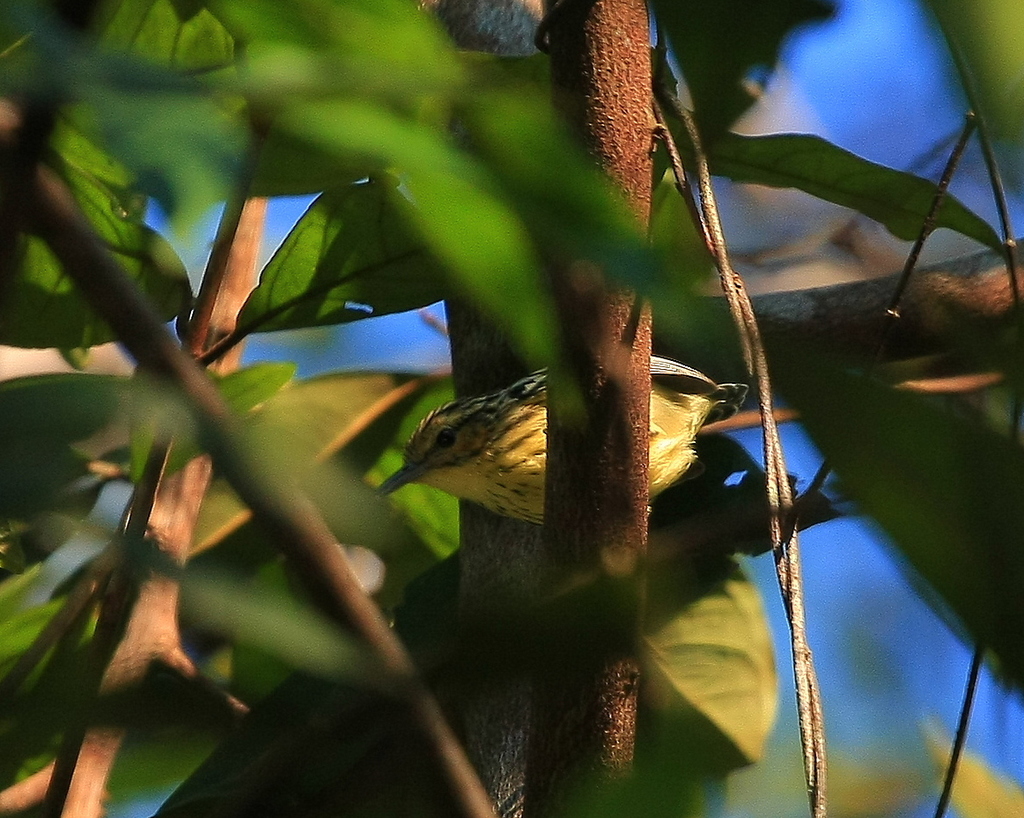
Sclater's antwren (Myrmotherula sclateri) is a species of bird in subfamily Thamnophilinae of family Thamnophilidae, the "typical antbirds". It is found in Bolivia, Brazil, and Peru.
From the article Sclater's antwren on Wikipedia (CC BY-SA), quoted section by section
Description
Sclater's antwren is 8 to 8.5 cm (3.1 to 3.3 in) long and weighs 8 to 10 g (0.28 to 0.35 oz). It is a smallish bird with a short tail. Adult males have a black and white streaked face and neck with yellow cheeks and a wide black "moustache". Their crown is black with light yellow streaks; the rest of their upperparts are black with whitish streaks. They have a light yellow patch between the shoulders. Their tail is black with white edges and tips to the feathers. Their wings are black with wide white edges on the coverts and narrower white edges on the flight feathers. Their throat and breast are yellow and the rest of their underparts paler; there are a few black streaks on the side of the breast. Adult females have somewhat more ochraceous streaks on the face, head, and upperparts than males. They do not have the male's patch between the shoulders. Their underparts have more streaks than the male's.
Range & habitat
Sclater's antwren is found in the upper Amazon Basin south of the Amazon River, in eastern Peru, northern Bolivia, and western Brazil east to the Xingu River and south to Mato Grosso state. It inhabits the mid-storey to canopy of lowland evergreen forest including terra firme, várzea, and transitional types. It tends to favor the forest interior rather than its edges. In elevation it ranges up to about 550 m (1,800 ft).
Wikipedia: “Distribution and habitat”
What it does
The diet of Sclater's antwren has not been detailed but is known to include insects and probably spiders. It typically forages in pairs or family groups and almost always as part of a mixed-species feeding flock. It mostly feeds in dense foliage in or just below the forest canopy at least 15 m (50 ft) up. It actively seeks prey mostly by gleaning leaves, and also takes prey from vine tangles and along branches by gleaning, reaching, lunging, and hovering.
Wikipedia: “Feeding”
Listen
Looking for field recordings…
Where it lives
Recorded sightings
—
geo-referenced records in GBIF, from museums, herbaria and field observers.
Drag the globe to turn it. Dots are where records exist, not a range map; darker means more records.
In the stacks
Searching the stacks…
Every page naming Myrmotherula sclateri in the Biodiversity Heritage Library →
This page is assembled live from iNaturalist, GBIF, Wikipedia, the Source Library and the Internet Archive. It is not yet part of the hand-edited codex. iNaturalist taxon 15821.