On eBird ↗
Bornean Black Magpie
Live sightings near you, the range map, bar charts of when it is seen, and Macaulay Library photos and recordings.
Bornean Black Magpie
Platysmurus aterrimus
The Bornean black magpie (Platysmurus aterrimus), also known as the black crested magpie, is a treepie in the family Corvidae. It is endemic to the Southeast Asian island of Borneo.
From the article Bornean black magpie on Wikipedia (CC BY-SA), quoted section by section
Description
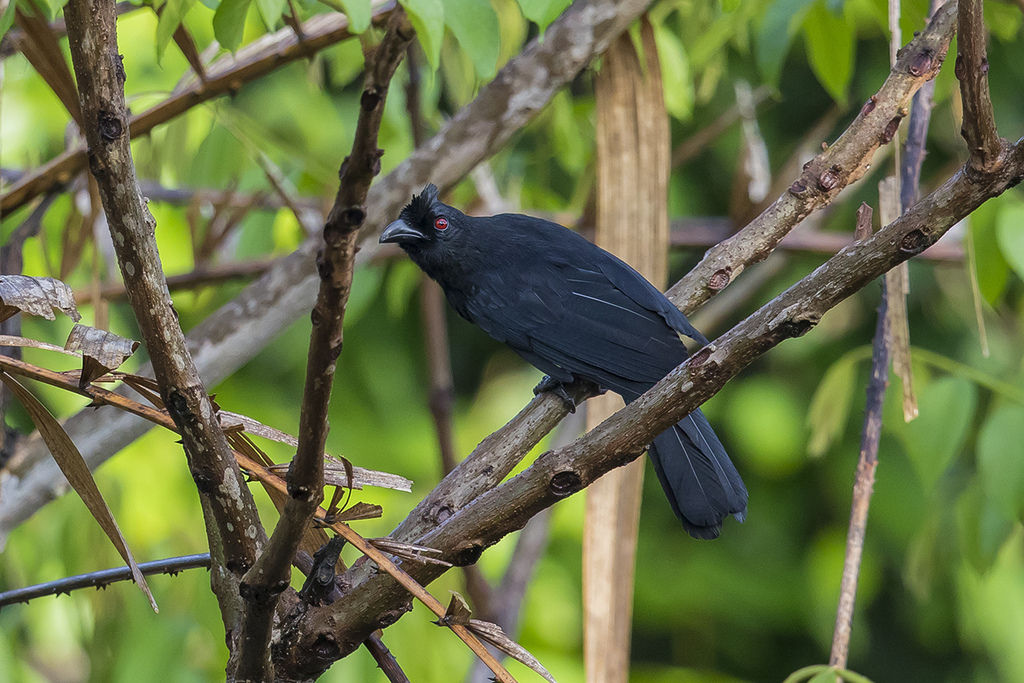
The magpie is about 43 cm in length. It has all-black plumage with a long, broad and graduated tail, a stout black bill, a tall, bristly crest, black legs and feet, and red irises. It has a taller crest than, and lacks the white wing patch of, the nominate subspecies.
Range & habitat
The magpie is found in the lowlands of Borneo, ranging in altitude up to about 300 m above sea level. It inhabits primary forest, including dipterocarp, kerangas and peat swamp forest, and is also found in secondary forest, overgrown tree plantations and scrub.
== References ==
Wikipedia: “Distribution and habitat”
What it does
The magpie is a garrulous and sociable bird, often seen in family parties. It has a variety of whistling and chattering calls and is also a vocal mimic. It flies with shallow wing beats that produce a distinctive low throbbing whoo or boobooboo sound.
Breeding. A nest found in the Tabin Wildlife Reserve in September 1981 was described as being about 20 cm across, built of sticks and sited 8 m up in a small tree.
Feeding. The magpie is an arboreal, foliage-gleaning, insectivore and frugivore, also opportunistically taking small mammals and reptiles.
Wikipedia: “Behaviour”
Listen
Looking for field recordings…
Where it lives
Recorded sightings
—
geo-referenced records in GBIF, from museums, herbaria and field observers.
Drag the globe to turn it. Dots are where records exist, not a range map; darker means more records.
In the stacks
Searching the stacks…
Every page naming Platysmurus aterrimus in the Biodiversity Heritage Library →
This page is assembled live from iNaturalist, GBIF, Wikipedia, the Source Library and the Internet Archive. It is not yet part of the hand-edited codex. iNaturalist taxon 1583474.