On eBird ↗
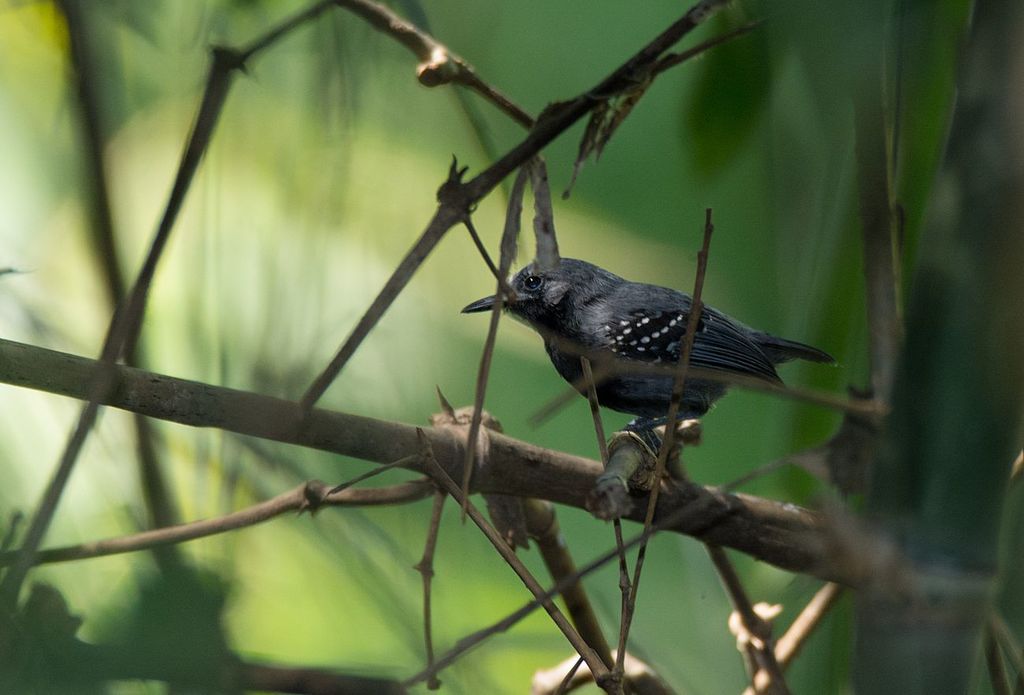
Ihering's Antwren
Live sightings near you, the range map, bar charts of when it is seen, and Macaulay Library photos and recordings.
Ihering's Antwren
Myrmotherula iheringi
Ihering's antwren (Myrmotherula iheringi) is a species of bird in subfamily Thamnophilinae of family Thamnophilidae, the "typical antbirds". It is found in Bolivia, Brazil, and Peru.
From the article Ihering's antwren on Wikipedia (CC BY-SA), quoted section by section
Description
Ihering's antwren is 8.5 to 9.5 cm (3.3 to 3.7 in) long and weighs 7.5 to 9 g (0.26 to 0.32 oz). It is a smallish bird with a shortish tail. Adult males of all three subspecies have dark gray upperparts with a hidden white patch between the shoulders. Their wings are dark gray with white-tipped black coverts. Their tail is dark gray. Their lower cheeks, throat, upper breast, and center of their lower breast are black. The rest of their underparts are a paler gray than the upperparts except for a whitish center to the belly. Adult females of the nominate subspecies have blue-gray upperparts. Their throat is whitish and their underparts pale buff. Subadult males resemble adult females with a blotchy black throat. Females of subspecies M. i. heteroptera have an ochraceous tinge to their upperparts and buff tips to their wing coverts. Females of subspecies M. i. oreni have a pale horn forehead, supercilium, and ring around the eye. Their upperparts are pure gray and the wing coverts' spots are white. The sides of their neck, throat, and belly are yellow-ochre.
Range & habitat
Ihering's antwren is a bird of the western Amazon Basin south of the Amazon. The nominate subspecies is found in south-central Brazil from the drainages of the rios Jiparaná and Roosevelt east to the Rio Tapajós and south into Rondônia. Subspecies M. i. heteroptera is found in southwestern Brazil from the headwaters of the Rio Juruá east to the Rio Madeira. Subspecies M. i. oreni is found in east-central and southeastern Peru, extreme northwestern Bolivia, and far western Brazil's Acre state. Ihering's antwren inhabits the understorey to mid-storey of evergreen forest in the lowlands, of both terra firme and transitional forest types. Subspecies M. i. oreni is very strongly associated with, and possibly restricted to, stands of Guadua bamboo. The other two subspecies favor areas with heavy vine tangles with or without bamboo. In elevation the species occurs below about 400 m (1,300 ft).
Wikipedia: “Distribution and habitat”
What it does
The diet of Ihering's antwren is not known in detail but is probably mostly insects and spiders. It forages singly, in pairs, or in family groups, and usually as part of a mixed-species feeding flock. It feeds mostly between about 3 and 10 m (10 and 30 ft) above the ground. It seeks prey by gleaning live leaves, and also takes prey from clusters of dead leaves, vine tangles, and along branches by gleaning, reaching, lunging, and with short sallies from a perch. Subspecies M. i. oreni apparently mostly takes prey from bamboo leaves and stems.
Wikipedia: “Feeding”
Listen
Looking for field recordings…
Where it lives
Recorded sightings
—
geo-referenced records in GBIF, from museums, herbaria and field observers.
Drag the globe to turn it. Dots are where records exist, not a range map; darker means more records.
In the stacks
Searching the stacks…
Every page naming Myrmotherula iheringi in the Biodiversity Heritage Library →
This page is assembled live from iNaturalist, GBIF, Wikipedia, the Source Library and the Internet Archive. It is not yet part of the hand-edited codex. iNaturalist taxon 15835.