On eBird ↗
Australian Pratincole
Live sightings near you, the range map, bar charts of when it is seen, and Macaulay Library photos and recordings.
Australian Pratincole
Glareola isabella
The Australian pratincole (Glareola isabella) is a species of bird in the family Glareolidae. It breeds in Australia's interior and winters in northern and eastern parts of the continent, Indonesia and New Guinea. It is a medium-sized nomadic shorebird but is commonly found in arid inland Australia. It breeds predominantly from south-western Queensland to northern Victoria, and through central Australia to the Kimberley region in Western Australia. The Australian population is estimated at 60,000 individuals.
They are a migratory species that generally move to the southern parts of their distribution range to breed during spring and summer. During winter they migrate to northern Australia, New Guinea, Java, Sulawesi and southern Borneo. Although they are common, their occurrence is unpredictable and varies in location.
From the article Australian pratincole on Wikipedia (CC BY-SA), quoted section by section
Description
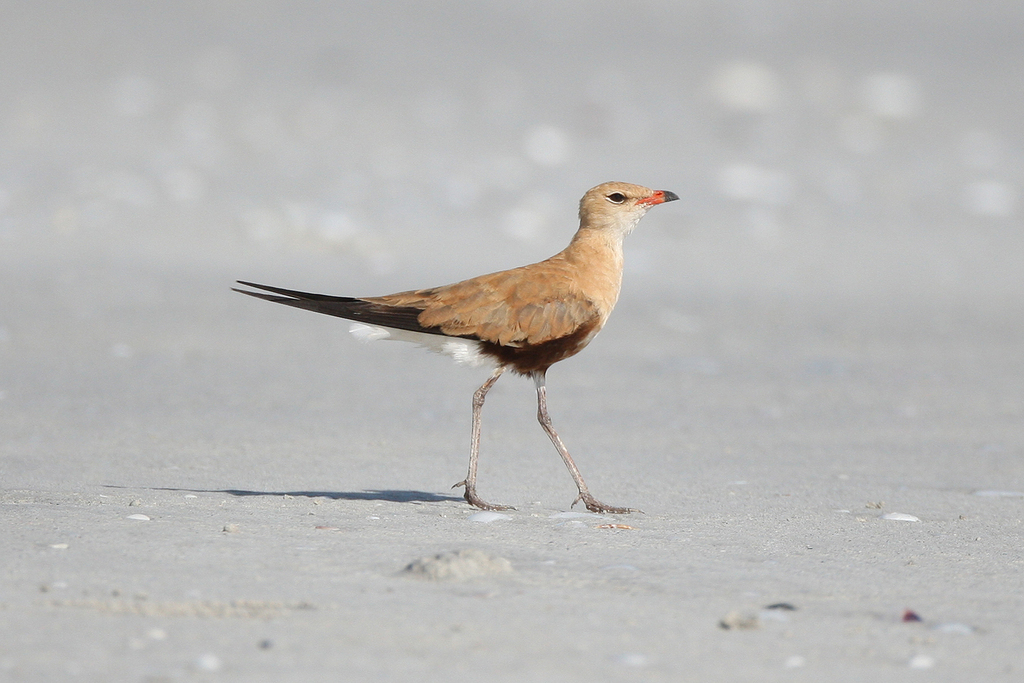
The Australian pratincole is a medium-sized slender shorebird with long legs, long pointed wings and a short decurved bill. It is 19–24 cm (7.5–9.4 in) long, has a wingspan of 50–60 cm (20–24 in) and weighs 55–75 g (1.9–2.6 oz). The sexes look alike but their breeding and non-breeding plumage differs. In their breeding plumage, the head, neck, breast and upperparts are a sandy brown grading. The wings are pointed and black and there is a black loral strip. The chin and throat are white and the breast is a sandy brown. The bill is bright red with a black base and the iris is dark brown. Their legs and feet are grey to black. Their non-breeding plumage is not well known, because there are seasonal and individual variations. The loral stripe is fainter than when in breeding plumage, and the base of the bill is paler. The upper parts are grey-brown with sandy-buff fringes. Sometimes there are dark flecks at the borders of the pale throat. Juvenile plumage is similar to a non-breeding adult but a slightly paler sandy brown colour. The lores lack the black colour and the forehead, crown and nape are streaked dark brown. The bill is grey-black with a faint reddish base. In flight, the upper body and inner wing are sandy brown with black on the outer wing. …
Range & habitat
The habitat of the Australian pratincole is treeless, open and sparsely wooded plains, grasslands, claypans and gibberstone. Most of those areas are in arid and semi-arid rainfall zones. The birds can also be found around the margins of wetlands, creeks, river beds, bore drains, lagoons, springs, claypans and sewage farms. During the breeding season, they inhabit low, scattered shrubland, because the chicks use the vegetation to hide and shelter in.
Wikipedia: “Habitat and distribution”
What it does
The diet of the Australian pratincole consists mainly of insects, spiders and centipedes. Insects are caught either hawking in the air or pecked from the surface of the ground. When foraging on the ground, the birds stalk their prey, then dart forward to catch the prey, sometimes with one wing outspread. They actively forage during the day, with peak periods at dawn and dusk. They require drinking water because they thermoregulate by evaporation from the mouth. They have salt glands, so both saline and ephemeral water can be drunk.
Wikipedia: “Diet”
Listen
Looking for field recordings…
Where it lives
Recorded sightings
—
geo-referenced records in GBIF, from museums, herbaria and field observers.
Drag the globe to turn it. Dots are where records exist, not a range map; darker means more records.
In the stacks
Searching the stacks…
Every page naming Glareola isabella in the Biodiversity Heritage Library →
This page is assembled live from iNaturalist, GBIF, Wikipedia, the Source Library and the Internet Archive. It is not yet part of the hand-edited codex. iNaturalist taxon 1583598.