On eBird ↗
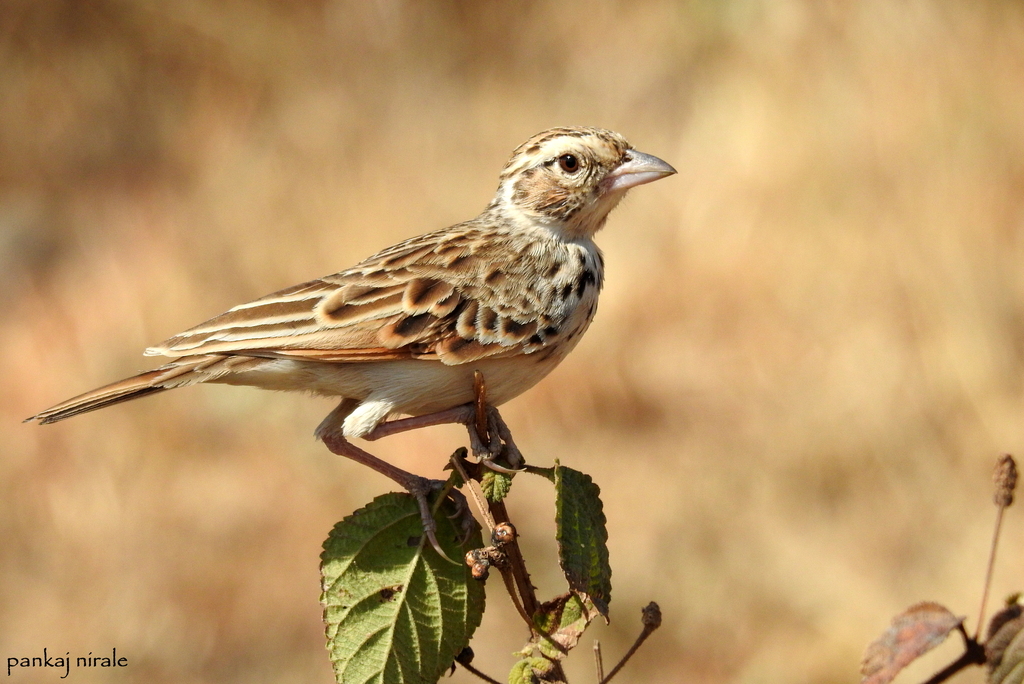
Indian Bushlark
Live sightings near you, the range map, bar charts of when it is seen, and Macaulay Library photos and recordings.
Indian Bush Lark
Plocealauda erythroptera
The Indian bush lark (Plocealauda erythroptera) is a species of lark in the family Alaudidae found in South Asia.
From the article Indian bush lark on Wikipedia (CC BY-SA), quoted section by section
Description
The plumage of the Indian bush lark is pale and it has a cheek patch completely bounded by a white supercilium and post-auricular border. The crown and upper-parts are heavily streaked. The pale underparts have large spots on the breast. Most of its wing coverts, tertials and central tail feathers have pale centres. The primary coverts look all brown. The rufous wing bars are diagnostic but care must be taken not to confuse the bird with Jerdon's bush lark in the central Western Ghats and country around where their ranges overlap. Jerdon's bush lark is darker with more rufous on the wings. It is distinguished from Jerdon's bush lark by its shorter bill and legs and longer tail. It sings from bush tops but does not usually perch on trees or wires. The calls are similar to that of Jerdon's bush lark but are lower and have longer rattling tremolos often falling in pitch.
Range & habitat
The Indian bush lark is most commonly found in arid areas. It is found in Pakistan and north-western, central and south-central India.
Wikipedia: “Distribution and habitat”
What it does
The song-flight during the mating season is an amazing spectacle. The bird flutters high over the ground, then holds its wings in an open "V" and "parachutes" down to its perch uttering its song consisting of short tweets and cheeps in three syllables followed by a longer fourth syllable. This combination is repeated till the bird perches again.
Wikipedia: “Behaviour and ecology”
Listen
Looking for field recordings…
Where it lives
Recorded sightings
—
geo-referenced records in GBIF, from museums, herbaria and field observers.
Drag the globe to turn it. Dots are where records exist, not a range map; darker means more records.
In the stacks
Searching the stacks…
Every page naming Plocealauda erythroptera in the Biodiversity Heritage Library →
This page is assembled live from iNaturalist, GBIF, Wikipedia, the Source Library and the Internet Archive. It is not yet part of the hand-edited codex. iNaturalist taxon 1583802.